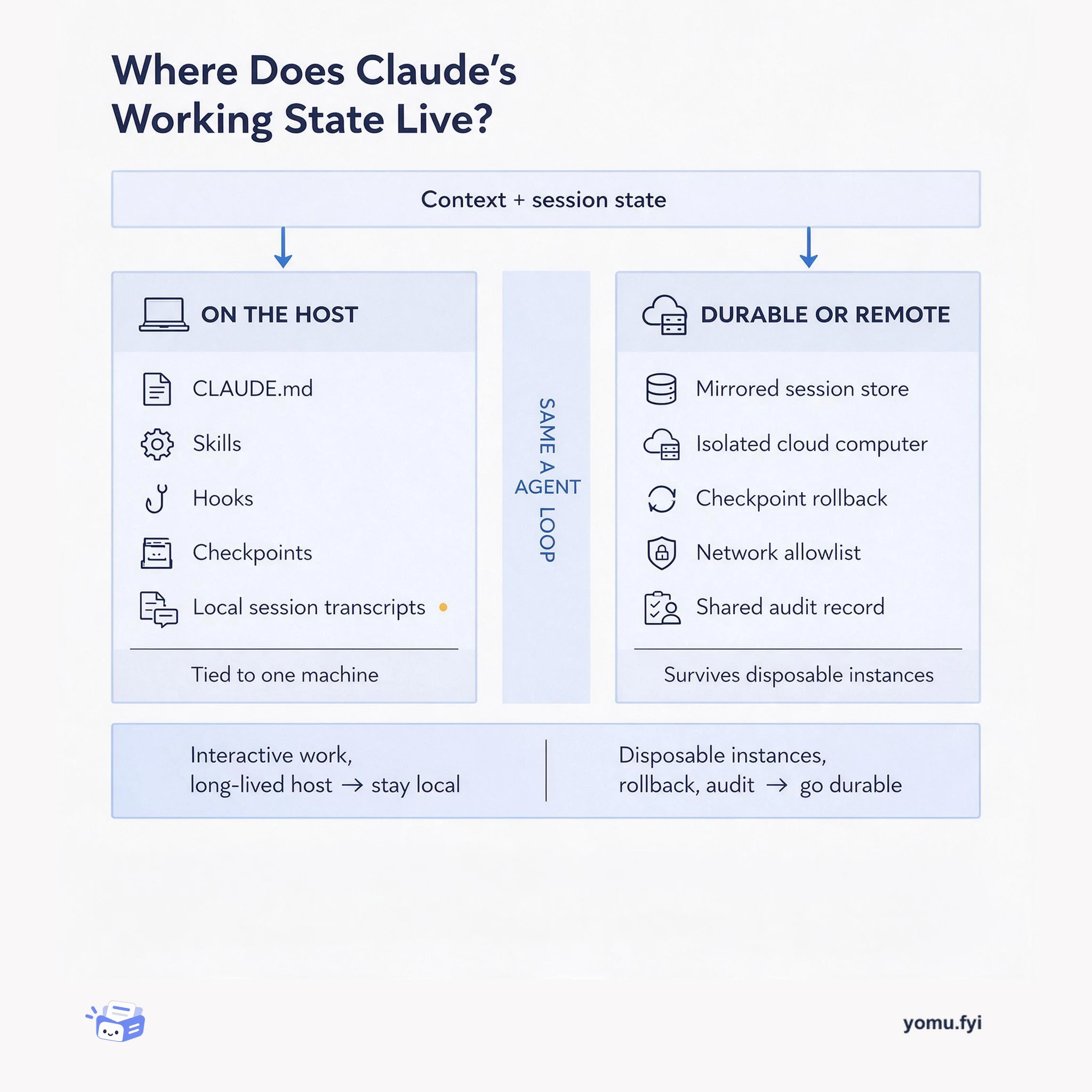
Context engineering is the practice of managing agent memory through curated files on disk, using hybrid search (BM25 and vector search with 70/30 weighting and diversity re-ranking) backed by local SQLite. The post argues work quality depends more on project context than model capability, advocating four mechanisms in Sprite: CLAUDE.md, Skills, Hooks, and Checkpoints. Daily logs are append-only and decay over time, while MEMORY.md only changes when deliberately promoted, representing a stream versus curated memory. The post illustrates context engineering with an Alibi excuse-as-a-service API built on Bun, Hono, and Postgres, where CLAUDE.md defines stack, commands, naming schemes, error format, logging, and test locations. Therefore, an agent can correctly fix a bug by sampling without replacement and write a regression test using bun test because the persistent context provides project knowledge.
Approach / What changed
The post presents four mechanisms for providing project-specific context to AI coding agents in the Sprite platform: CLAUDE.md defines project conventions and is read every session; Skills are reusable multi-step workflows activated by description; Hooks inject live environment state (e.g., git status, service health) into context; and Checkpoints create durable snapshots of the entire environment including files and running services.
Takeaways
1
An agent’s work quality depends more on how much it knows about the project and environment than on model capability.
2
CLAUDE.md is read at the start of every session and should be written before asking the agent to do anything; it captures stack, commands, conventions, error formats, and test locations.
3
Skills define reusable multi-step workflows triggered by description, such as a preflight skill that runs tests, type checking, linting, and TODO checks in sequence, stopping at the first failure.
FAQ
What is the difference between daily logs and MEMORY.md?
Daily logs are append-only and decay in relevance over time, acting as a stream of noise with signal. MEMORY.md does not decay and only changes when deliberately promoted, acting as curated memory.
How does memory recall work in context engineering?
It uses a hybrid of keyword search (BM25) and vector search weighted 70/30, with diversity re-ranking to avoid duplicates, all backed by local SQLite.
What are the four mechanisms for providing project-specific context to an agent?
The four mechanisms are CLAUDE.md for project conventions, Skills for reusable workflows, Hooks for injecting live environment state, and Checkpoints for durable snapshots of the entire environment.
Compare two places to keep Claude's working state: curated files on your own machine versus a durable session store or isolated cloud computer, and learn which one fits your deployment.
Keep reading
Related reading
The Good Stuff
Paid picks we use ourselves. Links carry a referral code — a subscription through one earns us a commission at no extra cost to you.