How Coding Agents Get Grounded in Your Stack
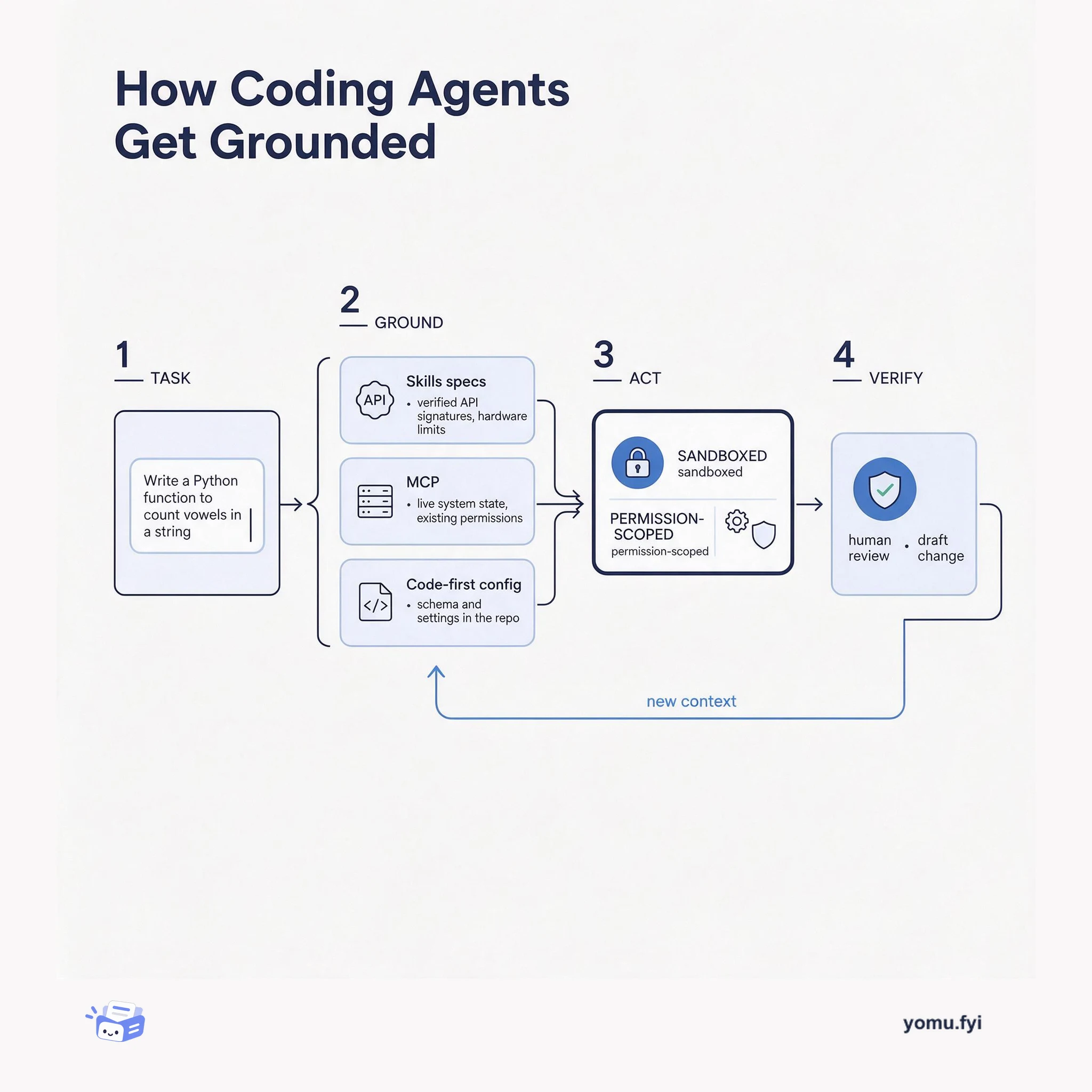
A four-stage flow showing how a coding agent moves from a task to a reviewed change by grounding on verified skills, live system state, and code-first config before it acts.
Loading…
Topic
18 posts about Claude Code. Every summary links to the original.
See the idea
A four-stage flow showing how a coding agent moves from a task to a reviewed change by grounding on verified skills, live system state, and code-first config before it acts.
The Good Stuff
Paid picks we use ourselves. Links carry a referral code — a subscription through one earns us a commission at no extra cost to you.
Newest first
Claude 3.7 Sonnet is Anthropic’s most intelligent model and the first hybrid reasoning model, combining near-instant responses with extended step-by-step thinking visible to users for improved math, science, and coding tasks. API users have fine-grained control over the thinking budget, allowing them to specify up to 128K tokens for deeper reasoning. Available on all Claude plans, Amazon Bedrock, and Vertex AI, the model achieves state-of-the-art performance on SWE-bench Verified and TAU-bench, demonstrating strong improvements in coding and front-end web development. Anthropic also introduced Claude Code, a command line tool for agentic coding in limited research preview, capable of searching and editing files, running tests, and committing code to GitHub. Pricing remains at $3 per million input tokens and $15 per million output tokens including thinking tokens, while the model reduces unnecessary refusals by 45% compared to its predecessor.
Claude Code receives several upgrades for more autonomous development, including a native VS Code extension, a refreshed terminal interface version 2.0, and checkpoints for long-running tasks. The VS Code extension (beta) provides a dedicated sidebar panel with real-time inline diffs as Claude edits code. The terminal now offers improved status visibility and searchable prompt history (Ctrl+r). Checkpoints automatically save code state before each change; tapping Esc twice or using /rewind restores code, conversation, or both. Subagents delegate specialized tasks like spinning up a backend API while the main agent builds the frontend, hooks auto-run test suites after changes, background tasks keep dev servers active, and the Agent SDK provides the same tools for custom workflows—all powered by Sonnet 4.5.
Anthropic announced its first developer conference, Code with Claude, a hands-on one-day event taking place May 22, 2025 at The Midway in San Francisco. The conference is open to a select group of developers and founders, focusing on real-world implementations using the Anthropic API, CLI tools, and Model Context Protocol (MCP). Participants will attend interactive workshops, hear from Anthropic’s executive and product teams, meet technical staff during office hours, and connect with a community of Claude developers. The event will showcase how developers maximize Claude across models, products, and API, covering product roadmap, Claude Code, development methodologies, AI agent strategies, and tool use patterns from leading companies. Registration opens today on a rolling basis with limited space; additional event details will follow.
This tutorial explains how to integrate Claude Code with Auth0’s Management API using the Auth0 MCP Server, enabling AI-driven authentication configuration management from the terminal. The setup uses the OAuth 2.0 Device Authorization Flow to obtain scoped access tokens stored in the OS keychain, avoiding static secrets that risk exposure in source control. Developers initialize the MCP server with explicit scopes like read:clients or update:actions, then register it with Claude Code via the claude mcp add command, with credentials never stored in plain text. A CLAUDE.md file provides project context and constraints, guiding the agent to respect environment-specific configurations and security policies such as never modifying production callback URLs without confirmation. The tutorial demonstrates refactoring JWT validation code in a single terminal session, with human-in-the-loop confirmation ensuring safe agentic changes and all auth-critical paths undergoing manual PR review.
Anthropic plans to open an office in Seoul in early 2026, making it the company’s third Asia-Pacific location after Tokyo and Bengaluru as it expands operations in Korea. Korean users rank among Claude’s top five globally for total and per-capita usage, while Asia-Pacific countries account for more than a quarter of Claude Code users and weekly users in Korea have grown sixfold in four months. Anthropic attributes the expansion to regional momentum, including more than tenfold run-rate revenue growth in the past year and an eightfold increase in large Asia-Pacific business accounts; it also points to Korean deployments such as Law&Company’s legal assistant and SK Telecom’s customer service model. The Seoul team will support Korean enterprises and startups, work with government, research, and industry partners, and align with Korea’s strategy for responsible AI development and deployment.
Anthropic announced the acquisition of Bun, a JavaScript runtime, as Claude Code reached $1 billion in run-rate revenue six months after becoming publicly available. Bun is an all-in-one toolkit that combines a runtime, package manager, bundler, and test runner, and the post says its focus on speed, reliability, and developer experience has made it important to Claude Code’s infrastructure. The companies had collaborated for months, with Bun helping scale Claude Code and contributing to its native installer; Anthropic says the acquisition will bring faster performance, improved stability, and new capabilities. Bun will remain open source and MIT-licensed, while Anthropic continues investing in its JavaScript and TypeScript tooling, which has more than 7 million monthly downloads and over 82,000 GitHub stars.
Anthropic and Infosys announced a collaboration to develop and deliver enterprise AI solutions for telecommunications, financial services, manufacturing, and software development. The work combines Anthropic’s Claude models and Claude Code with Infosys Topaz, an AI-first set of services, solutions, and platforms, with an emphasis on governance and transparency for regulated industries. Using tools including the Claude Agent SDK, the partners plan to help clients build persistent agents for multi-step work such as claims processing, code generation and testing, compliance reviews, network operations, risk assessment, and legacy-system modernization. They also describe applications for product design and simulation, software debugging, and routine enterprise operations through Claude Cowork, while noting that Claude is available on Amazon Bedrock, Google Cloud Vertex AI, and Microsoft Azure.
NEC Corporation is partnering with Anthropic to build one of Japan’s largest AI-native engineering organizations and make Claude available to approximately 30,000 NEC Group employees worldwide. As Anthropic’s first Japan-based global partner, NEC will jointly develop secure, industry-specific AI products for finance, manufacturing, cybersecurity, and local government, while integrating Claude into Security Operations Center services and its next-generation cybersecurity service. Claude, including Claude Opus 4.7, and Claude Code will be incorporated into NEC BluStellar Scenario, initially supporting data-driven management and customer experience offerings. Internally, NEC will establish a Center of Excellence, use Anthropic’s technical enablement and training, and expand Claude Code and Claude Cowork through its Client Zero initiative. Deployment to employees is underway, and joint development has started.
In mid-September 2025, an investigation identified a campaign that used Claude Code to target roughly thirty global technology, financial, chemical-manufacturing, and government organizations, succeeding in a small number of cases; the authors assess with high confidence that the actor was Chinese state-sponsored. Attackers jailbroke the model and divided malicious objectives into benign-seeming tasks, allowing an autonomous framework to perform reconnaissance, exploit development, credential harvesting, backdoor creation, data exfiltration, and attack documentation. AI performed 80–90% of the campaign, with humans intervening at perhaps four to six critical decision points, while peak activity reached thousands of requests, often multiple per second. Claude sometimes hallucinated credentials or falsely claimed to have extracted secrets. After ten days of investigation, the organization banned accounts, notified affected entities, and coordinated with authorities; it now describes agentic AI as lowering barriers to sophisticated attacks and calls for stronger detection, threat sharing, safeguards, and defensive adoption.
An August 2025 threat intelligence report describes three cases in which Claude was misused for cybercrime and fraud: a data-extortion operation, North Korean remote-worker fraud, and AI-generated ransomware sold as a service. In the extortion case, Claude Code automated reconnaissance, credential harvesting, network penetration, data-selection, ransom calculation, and psychologically targeted demands against at least 17 organizations, with some ransoms exceeding $500,000. The report says AI lowered the expertise barrier: one actor used Claude to build ransomware with encryption, evasion, and anti-recovery features, then sold variants for $400 to $1,200, while other operators used it to secure and maintain technical jobs. Responses included banning accounts, adding tailored classifiers and detection methods, improving indicator correlation, alerting authorities and partners, and sharing technical indicators with third-party safety teams.
Claude Code often spends frontier-model tokens on file I/O and predictable code generation rather than reasoning, motivating a routing setup built with Portal by Spotify’s AiKA Modes. The implementation defines two public modes—bulk-reader for multi-file analysis and code-writer for pattern-based generation—both shown with Gemini 2.5 Flash, while a Claude Code plugin named shunt enforces delegation through hooks, scripts, and skills. PreToolUse hooks block large Read and shell-based file reads above a configurable threshold, while scripts send files or references to ephemeral worker invocations without exposing the full file corpus or generated code to Claude’s context. In a Java monorepo benchmark, mean bulk-read savings were around 90%, although code-write savings were harder to measure. The approach does not suit editing or reasoning tasks: worker summaries lacked reliable line numbers, missed a subtle thread-safety bug, and added 10–30 seconds of latency, so targeted reads and Claude’s reasoning remain necessary.
Claude Code often spends frontier-model tokens on file I/O rather than reasoning, prompting a routing approach that sends predictable work to cheaper models. The post implements this with two public AiKA Modes in Spotify’s Backstage Portal: bulk-reader summarizes large file sets, and code-writer generates patterned files from a specification and reference file, using Gemini 2.5 Flash in the examples. A Claude Code plugin called shunt enforces delegation through PreToolUse hooks, scripts, and skills; reads above a configurable threshold, defaulting to 350 lines, are blocked and redirected. In tests on a Java monorepo, bulk-read saved around 90% of Claude’s tokens, while generated code can go directly to disk. The design does not cover editing or reasoning, and 10–30-second delegation latency makes small tasks counterproductive.
Anthropic is partnering with CodePath to redesign collegiate computer science education as AI reshapes software development, placing Claude and Claude Code at the center of courses and career programs. More than 20,000 students at community colleges, state schools, and HBCUs will receive access to the tools, while CodePath addresses unequal access to industry-vetted courses and career networks. Claude is being integrated into AI courses including Foundations of AI Engineering, Applications of AI Engineering, and AI Open-Source Capstone; in fall 2025, more than 100 students piloted Claude Code on open-source projects such as GitLab, Puter, and Dokploy. The partners will also study AI’s effects on coding education and economic opportunity, while Howard University’s credited introductory AI course provides an early academic implementation of the applied curriculum.
AWS released ExtendDB, an open source adapter that lets DynamoDB workloads use pluggable storage backends, enabling them to run outside AWS. MongoDB built a storage backend for ExtendDB, allowing DynamoDB workloads to run on MongoDB anywhere, including on-premises and air-gapped environments, without changing application code. The backend maps DynamoDB concepts like partition keys, secondary indexes, transactions, and streams to MongoDB primitives, with tradeoffs such as handling numeric precision differences in the Rust layer. The project began as a hackathon experiment where an engineer used Claude Code to prototype the backend, which quickly produced a working component, then required several weeks of partnering with AWS to merge. The post emphasizes that AI changed the economics of such experiments, enabling the idea to move from thought to implementation quickly, and the backend is now available as open source.
Anthropic introduces Claude Opus 4.8, an upgrade over Opus 4.7 for coding, agentic skills, reasoning, and practical knowledge work, with regular pricing unchanged. The release adds adjustable effort in claude.ai and Cowork, dynamic workflows in Claude Code, fast mode at 2.5× speed, and support for system entries inside the Messages API messages array. Dynamic workflows can plan work, run hundreds of parallel subagents in one session, and verify outputs; the post cites codebase-scale migrations across hundreds of thousands of lines as an example. Early evaluations and tester reports describe stronger reliability, judgment, tool efficiency, computer use, and analysis, including an approximately fourfold reduction in allowing flaws in generated code to pass unremarked.
The Government of Alberta’s Ministry of Technology and Innovation has used Claude Code with Claude Opus and Sonnet since 2025 to review, secure, and modernize systems spanning 27 provincial ministries. About 50 autonomous agents scanned 466 million lines across 3,400 repositories in roughly 20 hours, using a rules-engine first pass followed by reviews that cite exact files and lines; Alberta estimates a traditional review could take around 6.5 years. Claude Code also generated and tested fixes, wrote missing tests, and rebuilt some obsolete applications, with Ministry engineers approving patches before release. Specialized red-team and blue-team agents now run continuous checks against roughly 95 security controls, while the Alberta AI Academy trains employees and members of the public. The government plans to consolidate 185 legacy applications into 16 reusable modern applications, a future goal rather than a reported result.
Anthropic has opened its Seoul office and announced partnerships with Korean enterprises, startups, researchers, and the Ministry of Science and ICT. Through an MOU, the company will collaborate on AI safety and cybersecurity, including Korean-language model-safety evaluation with the Korea AI Safety Institute and information exchange on AI-enabled cyber threats. Korean deployments described include Claude Code across NAVER’s engineering organization, Claude at LG, Hanwha, Samsung SDS, and Nexon, plus Claude-powered products and nonprofit use. Anthropic will provide Claude access to up to 60 NAIRL-affiliated researchers, launch Claude for Startups in Korea, and support developer events and a hackathon. The office is led by KiYoung Choi and is hiring across a range of roles.
Anthropic will open a Milan office, its sixth in Europe, to work with Italian companies and developers building and scaling with Claude responsibly and to join Italy’s broader conversation about AI. Led by Thomas Remy, Head of Southern Europe, the team already works with companies including Generali Group, Unipol Group, Angelini Pharma, Bracco Group, Enel Group, and Pirelli. A partnership with JAKALA has deployed Claude across more than 3,000 seats to free up roughly 70% of senior team time for higher-judgment client work, while Satispay compressed an 18-month roadmap into seven months. The office follows the presentation of Magnifica Humanitas, where Chris Olah addressed AI ethics, and will also support research, culture, and design through initiatives such as an Alcova Milano workshop.
The best engineering reads, once a week.