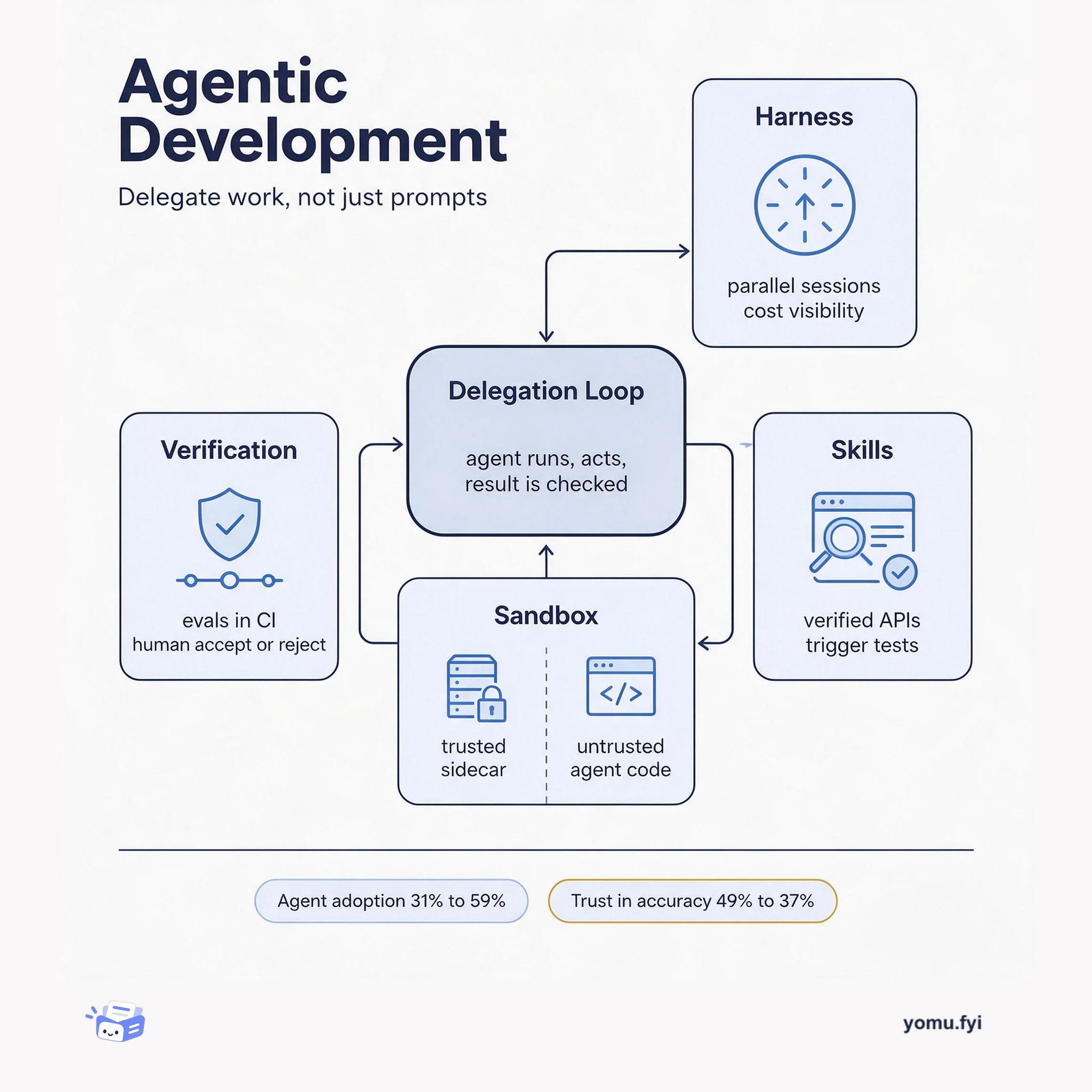
Agentic Development: The Four Parts of a Delegation Loop
Agentic development turns AI assistance into delegated work: a harness runs the agents, skills supply domain knowledge, a sandbox bounds execution, and evals verify the result.
 SalesforceScott NybergExplainer
Salesforce’s Assistive Authoring aimed to reduce prompt-template creation from 25 minutes to under a minute by using Agent Graph. A router node dispatches natural-language requests to specialized sub-agents for creation, refinement, or clarification while state variables carry context. Deterministic controls prevent the LLM from corrupting routing, record identity, or structured output through guarded transitions and a server-side transpose layer. A discovery service normalizes available data fields into an allowlist, and the LLM can only select from validated references. A human-in-the-loop gate ensures the agent never saves or executes, presenting output as an accept-or-reject diff only.
Salesforce’s Prompt Builder allows admins to create reusable prompts with dynamic placeholders grounded in CRM data. Building a template required expertise in merge fields and Jinja syntax, taking at least 25 minutes. The goal was to let admins describe a requirement in plain English and get a functional template in under a minute.
The team used Agent Graph, an orchestration framework, to divide creation and refinement into focused nodes with deterministic routing, identity preservation, and structured output. A router node dispatches requests to specialized sub-agents. A discovery service normalizes available data into an allowlist. A transpose step wraps template metadata in sentinel tags for structured parsing. A human-in-the-loop review gate prevents the agent from saving or executing.
LLM should not control routing, record identity, or structured output; these must be handled deterministically by the orchestration framework.
A discovery service that normalizes available data fields and reduces them to an allowlist based on user permissions is essential to prevent hallucinations.
Human-in-the-loop safety with accept-or-reject diffs and sentinel tags ensures the agent only proposes drafts and never executes or saves.
It uses a discovery service that normalizes available data fields into a consistent shape and reduces them to an allowlist based on relevance and user permissions. The LLM is constrained to select from validated data only, preventing invented fields or references.
Agent Graph provides deterministic orchestration by routing requests to specialized sub-agents, controlling execution order, and managing state variables. It ensures the LLM only interprets intent while the graph governs transitions and tool calls.
The agent generates templates wrapped in sentinel tags. The client extracts only the tagged JSON and parses it. The template appears as an accept-or-reject diff; the agent has no tool to save or execute, so the admin must approve manually.
Summaries are generated from the original by a language model. Check the original before relying on it.
See the idea
Agentic development turns AI assistance into delegated work: a harness runs the agents, skills supply domain knowledge, a sandbox bounds execution, and evals verify the result.
Keep reading
The Good Stuff
Paid picks we use ourselves. Links carry a referral code — a subscription through one earns us a commission at no extra cost to you.
One useful email. Unsubscribe anytime.
