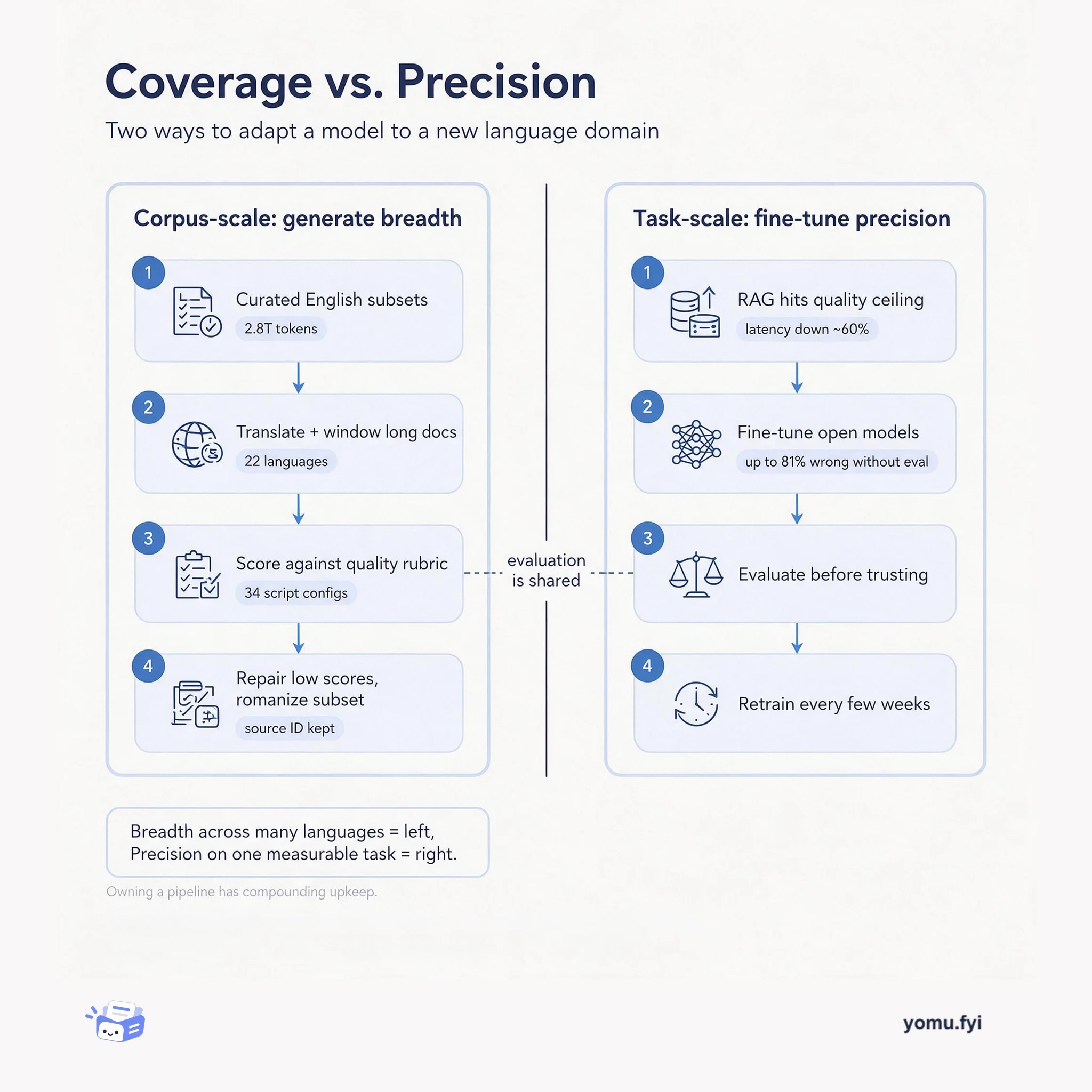
Coverage vs. Precision: AI4Bharat's Corpus Pipeline and When to Fine-Tune Instead
Compare two ways to adapt a model to a new language or domain: generate a broad synthetic corpus like AI4Bharat's, or fine-tune on one narrow task and evaluate it.
 DatabricksNikhil Hiriyur Sunderraj, Dakshina Murthy Malladi, Nikitha Goram, Ryan Roser, Kate Stepp, Julia Powell, Tejas Sundaresan, Lucas de PaulaProblem & solution
FactSet’s Text-to-Formula (TTF) system converts natural-language investment queries from professionals into correct FactSet Query Language (FQL) formulas. Initially built on retrieval-augmented generation (RAG), the approach hit a quality ceiling as queries became more specialized and formulas more complex. FactSet adopted fine-tuned open models within a Compound AI architecture, reducing end-to-end latency by about 60 percent and improving quality for complex formulas. Fine-tuning runs on Databricks AI Runtime with serverless GPU infrastructure, where engineers choose compute based on prompt length and output needs, and the pipeline integrates with MLflow, the Lakehouse, and Lakeflow Jobs for a unified workflow. This setup cut model setup, training, and deployment from days to hours, enabling the team to retrain every two to three weeks as new data and models become available.
FactSet’s Text-to-Formula (TTF) system converts natural-language investment queries into FactSet Query Language (FQL) formulas. Initially built on RAG, the approach hit a quality ceiling as queries became more specialized. The team turned to fine-tuned open models, but needed efficient infrastructure for recurring training every two to three weeks.
FactSet uses Databricks AI Runtime to run fine-tuning on serverless GPU infrastructure, allowing engineers to select compute based on prompt length and output needs without provisioning hardware. The pipeline integrates with MLflow for experiment tracking and the Lakehouse for data governance, and uses Lakeflow Jobs as a plug-and-play reusable framework. This setup keeps training inside the development loop alongside data, experimentation, and model management.
FactSet’s earlier work on TTF found that incorporating fine-tuned open models reduced end-to-end latency by about 60% compared to a RAG-only system.
By running fine-tuning on Databricks AI Runtime’s serverless GPU infrastructure, FactSet eliminated the need to provision and configure GPU environments for each training run, cutting setup, training, and deployment from days to hours.
FactSet retrains its TTF models every two to three weeks, and the reusable pipeline built on Lakeflow Jobs allows easy adoption across different TTF tasks and other teams.
FactSet fine-tunes its models roughly every two to three weeks, as new training data accumulates and model updates become part of the development cycle.
FactSet found that incorporating fine-tuned models reduced end-to-end latency by about 60% compared to the earlier RAG-only approach.
FactSet has worked with Llama-based models and continues to evaluate newer open models. Different models, prompt lengths, and output characteristics can require different compute configurations.
Summaries are generated from the original by a language model. Check the original before relying on it.
See the idea
Compare two ways to adapt a model to a new language or domain: generate a broad synthetic corpus like AI4Bharat's, or fine-tune on one narrow task and evaluate it.
Keep reading
The Good Stuff
Paid picks we use ourselves. Links carry a referral code — a subscription through one earns us a commission at no extra cost to you.
One useful email. Unsubscribe anytime.
