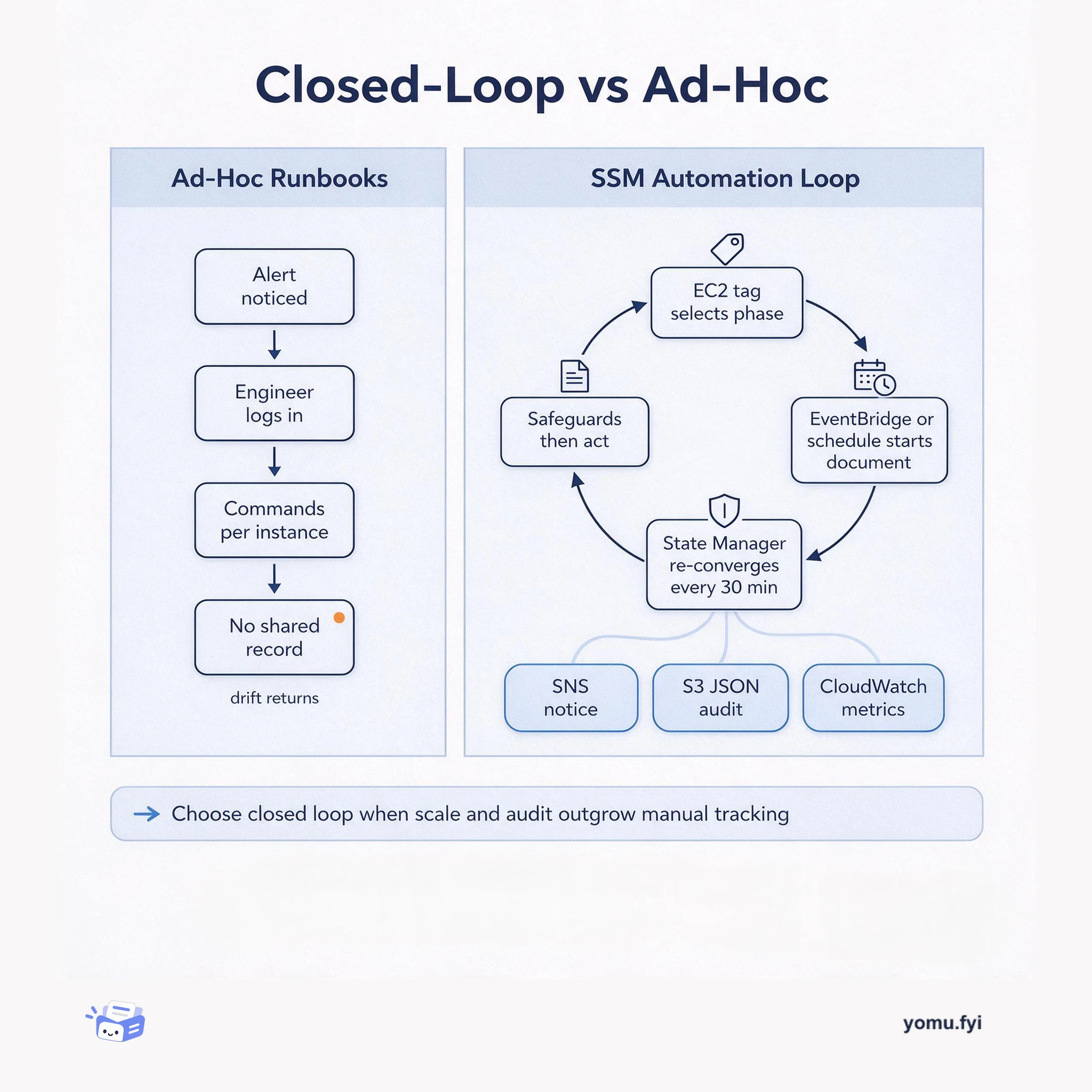
AWS Systems Manager: Closed-Loop Automation vs Manual Runbooks
A side-by-side comparison of ad-hoc, human-run remediation and tag-driven AWS Systems Manager Automation, showing what each costs in audit trail, drift, and time to recover.
 AWSPeter GarnepudiTutorial
The article describes a structured disaster recovery readiness engagement that compresses the three business decisions and progressive validation framework into a weeks-long process. The kickoff brings together application owner, business owner, and platform team to produce a boundary map listing every service and account in the recovery path with assigned owners and timelines. Assessment uses Well-Architected and Operational Readiness Reviews to surface dependency gaps, which are then addressed with owners and fix dates before testing proceeds. Validation progresses through tabletop exercises, planned failovers, and surprise drills, with each test’s findings fed back into the three business decisions to update the recovery commitment. An enterprise example shows the engagement exposed a missed 5-hour RTO, missing authentication platform, and manual DNS failover, then over four months automated failover with ARC routing controls and pre-provisioned resources to pass the second exercise.
Part 3 of a three-part series on disaster recovery readiness. Parts 1 and 2 introduced three business decisions and progressive validation. This post details a structured engagement to compress those decisions into weeks, with concrete steps and a real enterprise example.
The engagement follows five steps: (1) Kickoff with application owner, business owner, and platform team to create a boundary map of all recovery-path services and accounts. (2) Assessment using Well-Architected Framework Review (Reliability pillar) and Operational Readiness Review to identify dependency gaps. (3) Validation plan progressing through tabletop, planned failover, and surprise drill. (4) Execute tests and map findings back to the three business decisions to update the recovery commitment. (5) Ongoing quarterly review to prevent drift from architecture changes. Acceleration options include AWS Enterprise Support mechanisms such as Technical Account Managers, Countdown, and Resilience Hub.
The boundary map, listing every service and account in the recovery path with owners and recovery timelines, is the foundational artifact for all subsequent steps.
Testing must progress through levels: tabletop first, then planned failover, then surprise drill; skipping levels produces noisy findings that obscure real gaps.
In the example, manual DNS failover took over 3 hours; automating with ARC routing controls (data plane switches) eliminated that step and improved recovery time.
A boundary map is a document produced during the kickoff that lists every service and account in the recovery path, with an owner assigned to each and their stated recovery timeline recorded. It becomes the foundation for assessment and testing.
Gaps are surfaced through a Well-Architected Framework Review against the Reliability pillar and an Operational Readiness Review. These checks verify pre-provisioned resources, upstream dependency recovery targets, manual steps, and runbook assumptions, producing a prioritized list with owners and fix dates.
Progressive validation builds confidence through increasing realism: tabletop exercises confirm ownership and escalation, planned failovers measure actual recovery time, and surprise drills test coordination without notice. Each level should pass cleanly before moving to the next to avoid wasted effort.
Summaries are generated from the original by a language model. Check the original before relying on it.
See the idea
A side-by-side comparison of ad-hoc, human-run remediation and tag-driven AWS Systems Manager Automation, showing what each costs in audit trail, drift, and time to recover.
Keep reading
The Good Stuff
Paid picks we use ourselves. Links carry a referral code — a subscription through one earns us a commission at no extra cost to you.
One useful email. Unsubscribe anytime.
