What Is an AI Factory? Four Stages From Data to Served Answer
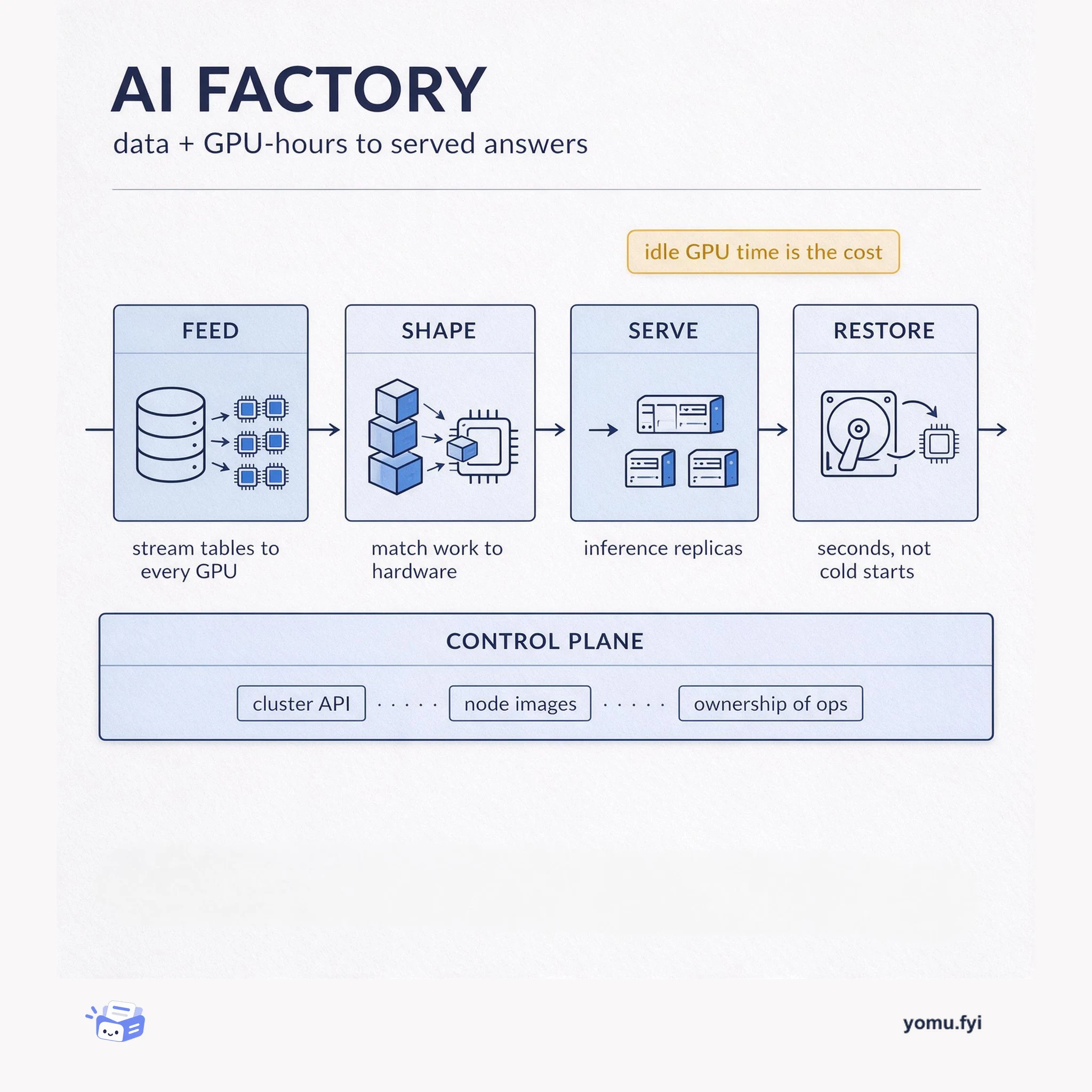
An AI factory turns raw data and GPU-hours into served model output. This diagram breaks it into four stages — feed, shape, serve, restore — plus the control plane that owns them.
 MetaBy Hongtao Yu, Peng Chen, Daohang Shi, Nick Riasanovsky, Lei Wang, Partha KanuparthyAnnouncement
Triton Low-Level Extensions (TLX) is an extension to Triton that helps engineers optimize GPU performance while preserving Triton’s productive programming model. TLX introduces explicit warp-group and cluster-level orchestration, letting developers adopt new hardware capabilities without sacrificing velocity. Modern GPU architectures increasingly rely on execution-oriented features such as warp specialization, asynchronous memory movement, tensor memory, and cluster-level execution to optimize their performance. TLX has demonstrated performance improvements in RecSys training, RecSys inference, and large-scale LLM pretraining. Across NVIDIA and AMD GPUs, TLX combines state-of-the-art kernels with explicit execution orchestration and model-aware fusion to deliver end-to-end improvements beyond what standalone libraries can achieve.
Modern GPU architectures (NVIDIA Hopper, Blackwell, AMD Mi300/Mi350x) introduce execution-oriented features like warp specialization, TMA, TMEM, and cluster-level execution that create a gap between low-level CUDA control and high-level Triton productivity. TLX fills this missing middle by elevating warp groups to first-class execution agents.
TLX extends Triton with explicit warp-group and cluster-level orchestration (MIMW model), enabling developers to coordinate execution agents, asynchronous memory movement, and shared resources on modern GPUs while preserving Triton’s productive programming model.
TLX introduces a MIMW (Multiple Instructions, Multiple Warps) programming model that elevates warp groups to first-class execution agents, filling the gap between CUDA’s SIMT and Triton’s SIMB models.
TLX makes hardware features like WGMMA, TMA, and TMEM accessible through concise annotations, enabling warp-specialized fusion and multi-DSL kernels that would be prohibitively complex in raw CUDA.
TLX typically delivers performance on-par with hand-tuned CUDA but enables significantly faster iteration, with implementations taking weeks rather than months for complex kernels.
TLX introduces explicit warp-group and cluster-level orchestration (MIMW model) on top of Triton, letting developers coordinate execution agents, asynchronous memory movement, and shared resources without dropping into low-level CUDA code.
TLX has demonstrated performance improvements in RecSys training, RecSys inference, and large-scale LLM pretraining at Meta, with kernels that match hand-tuned CUDA performance while enabling faster iteration.
TLX currently targets NVIDIA Hopper and Blackwell, and AMD Mi300 and Mi350x, with work underway for more architectures including custom accelerators like MTIA.
Summaries are generated from the original by a language model. Check the original before relying on it.
See the idea
An AI factory turns raw data and GPU-hours into served model output. This diagram breaks it into four stages — feed, shape, serve, restore — plus the control plane that owns them.
Keep reading
The Good Stuff
Paid picks we use ourselves. Links carry a referral code — a subscription through one earns us a commission at no extra cost to you.
One useful email. Unsubscribe anytime.
