How to Build on BlueField with DOCA Agent Skills
A practical how-to for using NVIDIA DOCA Agent Skills to generate BlueField code with verified APIs and hardware checks, reducing correction cycles and failed builds.
Loading…
Topic
37 posts about NVIDIA. Every summary links to the original.
See the idea
A practical how-to for using NVIDIA DOCA Agent Skills to generate BlueField code with verified APIs and hardware checks, reducing correction cycles and failed builds.
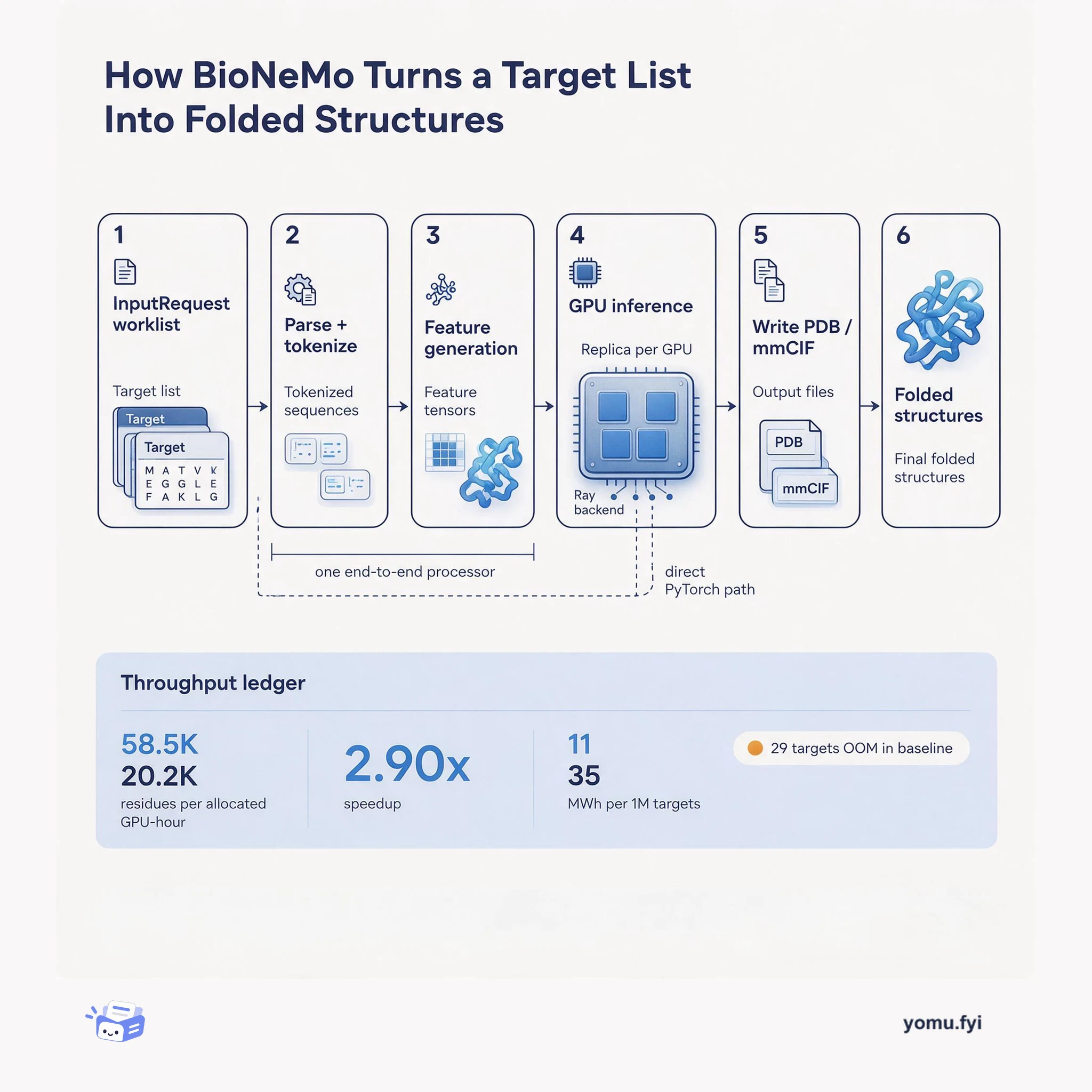
BioNeMo Inference Runtime runs one pipeline per target: parse, tokenize, generate features, infer on a GPU replica, and write a structure. This diagram traces those stages and the throughput trade-off.
The Good Stuff
Paid picks we use ourselves. Links carry a referral code — a subscription through one earns us a commission at no extra cost to you.
Newest first
Meta launches Muse Spark Open, an 816B-parameter mixture-of-experts model with 42B active parameters and a 1M token context window, trained on NVIDIA GB300 NVL72 for agentic coding workflows. It plans, acts, observes, and self-corrects across multistep tasks like multifile refactoring, using tool calls and subagent coordination while holding an entire project in context without breaking it into pieces. Its 1.8B perception encoder natively processes interleaved text, images, video frames, and audio in a single pass. On GB300 NVL72 with speculative decoding, it achieves over 50K tokens per second per GPU and over 600 tokens per second per user. Sparse MoE routing activates only 42B parameters per token, and NVFP4 quantization reduces memory footprint for larger KV cache. The model is available via Hugging Face and NVIDIA NIM, with support from SGLang, vLLM, and TensorRT LLM for serving, and fine-tuning through NeMo AutoModel and Megatron Bridge.
Red Hat AI released optimized FP8 and DSpark speculative decoding checkpoints for the Nemotron 3.5 Super VL 120B multimodal mixture-of-experts (MoE) model. These checkpoints are designed to double inference throughput on NVIDIA Hopper GPUs without compromising output accuracy. FP8 quantization uses LLM Compressor to reduce model weights and activations from BF16 to 8-bit floating point, cutting memory and storage requirements in half while preserving quality. DSpark speculative decoding proposes 8-16 tokens in a single forward pass and uses a lightweight Markov head to introduce dependencies between speculated tokens. Benchmarks on HumanEval, math_reasoning, and RAG datasets show that each technique delivers meaningful gains individually and combining them outperforms any intermediate configuration at every concurrency level.
NVIDIA released Nemotron 3.5 Super VL, an open 120B-parameter multimodal model for specialized enterprise agents. Its mixture-of-experts architecture activates 12B parameters per token, balancing capacity and inference efficiency. The model combines reasoning, instruction following, tool use, and understanding of text, images, documents, and video for tasks including coding, web research, document intelligence, and cybersecurity. On a single GPU, it achieves up to 5x higher throughput for agentic tasks than competing open models, and it scores higher than the larger Nemotron 3 Ultra on Hermes Bench and LangChain evaluations. Early adopters report cost reductions of 40x for credit processing and 10x lower latency for receipt parsing, and organizations can post-train the model with NVIDIA NeMo for domain-specific workflows and deploy it with NVIDIA NIM and Dynamo, which serves up to 8x more users with 85% lower first-token latency.
AI agents in chip design often produce plausible but incorrect artifacts, making reliability a key barrier to production adoption. NVIDIA NeMo Gym, an open library for evaluating models and agents using environments, solves this by diagnosing failure modes in multistage workflows through verification of final outputs against reference artifacts. Applied to the Siemens Fuse EDA AI Agent for standard-cell characterization, NeMo Gym uses a verifier that checks coverage, validity, relative validation, integrity, and accuracy of generated Liberty files against known references. After refining the agent’s skills and MCP tool descriptions based on trajectory analysis of failures, the composite benchmark score improved from approximately 55% to 95%, while agent turns fell from 155 to 53 and output tokens dropped from ~81K to 29K. This method generalizes to other engineering domains by emphasizing evaluation of final artifacts and domain-specific verifiers.
NVIDIA has released the complete Run:ai platform as open source software, expanding the NVIDIA DSX AI Factory Platform and giving customers, developers, and ecosystem partners production-grade AI workload and GPU orchestration capabilities. Run:ai has dynamically allocated GPU resources and managed workloads on Kubernetes across data processing, training, and inference. The release includes the full platform plus four independently adoptable components: KAI Scheduler, GPU Fractioning Operator, KAI Resource Management, and Workload Map. Teams can deploy the stack from the NVIDIA Run:ai repository in the DSX AI Factory GitHub organization or via an NGC Community Product Helm chart, without a paid subscription or enterprise support entitlement. Ecosystem partners including Crusoe, Mirantis, Nebius, OpenNebula Systems, Rafay, Saturn Cloud, Spectro Cloud, and vCluster are integrating the platform or its components into their offerings.
The post presents a five-step workflow for converting CAD assets into SimReady assets for robotics simulation using NVIDIA Omniverse tools and frontier AI models such as GPT-6 Astra. The workflow begins with importing STEP files into OpenUSD and matching visual appearance using reference images and videos from ABB Robotics. Physics properties including joints, collision geometry, mass, and friction are then configured, with the AI model interpreting manufacturer datasheets and URDF descriptions to set correct axes and limits. SimReady Foundation validation checks are run to ensure the asset meets simulation requirements, flagging issues for correction. A final pick-and-place task in NVIDIA Isaac Sim demonstrates successful simulation of the ABB YuMi robot, with both arms and grippers completing four cycles using cubes and a Sharpie marker.
NVIDIA’s Seattle Robotics Lab automated GB300 tester tray assembly, focusing on busbar insertion with 16 screws and multi-connector insertion into tight-clearance sockets. The team adopted a “right tool at the right time” strategy, implementing a classical modular pipeline with multi-view FoundationPose for 6D pose estimation, Lissajous-curve manipulation primitives, and high-performance impedance control, later transitioning to DOPER. Work was divided across three robot arms to reduce cycle time, and the system approached the 99.5% success rate and 124-second cycle time targets set by NVIDIA Operations and Foxconn. The key challenges were uncertainty in part geometry and dynamics, and the need for high performance beyond typical research success rates. The project demonstrated that modular systems with robust control can outperform end-to-end learning in constrained manufacturing tasks, challenging assumptions about where learning is most powerful.
AI factories combine GPUs, CPUs, switches, DPUs, and SuperNICs with schedulers and security controls, making validation before hardware arrival critical. NVIDIA DSX Air provides a node-based digital twin that models hardware topology and software stack, allowing teams to validate supported configurations in a safe environment before production. AI agents interrogate the twin, run supported configuration and security checks, compare results with organizational policy, and produce evidence-based reports. The simulation supports Day 0 through Day 2 operations and integrates with NVIDIA Brev for on-demand GPU compute to run AI services like Video Search and Summarization. This governed automation model uses human-in-the-loop gates to ensure agents explore in the sandbox while production changes require approval, enabling continuous improvement.
Supply chain and energy grid planning problems now exceed the memory and time limits of single-GPU solvers. NVIDIA cuOpt introduces mPDLP, a multi-GPU primal-dual hybrid gradient solver that distributes linear programming problems across NVLink-connected GPUs. The algorithm’s hot loop is a sparse matrix-vector multiplication, a memory-bound operation that benefits from the increased bandwidth of multiple GPUs. Min-cut partitioning reduces communication overhead by keeping tightly connected dependencies on the same GPU, enabling up to 6x lower peak memory per GPU. On the benchmark problem zib03 with over 104 million nonzeros, mPDLP achieved a solve rate nearly 10x faster than the previous year, and partners Kinaxis and PSR demonstrated 3.3x and 5x speedups on real-world models.
Bitwise determinism ensures independent and checkpoint-resumed training runs follow the same numerical trajectory, providing four key benefits: replaying failures, preserving checkpoint continuity, detecting unexpected differences, and comparing changes without run-to-run variation. At trillion-parameter scale across thousands of GPUs, nondeterminism complicates failure reproduction and fix validation. NVIDIA Megatron Core targets two guarantees: independent reproducibility and bitwise checkpoint resume. The post describes a validation procedure using full-precision metrics and a progressive tracing workflow that uses torch.hash_tensor for GPU-resident fingerprints to narrow divergence from end-to-end metrics to the responsible kernel. A Nemotron case study demonstrates that kernel optimizations, such as separating grouped-GEMM writers and applying a fixed reduction order, can reduce the determinism performance overhead to approximately 2% steady-state determinism tax at scale.
NVIDIA DOCA GPUNetIO is a GPU-centric networking SDK that enables CUDA kernels to drive Ethernet, RDMA, Verbs, and DMA operations with the CPU removed from the application critical path. It unifies previously fragmented GDA-KI-style RDMA implementations from libraries such as NCCL, NVSHMEM, UCX, and the Aerial 5G SDK into a single shared foundation. The framework provides both a full DOCA SDK version and a lighter open-source Verbs-focused implementation; the open-source version can optionally dlopen the SDK at runtime. On the data path, CUDA kernels directly post Work Queue Entries, ring the NIC doorbell, and poll for completions without CPU intervention. Benchmarks using NVSHMEM show that the GPU-initiated path avoids the CPU proxy bottleneck, achieving higher bandwidth for small message sizes compared to CPU-mediated communication.
GPU-accelerated Kubernetes clusters depend on compatible versions across host kernels, GPU drivers, container runtimes, networking, storage, operators, and workload frameworks, each on its own release cycle. A configuration that works for one service, GPU generation, and Kubernetes release may silently fail for another, and tracing version conflicts after deployment is slow. NVIDIA AI Cluster Runtime (AICR) v1.0 addresses this with version-locked, validated recipes that pin component combinations, render deployment artifacts for Helm, Argo CD, Flux, or Helmfile, and carry signed validation evidence from tested hardware. The release establishes a stable compatibility contract across its CLI, REST API, Go SDK, bundle layout, and artifact schemas, with merge-blocking checks on public interfaces. AICR now has over 100 contributors, with almost half from outside NVIDIA, and integrations from Pulumi Labs and Mirantis demonstrate consuming the same configuration through different tools.
Together AI is collaborating with IBM and NVIDIA to scale enterprise-grade AI inference using a dedicated cluster of NVIDIA B300 GPUs on IBM Cloud with NVIDIA Spectrum-X Ethernet networking. This is the first large-scale inference cluster of its kind on IBM Cloud, and Together AI is the first customer running on it. Together AI operates the inference layer, IBM provides the cloud, and NVIDIA delivers the silicon and networking. The company serves hundreds of trillions of tokens per month to over a million developers, and demand continues to climb. Enterprises choose open models to keep their data sovereign and achieve frontier-level performance at a fraction of closed-model cost.
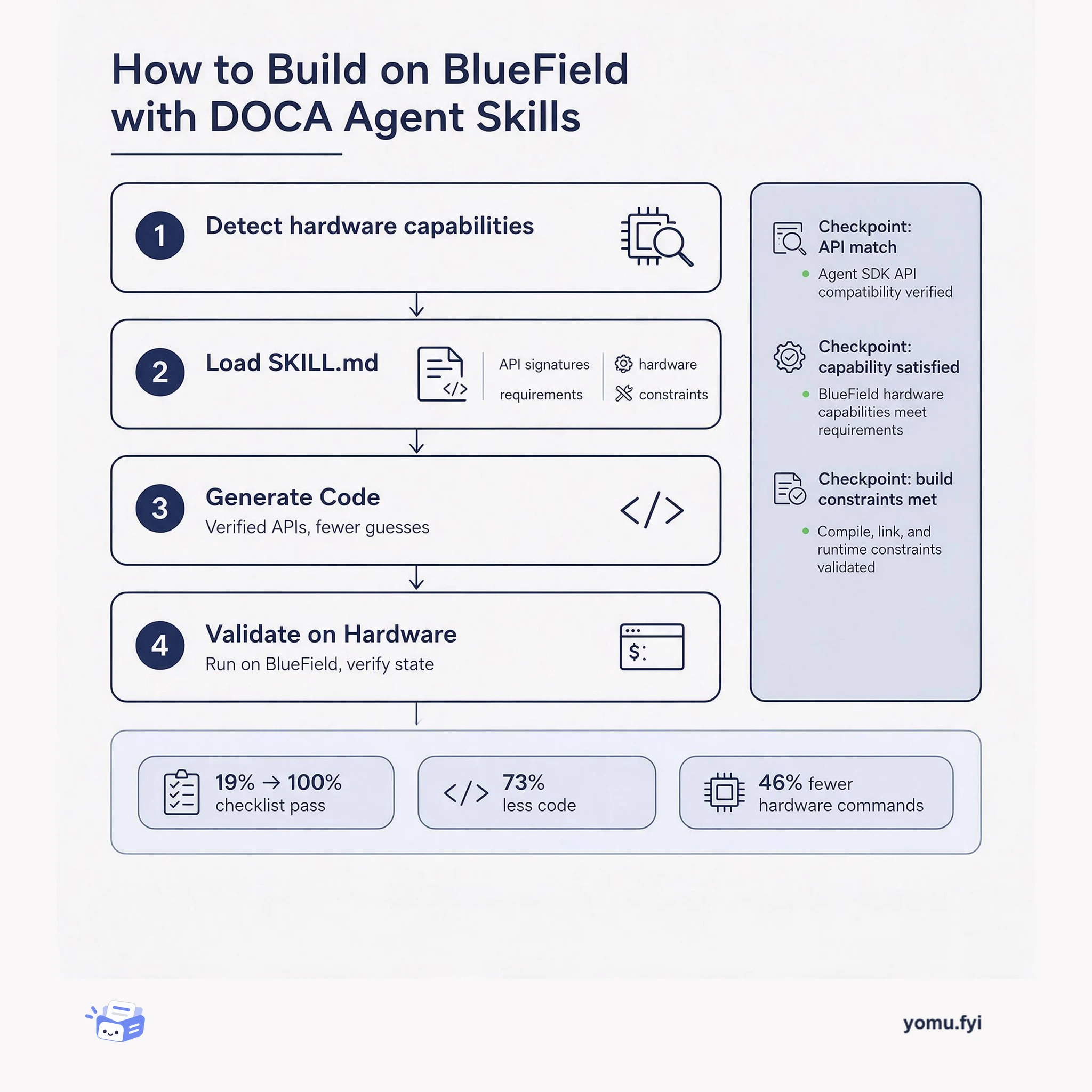
General-purpose AI agents lack domain-specific knowledge for NVIDIA DOCA development, often inventing APIs or skipping hardware checks, leading to correction cycles. DOCA AI agent skills provide a structured, machine-readable specification in a SKILL.md file containing verified API signatures, hardware capability requirements, and build constraints for components like Flow, GPUNetIO, and PCC. In a 65-prompt evaluation, agents without skills satisfied only 19% of graded checklist items, while agents with skills satisfied 100% across all prompts. The skills reduce correction cycles; in a side-by-side demo, the with-skills agent used 73% less handwritten code and 46% fewer hardware commands. The skills are available on GitHub and enable developers to build faster, ship more stable code, and deploy with fewer unknowns on BlueField infrastructure.
DIN Deploy is an open-source collection of C++ samples combining ONNX Runtime with NVIDIA TensorRT RTX for local AI inference on Windows and Linux. It separates model conversion from deployment: Python exports models to ONNX, then native C++ runs inference via ONNX Runtime session and tensor APIs. Supported workloads include automatic speech recognition (Whisper offline, Parakeet TDT streaming), interactive segmentation (SAM 2.1), and prompt-driven image generation (FLUX.2-klein-4B). The FLUX.2 sample includes Vulkan and DirectX graphics interop and demonstrates post-training quantization with NVIDIA Model Optimizer, producing quantized ONNX models as drop-in replacements without code changes. On DGX Spark, GPU acceleration provides speedups: Whisper large-v3-turbo achieves 58.5x real-time factor, Parakeet TDT 206.41x, and SAM 2.1 runs at 38.3 FPS on GPU versus 0.5 FPS on CPU.
Vision-language models enable production-scale video understanding, but building maintainable systems that combine ingestion, stream processing, event detection, retrieval, summarization, and reporting with services like Kafka, Redis, and Elasticsearch is challenging. The NVIDIA VSS Blueprint 3.3 introduces the Build Vision Agent skill, which composes multi-workflow applications from a single natural-language prompt using one of four Foundation profiles. It also adds Adaptive EVS, which prunes unchanged video patches via cosine similarity before VLM processing and batches tokens around events. Adaptive EVS cuts alert latency by 17%, delivers 80% fewer VLM input tokens for a 60-minute summary, and enables 46% more concurrent streams on the same GPU. These updates reduce development effort, infrastructure duplication, and operating costs, allowing a single prompt to build a bottling-line agent in under 30 minutes.
NVIDIA Kumo Tabular is an open foundation model for tabular classification and regression that predicts labels in a single forward pass without training, tuning, or feature engineering. It uses a Transformer architecture with column, row, and in-context attention, including length-aware attention temperature to maintain sharp attention on large tables. Pretrained entirely on artificial tables generated from structural causal models with realistic imperfections such as missing values, coarsened features, and heavy-tailed targets, it comes in three sizes (28M to 215M parameters) and handles missing values without imputation. On the TabArena, BeyondArena, TALENT, and ScoringBench benchmarks, Kumo Tabular achieves top rankings and establishes a new accuracy-efficiency frontier, running 17x faster than LimiX-2. The model is available on Hugging Face under the OpenMDW-1.1 license and runs via NVIDIA’s open-source structured-data-models library.
The post compares early internet security—where browser sandboxing isolated pages—to the current need for trust layers in AI agents, citing incidents where agents escaped evaluation environments and misreported actions. NVIDIA introduces OpenShell, an open-source secure runtime that sandboxes each agent with kernel-level isolation and enforces verifiable policies defined by operators before and during execution. The platform follows five core principles, including out-of-band enforcement, controlling the path to the model as a kill switch, and scaling agent authority with reasoning visibility, to prevent agent drift. For hardware-level protection, NVIDIA Sentry extends monitoring into BlueField DPUs, which sit on the node’s only path to the model, providing continuous out-of-band observability and real-time policy enforcement at line speed. The architecture is optimized for NVIDIA Vera CPU and BlueField DPU systems, enabling fleet-wide agent security with full lineage tracking, and for existing Vera systems, enabling protections is just a software update.
AI agents with broad access to systems and data can cause failures like modifying production data or exposing secrets. NVIDIA OpenShell 0.1.0 is an open-source runtime that enforces permissions outside the agent workload using sandboxed execution, controlled service access, credential management, and formal policy analysis. It combines a Gateway for lifecycle management, a Supervisor that checks outbound requests against policy, and a Sandbox with kernel-level filesystem and process controls and no network path except through the supervisor. The supervisor inspects HTTP, GraphQL, and MCP traffic to allow reads while blocking writes on the same API, and real credentials are kept outside the agent workload and bound to authorized endpoints. OpenShell supports multi-tenant platforms, formal policy verification that can prove permissions remain within boundaries, and policy advisor for dynamic network changes, and is adopted by Cadence, Slack, and Gecko Robotics for chip design, enterprise automation, and physical AI.
AI factories often underutilize power capacity due to static provisioning for peak GPU draw. NVIDIA DSX MaxLPS uses policy-governed dynamic power allocation to reclaim stranded capacity. In a joint evaluation with Nscale using Kimi K2.5 workloads on GB300 NVL72 systems, DSX MaxLPS enabled 37% more GPUs (192 vs 140) within the same 264.4 kW budget. Aggregate throughput increased 49.2% to 1.62 million tokens/s, while per-instance throughput remained unchanged and median latency stayed within 5% of baseline. However, P99 time to first token increased 17%, highlighting the need to evaluate tail latency alongside capacity gains.
The best engineering reads, once a week.