Clera, an AI talent agent representing 200,000+ candidates, migrated its 500 GB production Postgres database to ClickHouse Managed Postgres after outgrowing its previous provider. The previous database suffered from point lookups taking multiple seconds, 100% CPU for six straight days, and timeouts. Clera evaluated Supabase, Neon, PlanetScale, and ClickHouse, choosing ClickHouse for its local NVMe storage that avoids network-attached disk latency. In sysbench TPC-C testing, ClickHouse showed 16–42% higher throughput than the runner-up. The team migrated 500+ tables from the EU to the US overnight using ClickPipes and manual replay, with production traffic still hitting the database. After migration, CPU usage dropped to 10–20%, and no settings have been changed since the cutover.
Context
Clera is an AI talent agent representing 200,000+ candidates. Its operational Postgres database had grown to 500 GB (now ~1 TB). The previous provider caused point lookups taking multiple seconds, 100% CPU for six straight days, timeouts, and failed writes. The workload includes hot reads, point lookups, and background analytics queries that were blocking each other.
Approach / What changed
Clera migrated 500+ tables from an EU-based Postgres provider to ClickHouse Managed Postgres in a single night using ClickPipes for initial sync, then manually replayed remaining writes, rebuilt indexes, resequenced tables, and cut over by redeploying the entire system pointing at the new database.
Takeaways
1
Clera’s previous database suffered from point lookups taking multiple seconds and 100% CPU for six straight days because background analytics queries blocked hot reads and point lookups.
2
ClickHouse Managed Postgres uses local NVMe storage instead of network-attached disks, which eliminated the latency that caused blocking and poor performance under mixed workloads.
3
In sysbench TPC-C testing, ClickHouse Managed Postgres showed 16–42% higher throughput than PlanetScale without any tuning, and Clera has not changed a single setting since migration.
FAQ
How did Clera choose ClickHouse Managed Postgres?
Clera evaluated Supabase, Neon, PlanetScale, and ClickHouse Managed Postgres. They tested each with a replay of their own production workload and with sysbench TPC-C. ClickHouse won on both, primarily because its local NVMe storage avoids the latency of network-attached disks used by most providers.
How did they migrate 500 GB overnight?
The migration used ClickPipes for the initial sync, then Julian manually replayed writes that occurred during the sync, rebuilt indexes, resequenced tables, and performed parity checks. The cutover involved redeploying the entire system pointing at the new database. The process ran from 11 p.m. to 6–7 a.m.
What performance improvements did Clera see?
CPU usage dropped from days at 100% to 10–20% most of the time. Point lookups that previously took multiple seconds now complete quickly. The team has not changed any settings since migration, and the price is about the same or slightly cheaper than the previous provider.
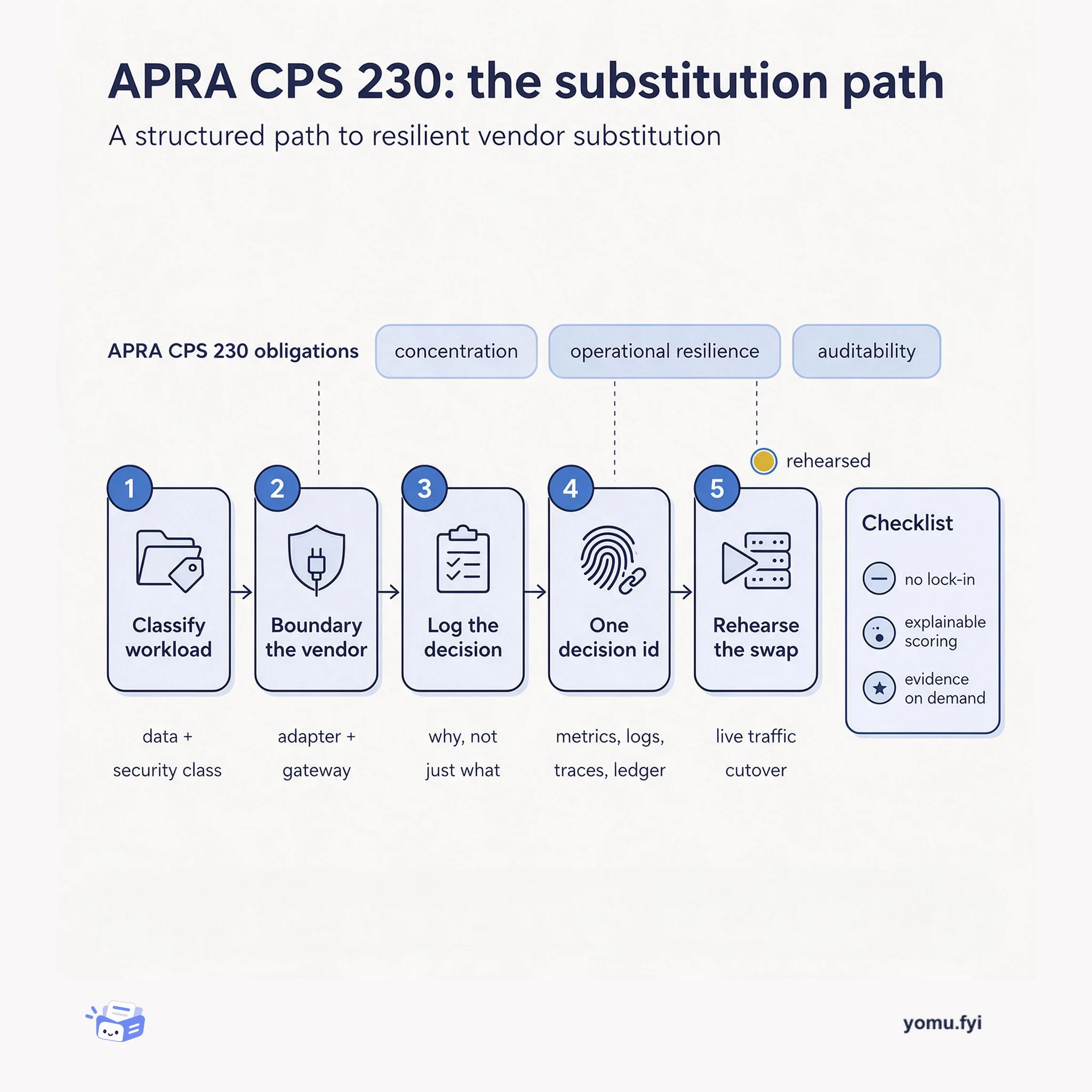
APRA's April 2026 letter flags single-provider concentration as a CPS 230 risk, so AI stacks need a rehearsed substitution path. This flow maps five stages, from workload classification to provider swap.
Keep reading
Related reading
The Good Stuff
Paid picks we use ourselves. Links carry a referral code — a subscription through one earns us a commission at no extra cost to you.