Amazon RDS: The Managed Database Boundary
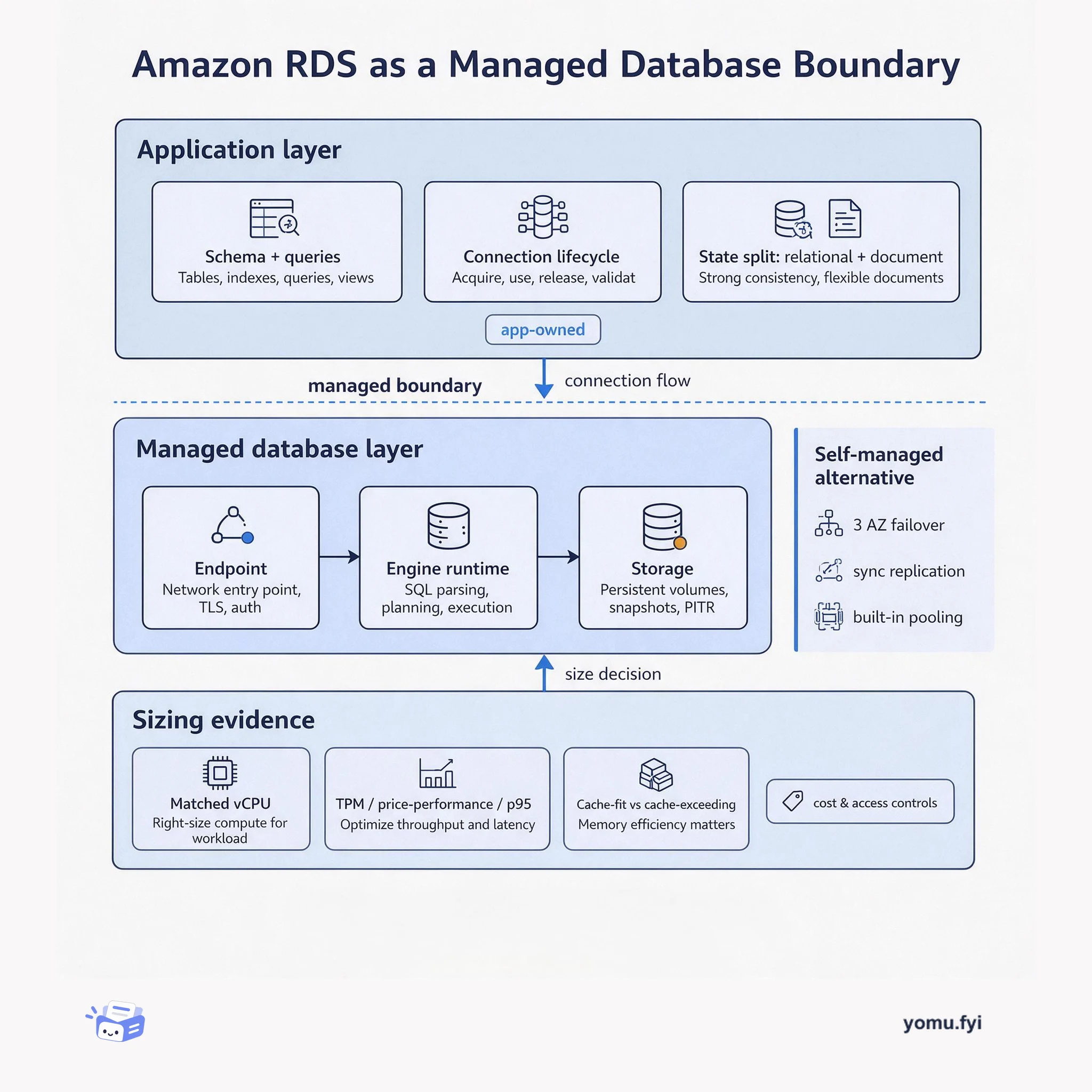
Amazon RDS is a managed relational database layer. This architecture map shows where the provider boundary sits, what your app still owns, and how to size it with workload evidence rather than defaults.
 Supabaseaditya_maruvada,daniel_mitterdorferAnnouncement
DBArena is a new site that publishes open, reproducible benchmarks of hosted Postgres providers. The first results compare Supabase Postgres (default and OrioleDB), Amazon RDS, and Google Cloud SQL at up to seven compute sizes. Each test uses a TPC-C-derived workload with matched vCPU counts and default configurations, measuring transactions per minute, price-performance, and p95 latency in both cache-fit and cache-exceeding scenarios after a 30-minute warmup and 60-minute measurement. The published result is the median of three successful runs at peak concurrency, and each result includes a raw data file with exact commands, configuration, and metadata, plus open-source tools (dbarenactl, benchctl, go-tpc) for reproduction. The methodology is public, and the first round covers 62 results from over 750 runs, with limitations such as list prices and single-region testing documented on the methodology page.
Most published database benchmarks come from vendors and are difficult to compare because they use different instance sizes, tuned configurations on one side and defaults on the other, and are hard to reproduce. Many report performance without considering price, hiding the tradeoff teams care about.
DBArena benchmarks hosted Postgres providers using a TPC-C-derived workload with matched vCPU counts and default configurations. Each test runs a 30-minute warmup followed by a 60-minute measurement, sweeping client concurrency to find peak throughput. Results are the median of three successful runs and include raw data files for reproduction. The methodology is public and all tools are open source.
DBArena tests four products at up to seven compute sizes, measuring throughput, price-performance, and p95 latency in both cache-fit and cache-exceeding scenarios.
The workload is derived from TPC-C with think time disabled, so results show maximum sustained throughput, not typical application behavior.
Every published result includes a result.json file with exact commands, configuration, and metadata, and the benchmarks are run with open-source tools (dbarenactl, benchctl, go-tpc) that anyone can use to rerun tests.
DBArena matches providers by vCPU count and uses each provider's default configuration. It runs the same TPC-C-derived workload in both cache-fit and cache-exceeding scenarios, and reports price-performance normalized by monthly list price.
Yes. Every result includes a raw data file with exact commands and configuration. The benchmarks use open-source tools (dbarenactl, benchctl, go-tpc) that you can set up with your own cloud accounts to rerun any test.
The benchmarks use list prices without discounts, match by vCPU rather than memory, run in a single region per cloud, and disable think time so results show maximum throughput rather than typical application behavior.
Summaries are generated from the original by a language model. Check the original before relying on it.
See the idea
Amazon RDS is a managed relational database layer. This architecture map shows where the provider boundary sits, what your app still owns, and how to size it with workload evidence rather than defaults.
Keep reading
The Good Stuff
Paid picks we use ourselves. Links carry a referral code — a subscription through one earns us a commission at no extra cost to you.
One useful email. Unsubscribe anytime.
