Amazon RDS: The Managed Database Boundary
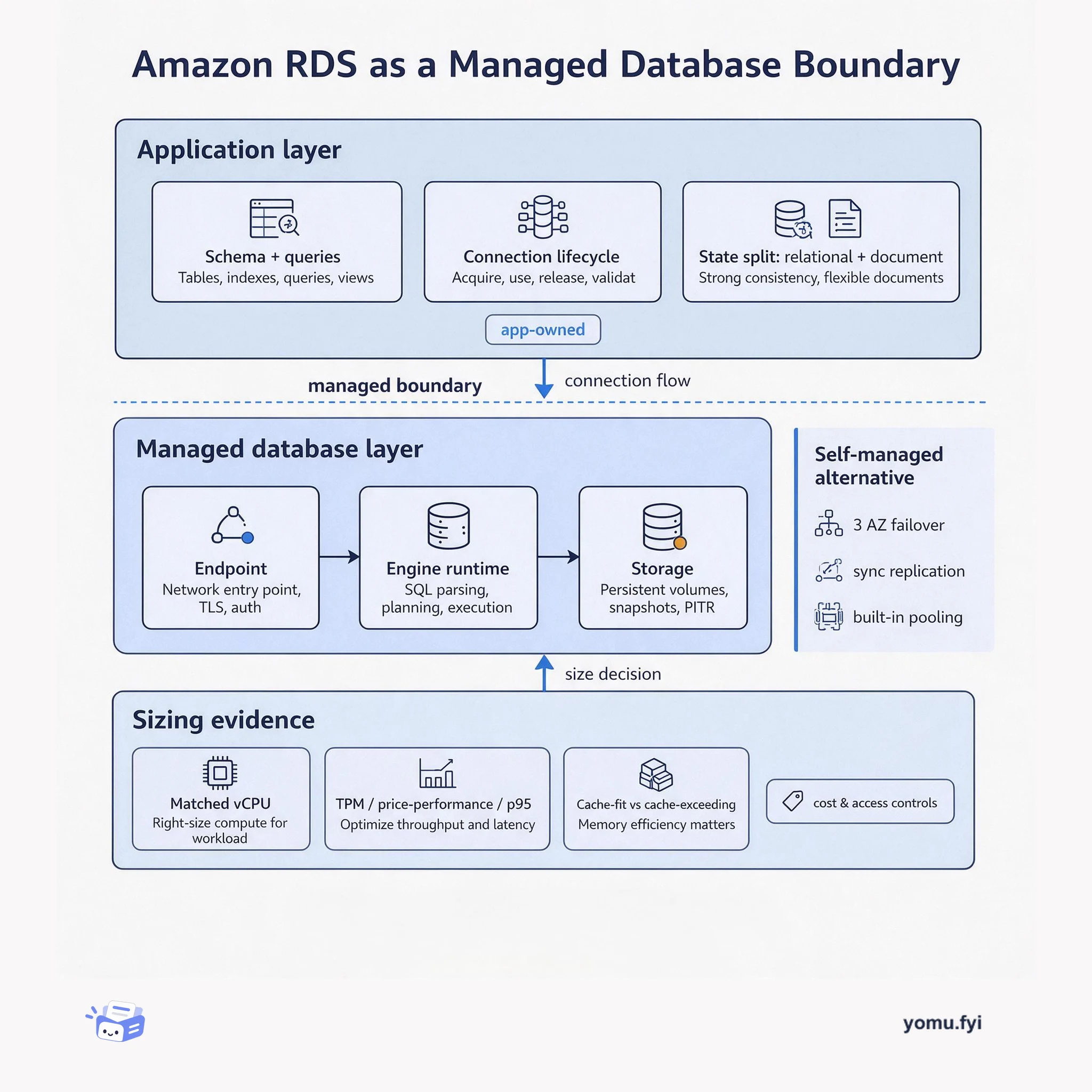
Amazon RDS is a managed relational database layer. This architecture map shows where the provider boundary sits, what your app still owns, and how to size it with workload evidence rather than defaults.
Loading…
Topic
4 posts about AWS Lambda. Every summary links to the original.
See the idea
Amazon RDS is a managed relational database layer. This architecture map shows where the provider boundary sits, what your app still owns, and how to size it with workload evidence rather than defaults.
The Good Stuff
Paid picks we use ourselves. Links carry a referral code — a subscription through one earns us a commission at no extra cost to you.
Newest first
Agent Anomaly Detection, now in Private Preview, can monitor agents running outside Google Cloud by reading their traces and logs. Agents on AWS Lambda, Microsoft Foundry, or on-premises send telemetry to a Google Cloud project via the Telemetry API and OpenTelemetry conventions. ADK for Python 2.12.0+ Google Cloud exporters and Workload Identity Federation enable this without a service account key. In tests, it flagged an AWS Lambda inventory agent for systematic scraping and resource exhaustion, and a Foundry customer-service agent for unverified refunds coerced by override instructions. The analysis runs separately and does not slow the agent.
Aderant modernized its Stridyn analytics pipeline using Apache Iceberg, AWS Lambda, and AWS Glue, replacing a 15-minute batch cycle with event-driven processing. The new architecture handles 380 million CDC events per month across 700 client environments and 266 source tables, processing changes in single-digit seconds. It uses a medallion architecture (bronze, silver, gold) on Iceberg tables in S3, with Lambda functions deployed as Docker containers for ingestion and AWS Glue for transformations. The system achieved 10–26x faster query performance on Amazon Redshift and a 77 percent cost reduction compared to streaming alternatives. Key design choices include Iceberg for ACID transactions and schema evolution, DynamoDB-based watermarking for exactly-once semantics, and a hybrid gold-layer strategy using incremental Glue jobs and materialized views with snapshot comparison.
PHP applications on AWS Lambda lose visibility when requests time out or responses exceed the 6 MB limit, because the Sentry SDK is cut off before it can report. Bref, the open-source project that runs PHP on AWS Lambda, now has an official Sentry integration called sentry/sentry-bref. The integration catches timeouts by hooking into the Bref runtime after PHP-FPM is stopped, and it reports responses too large from the same point. It also creates a transaction per invocation for non-HTTP events like SQS messages and adds cold start spans (lambda.cold-start and bref.startup) to traces. AWS SDK calls can be traced opt-in per client, and every event links to the corresponding CloudWatch log for that invocation.
boAt, a leading Indian consumer electronics brand, launched the AI Coach feature on its smartwatches using Amazon Bedrock and AWS Lambda to deliver personalized, actionable fitness coaching. The system ingests encrypted user metrics and preferences from the boAt Crest app, stored in Amazon RDS and Amazon DocumentDB, using historical context to generate plans via the Meta Llama 3.3 70B Instruct model on Amazon Bedrock. To improve personalization, the team made JSON keys more descriptive and added watch-supported activity lists in prompts, reducing unsupported recommendations. A parsing layer with safe defaults handles missing keys, and configurable nudges in various styles help users adhere to their plans. The serverless architecture, chosen for model-agnostic access, built-in observability, and zero infrastructure overhead, has reliably served millions of users across India for over six months.
The best engineering reads, once a week.