Analytics Is a Signal-Selection Problem
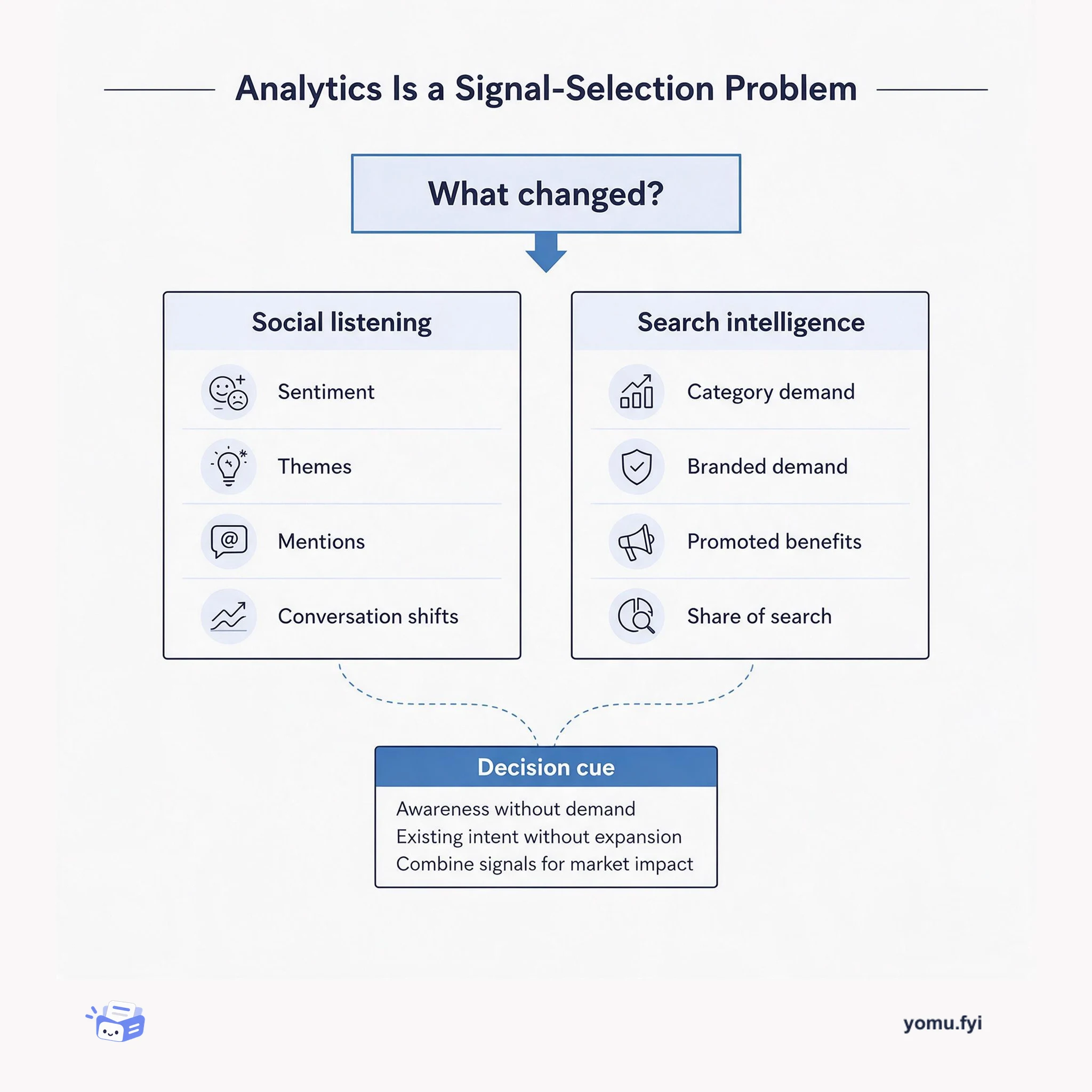
Compare social listening with search intelligence to see which signals answer questions about perception, demand, and campaign impact—and when combining them is more useful.
 BrandwatchKsenia NewtonExplainer
Campaign post-mortems often report reach, engagement, impressions, and sentiment without establishing whether a campaign changed perception or behavior. It argues that social listening should measure sentiment, themes, mention volume, and audience conversation shifts, while search intelligence measures category and branded demand, promoted benefits, and share of search. A client example contrasts a campaign that generated strong social buzz while category search declined with a later campaign that reversed declining demand, captured two-thirds of share of search, and grew search intent 134%. The difference was attributed to combining socially engaging creative with media strategy and messaging designed to drive search demand. The proposed framework aligns measurement with campaign goals and uses gaps between social sentiment and search intent to identify awareness without demand, existing intent without audience expansion, or stronger market impact.
Traditional campaign metrics show how content performed but do not establish whether people’s perceptions changed or whether they developed purchase intent. Social conversations can indicate perception shifts, while search behavior can indicate active consideration, and the source argues that evaluating only one leaves campaign impact incomplete.
Measure social listening and search intelligence together, selecting indicators based on the campaign objective. Use social data for sentiment, themes, mentions, and conversation shifts; use search data for category and branded volume, promoted benefits, and share of search. Compare the signals to identify alignment or gaps between perception and behavior.
A campaign can generate strong social engagement and positive conversation while category search volume and share of search decline, indicating buzz without purchase intent.
In the later campaign, category search reversed its decline, the brand captured two-thirds of share of search, and search intent grew 134% while competitors were flat or declining.
Social and search signals have different biases: social behavior is performative, while search is private and direct but lacks complete context; agreement strengthens insight, while divergence reveals nuance.
Summaries are generated from the original by a language model. Check the original before relying on it.
See the idea
Compare social listening with search intelligence to see which signals answer questions about perception, demand, and campaign impact—and when combining them is more useful.
Keep reading
The Good Stuff
Paid picks we use ourselves. Links carry a referral code — a subscription through one earns us a commission at no extra cost to you.
One useful email. Unsubscribe anytime.
