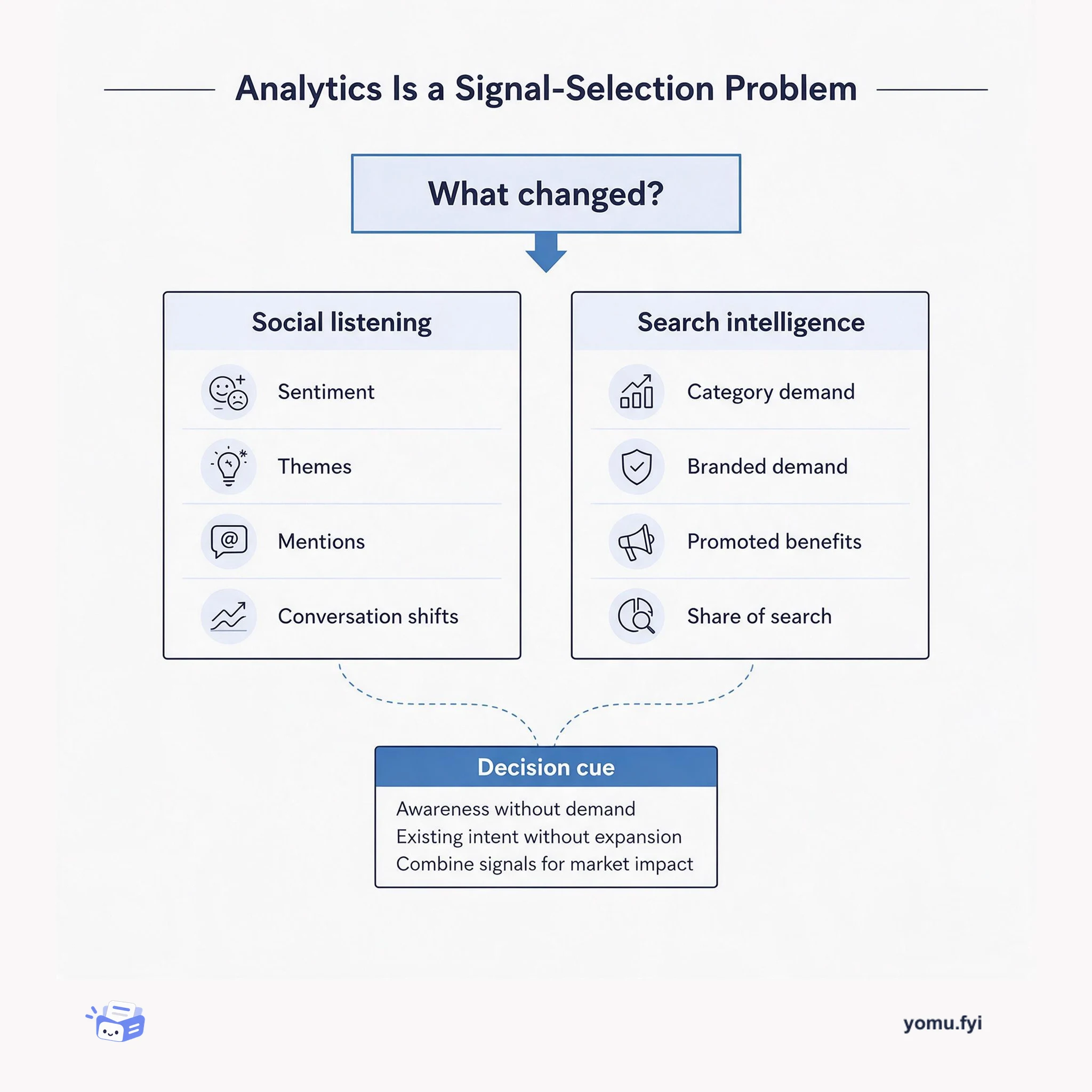
Analytics Is a Signal-Selection Problem
Compare social listening with search intelligence to see which signals answer questions about perception, demand, and campaign impact—and when combining them is more useful.
Loading…
Topic
66 posts about Data Analytics. Every summary links to the original.
See the idea
Compare social listening with search intelligence to see which signals answer questions about perception, demand, and campaign impact—and when combining them is more useful.
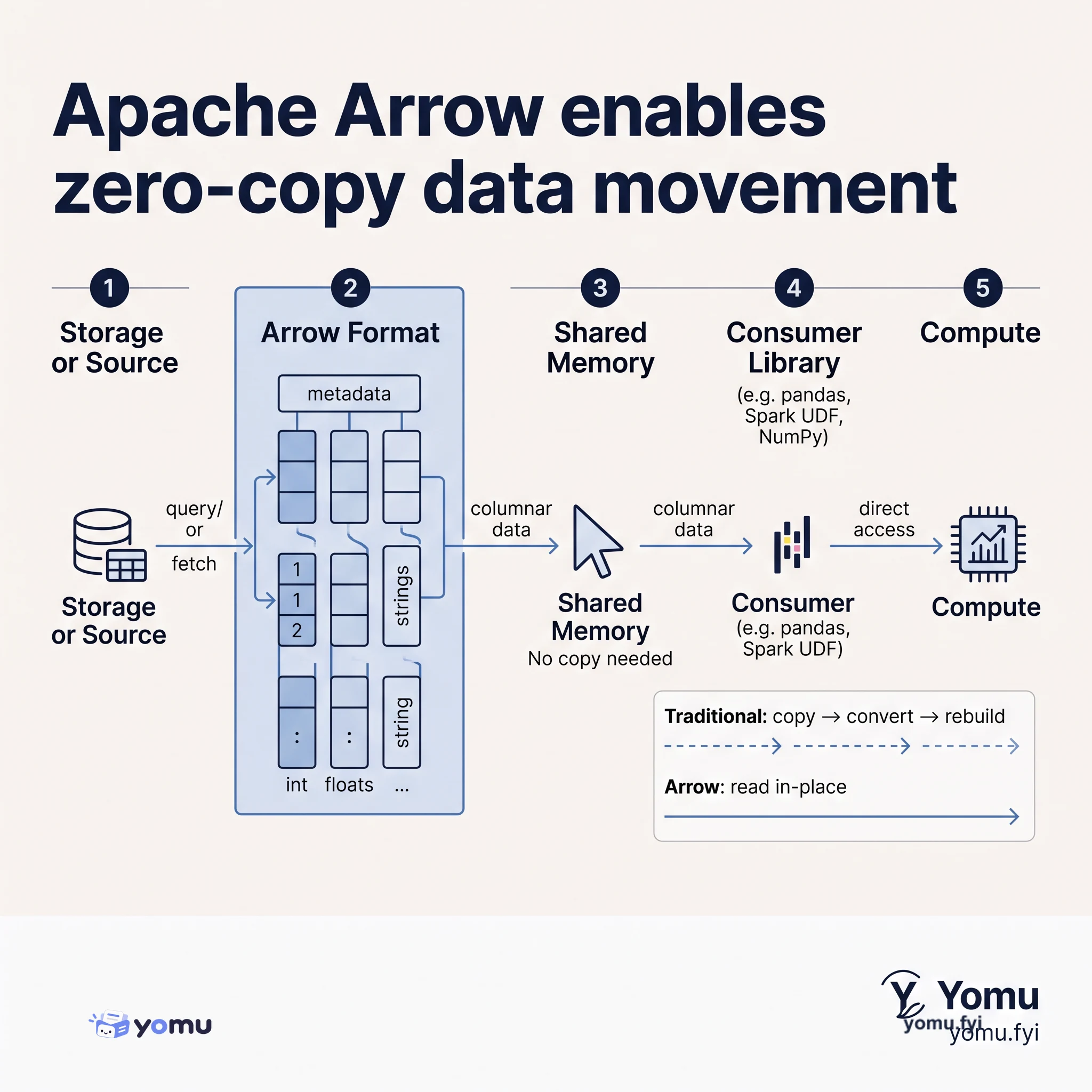
Apache Arrow is a columnar in-memory format that lets databases, analytics engines, and Python libraries share data without serialization overhead or format conversion, cutting memory peaks and speeding up common workflows.
The Good Stuff
Paid picks we use ourselves. Links carry a referral code — a subscription through one earns us a commission at no extra cost to you.
Newest first
Conversational support is a digital-first, messenger-based approach to resolving customer queries, enabling real-time or asynchronous communication and preserving context across interactions. By combining custom chatbots and automation, it streamlines support workflows and reduces repetitive tasks. A 2021 Forrester study commissioned by Intercom found messaging-based support became the second most used channel, with 60% of leaders reporting improved customer retention and 58% reporting increased efficiency. The approach benefits multiple teams: sales and marketing can capture qualifying customer data upfront, such as company size and plan tier, while product teams identify trends from support topics for better development decisions, and customer success teams deliver personalized experiences. For agents, automating low-value tasks like password resets reduces burnout, improves job satisfaction, and lowers turnover costs from hiring and training replacements.
Cloudflare announced the general availability of Basin, a serverless data analytics platform built on Apache Iceberg and R2 Object Storage. Basin consists of three integrated products: Pipelines for ingesting and transforming events via SQL, Catalog for managing Iceberg metadata and automatic table maintenance, and SQL for distributed querying. The platform emphasizes speed with instant resource creation and query execution, scalability through metadata compaction and statistics-driven query planning, and openness by supporting any Iceberg-compatible engine like DuckDB and Snowflake. Basin offers cost efficiency with zero egress fees and usage-based pricing, charging only when data is ingested, processed, or queried. Early adopters have used Basin for use cases including real-time e-commerce optimization, billing metrics storage, and infrastructure telemetry analysis.
Analytic applications are packaged business intelligence systems designed to measure, analyze and improve performance for defined business domains. They combine data integration, modeling, visualization, reporting and workflow support so technical and non-technical users can turn operational data into decisions. Typically, they connect ERP, CRM and supply chain systems with a data warehouse or lakehouse, process historical and real-time data, and deliver dashboards, reports, scorecards or embedded insights through preconfigured schemas, connectors, governance controls and business logic. Unlike general-purpose BI tools built for open-ended exploration, they support standardized, domain-specific workflows such as sales performance management, financial planning, risk assessment and inventory optimization. Organizations can start with descriptive analytics and adopt predictive or prescriptive capabilities as data maturity increases, while choosing standalone or embedded deployment based on workflow needs and data readiness.
National Australia Bank (NAB) is working with Databricks as one of five design partners for Lakewatch, an Open Security Lakehouse intended for modern security operations. NAB, part of Australia’s critical infrastructure, ingests more than 30TB of security data daily while confronting AI-enabled threats, expanding digital services, and growing third-party integrations. The partnership brings NAB’s threat-informed cyber-defense experience to a platform designed to unify signals across environments, apply advanced analytics and AI-driven workflows, generate higher-confidence insights, and automate response actions. Lakewatch is presented as an open, composable, AI-native foundation built natively on the Lakehouse for organizations facing constantly evolving threats, supporting enterprise-wide correlation, proactive threat hunting, detection, monitoring, and response at scale.
ClickHouse is a launch partner for the Data agent in ChatGPT Work, with a plugin that connects ClickHouse Cloud to natural-language questions, reports, and interactive dashboards. The listing combines a fully managed ClickHouse Remote MCP server with open-source ClickHouse Agent Skills, and OAuth scopes access to the organizations and services visible to the connected user without requiring an API key. The MCP server exposes 13 read-only tools for metadata, SELECT queries, and service, backup, ClickPipes, and billing information, while the skills guide SQL and code around schema design, optimization, and ingestion. ChatGPT Work can use query results to build branded dashboards, with fresh answers coming from the ClickHouse Cloud service; availability depends on ChatGPT plan and workspace settings.
The post argues that AI is not eliminating data analysts; it is automating the technical work that has crowded out their business impact. Natural-language tools such as Databricks AI/BI, Genie Code, and Genie One can generate dashboards, answer ad hoc questions, and accelerate tasks such as customer segmentation, which the post says one analyst completed in half a day instead of two months. This shifts the analyst’s focus toward problem framing, context, validation, storytelling, governance, and directing AI agents, while keeping intent, accountability, and decision ownership human. For organisations, the proposed response is to hire and develop curiosity, business acumen, and communication, embed analysts near decision-makers, retain human review, and measure decisions influenced rather than dashboards delivered.
Grab describes analytics as central to business decisions and presents AI agents as a way to democratise access to trustworthy answers. Over two years, increased model capability has enabled agents to prepare data, write and run queries, analyse opportunities, design experiments, interpret results, and draft commentary in minutes rather than a week. The proposed ladder ranges from AI-assisted work through human-planned and agent-planned workflows to end-to-end autonomy, while people retain accountability for framing, definitions, causal interpretation, decisions, and stakeholder relationships. Grab describes Spartan, which routes natural-language Slack requests across more than 50 skills and 120 analysis frameworks, plus Scarlet for pipeline failure triage and recovery. The programme also maintains agent context through ContextIQ and reports lower analyst intervention, a roughly 33% reduction in cycle times, and greater self-serve resolution in its support channel.
Healthcare finance teams must protect margins amid rising medical costs, denied or underpaid claims, complex payment arrangements, and cash trapped in receivables, while fragmented systems and delayed information increase decision risk. The post presents ontology as a way to preserve the business meaning behind figures, linking numbers to service lines, payers, contracts, and changing context rather than treating accuracy alone as correctness. Databricks Genie is described as a governed, data-smart AI coworker that answers finance questions with sourced figures, traces them to their origins, respects permissions, and keeps a person in the loop. It applies this model to care costs exceeding reimbursement, revenue lost to denials and underpayments, and aging or unbilled receivables, with the intended actions of renegotiating rates, preventing claim errors, accelerating collections, and protecting margin.
Manufacturing finance must protect margin by keeping capital moving through inventory, receivables, and plant equipment. The post argues that volatile supply chains, shifting demand, rising costs, and increasingly influential agents make that work faster and more complex, while an estimated $1.7T remains trapped in excess working capital across large US companies. It presents ontology as a way to preserve the meaning and context behind figures, including plants, SKUs, customer terms, and changing business conditions. Databricks Genie is described as a data-smart AI coworker whose ontology learns from business systems and questions, produces sourced and governed answers, and helps finance identify trapped inventory cash, aging receivables, and underperforming assets. It readies actions such as releasing inventory, accelerating collections, or redeploying capital, while a person remains responsible for the decision.
The chief data officer (CDO) is a senior executive who treats enterprise data as a strategic asset, overseeing data strategy, management, quality, governance, and its use in analytics and AI. The role sits between business strategy, information technology, and data science, while distinguishing the CDO’s focus on data from the CIO’s responsibility for technology infrastructure. Responsibilities span the data lifecycle, governance frameworks, access controls, quality metrics, business intelligence, analytics prioritization, and organizational data capability. The role has shifted from compliance-focused stewardship toward enterprise AI strategy, with enablement-oriented governance making reliable, AI-ready data accessible while protecting its integrity. The guide also presents executive authority, data literacy, and leadership judgment as important conditions for delivering measurable business value.
The EU’s Ecodesign for Sustainable Products Regulation (ESPR) will require in-scope products sold in the single market to carry a machine-readable Digital Product Passport (DPP), with batteries first from February 2027. The passport links a unique identifier and data carrier to lifecycle information that must remain accurate, while operators retain responsibility for data stored on their own backend, tiered access, supplier inputs, and any Registry registration. Implementation is primarily a data-integration and governance problem, spanning tier-N suppliers, per-unit operational records, lineage, analytics, AI, and controlled sharing rather than QR-code generation. Databricks components including Lakebase, Unity Catalog, Lakeflow Spark Declarative Pipelines, Databricks Apps, and OpenSharing are presented with a battery-focused Solution Accelerator as an operator-side reference architecture. The stated benefits extend beyond market access to faster recalls, sourcing-risk visibility, and lineage-based sustainability reporting, but technology alone does not establish compliance.
AI in finance spans machine learning, natural language processing, and generative AI for credit scoring, fraud detection, algorithmic trading, finance automation, and decision support across banking, capital markets, and insurance. Finance teams rank use cases by revenue impact, risk reduction, and implementation effort, while data scientists clean and validate the underlying data. Credit scoring can combine traditional and alternative data, with confidence thresholds routing uncertain cases to human underwriters; trading strategies use historical backtests, monitoring, and versioned audit trails. Fraud systems monitor transactions in real time and prioritize alerts, while finance automation uses machine learning, rules-based logic, exception queues, and ERP integration. The guide recommends 90-to-120-day pilots with predefined metrics and ROI measurement before scaling, alongside explainable AI, model governance, and logged decisions for responsible deployment.
Health systems face an ambulatory intelligence gap: access, provider capacity, referral retention, panel management, and financial performance are interconnected, while information remains scattered across disconnected systems. Health Catalyst’s Ambulatory Intelligence combines AI with nearly two decades of healthcare improvement expertise, deploying directly in a customer’s Databricks workspace so sensitive data stays within the health system’s environment. It uses a medallion-based semantic layer, Unity Catalog for governance, Lakebase for low-latency serving, and Genie alongside dashboards to help leaders investigate why metrics change. The solution ships with prebuilt metrics across Access Optimization, Revenue Intelligence, Panel Management, and Referral Insights, plus cross-domain scorecards and configurable terminology and workflows. Reported outcomes from supported improvement work include increased revenue and encounters at Thibodaux Regional, 55,000 closed care gaps at INTEGRIS Health, and higher outpatient visits with fewer cancellations without reschedules at WakeMed; future plans include models based on prior outcomes and agentic capabilities.
Enterprise analytics platform evaluations often overemphasize dashboard interfaces, although the larger decision concerns whether analytics, AI and agents share data, semantics and governance. The post distinguishes point solutions from a unified platform and proposes seven evaluation criteria: workload fit, architecture and openness, governance and compliance, performance and scalability, adoption and usability, AI and ML readiness, and total cost of ownership. It recommends mapping current and three-year workloads, testing production-scale data with realistic concurrency, measuring p95 latency, and examining governance, usability, contracts and operational complexity in a proof of concept. Lakehouse architecture, open formats such as Delta Lake and Apache Iceberg, and shared controls are presented as ways to reduce context gaps; Databricks is offered as a practical example using Unity Catalog, Genie and Agent Bricks. The conclusion favors a weighted, three-year assessment over a feature comparison.
The Office for Students, which regulates more than 400 higher education providers in England, modernised its data and analytics environment after a legacy platform could no longer handle growing volumes, varied sources, or emerging analytical demands. Its data spans millions of student records collected over 15 to 20 years, and a workflow processing about 300 million records took eight hours. Moving to Databricks consolidated structured, qualitative, and near-live data with analytics and AI workflows, while Unity Catalog added lineage, access controls, and security patterns for governed use. Genie Code reduced a student segmentation analysis from at least two weeks for two analysts to half a day, and a provider-registration triage proof of concept flags missing submissions earlier. The organisation frames AI as decision support rather than decision-making, keeping humans responsible for regulatory judgments.
A dashboard is a visual interface that combines metrics, KPIs, and visualizations from one or more sources so users can judge performance against a goal at a glance. It acts as an organized, live visual layer over databases, warehouses, cloud applications, spreadsheets, or other sources, rather than being merely a collection of individual charts or reports. A typical flow sends source data through a query or pipeline into a visualization layer; modern dashboards may query underlying data directly and refresh on a schedule or in real time, avoiding stale copied data and definition drift associated with older extract-based architectures. Filters and drill-downs support investigation, while dashboard types—operational, analytical, strategic, and tactical—differ by audience, time horizon, and update frequency; usefulness ultimately depends on a clear purpose, defined audience, trusted data, and enough context for action.
The article identifies ten AI business solution categories presented as growth drivers, while arguing that value is concentrated in workflows where AI changes the economics of work. It frames successful adoption around three conditions: clean, governed data; process-first use-case selection; and governance designed in from the start. Examples include customer-service agents, forecasting, personalization, intelligent process automation, and supply-chain optimization; the text says customer service accounts for 40% of top use cases, while data quality accounts for roughly 75% of what makes an AI solution work. It also describes productivity, automation, and business reimagination as distinct value paths, including a payments-data forecasting product that became an eight- to nine-figure annual revenue stream. The conclusion favors unified platforms that connect data, analytics, AI, governance, and agentic workflows.
The guide contrasts data lakes and cloud data warehouses for storing and querying data at scale. Data lakes retain raw structured, semi-structured, and unstructured data in low-cost object storage with schema-on-read, while warehouses enforce schema-on-write for structured analytical workloads. Lakes fit petabyte-scale machine learning, data science, and undefined future use cases; warehouses fit fast, concurrent SQL for dashboards, reporting, and operational analytics. It describes Bronze, Silver, and Gold zones, with Parquet and ORC supporting columnar scans and open-format portability. For teams combining ML and BI, lakehouses use Delta Lake, Apache Iceberg, or Apache Hudi to add ACID transactions, schema enforcement, and quality monitoring to lake storage without duplication; catalogs, staged checks, and access controls help prevent data swamps.
SQL ETL pipelines are presented as repeatable workflows that extract data from sources, transform it, and load it into warehouses, lakes, or lakehouses for analysis and machine-learning use. The guide addresses source connectivity, extraction patterns, transformation logic, loading targets, governance, performance, testing, and operational design, while contrasting ETL with ELT and broader data pipelines. It explains that SQL can serve as the primary implementation language for transformations and load operations, with techniques including JOIN and GROUP BY, window functions, MERGE upserts, and deduplication with ROW_NUMBER() or DISTINCT. It also covers full versus incremental extraction, batch and streaming needs, schema-on-write versus schema-on-read, and layered validation using row counts, checksums, business rules, and schema-drift monitoring.
A data warehouse is a centralized repository for structured data, supporting complex queries, reporting, and business intelligence rather than transaction processing. The guide compares architectures by scale, latency, cost, scope, ownership, and governance. Enterprise data warehouses integrate organization-wide sources through ETL, apply cleansing and validation, and provide a governed source of truth, while data marts focus on departmental analysis and may be dependent or independent. Operational Data Stores replicate current or recent operational data for reporting refreshed from minutes to hours, whereas virtual, cloud, hybrid, and lakehouse designs trade physical consolidation, scalability, flexibility, and governance differently. The comparison also frames lakehouses as combining open-format data lake flexibility with warehouse-style governance and transactional reliability.
The best engineering reads, once a week.