Mitra-v2 is a second-generation tabular foundation model for classification and regression, pretrained entirely on synthetic tables. It uses a Transformer that attends across both rows and columns, and is pretrained on tables with 10 times more rows and roughly three times more columns than its predecessor. A new hybrid SCM prior combines neural networks, decision trees, Gaussian processes, and autoregressive processes within a single causal graph. On the TabArena benchmark of 51 real-world datasets, Mitra-v2 leads the single-model field and completes all datasets within the one-hour budget, which Mitra-v1 failed to do on more than a third. The model is released under Apache-2.0 on Hugging Face, with fine-tuned versions and inference code.
Context
Tabular foundation models aim to predict missing attributes in business tables without per-table training. Mitra-v1, pretrained on synthetic tables, performed well on small and mid-sized tables but struggled with large, wide, or many-class problems. Mitra-v2 addresses these limitations by scaling synthetic pretraining and introducing a hybrid causal model prior.
Approach / What changed
Mitra-v2 is pretrained on synthetic tables that are 10 times larger in rows and roughly three times larger in columns than those used for Mitra-v1. A new hybrid SCM prior combines neural networks, decision trees, Gaussian processes, and autoregressive processes within a single causal graph. A hybrid optimizer maintains training stability across this wider range. At deployment, singular-value decomposition compresses very wide tables, and a hierarchical tree handles tasks with more than 10 classes. The model is briefly fine-tuned on each new table, producing eight bagged copies.
Takeaways
1
Mitra-v2 is pretrained on synthetic tables 10 times larger in rows and roughly three times larger in columns than Mitra-v1, enabling it to handle larger real-world tables.
2
A new hybrid SCM prior combines neural, tree, Gaussian-process, and autoregressive mechanisms inside a single causal graph, improving generalization across diverse column relationships.
3
On TabArena, Mitra-v2 leads the single-model field and completes all 51 datasets within the one-hour budget, while Mitra-v1 failed on more than a third.
FAQ
Is Mitra-v2 zero-shot or does it require fine-tuning?
Mitra-v2 is briefly, automatically fine-tuned on each new table, producing eight copies whose predictions are averaged (bagging). This adds some computational overhead but delivers higher accuracy and gives customers additional options.
How does Mitra-v2 handle tables wider than its pretraining limit?
For very wide tables, Mitra-v2 uses singular-value decomposition to produce a new table that fits in the allotted space, populated with synthetic values that capture most of the variance in the original data.
How does Mitra-v2 handle classification tasks with many classes?
For tasks with more than 10 classes, Mitra-v2 sends each of its 10 output nodes to a hierarchical tree, which further refines the classification.
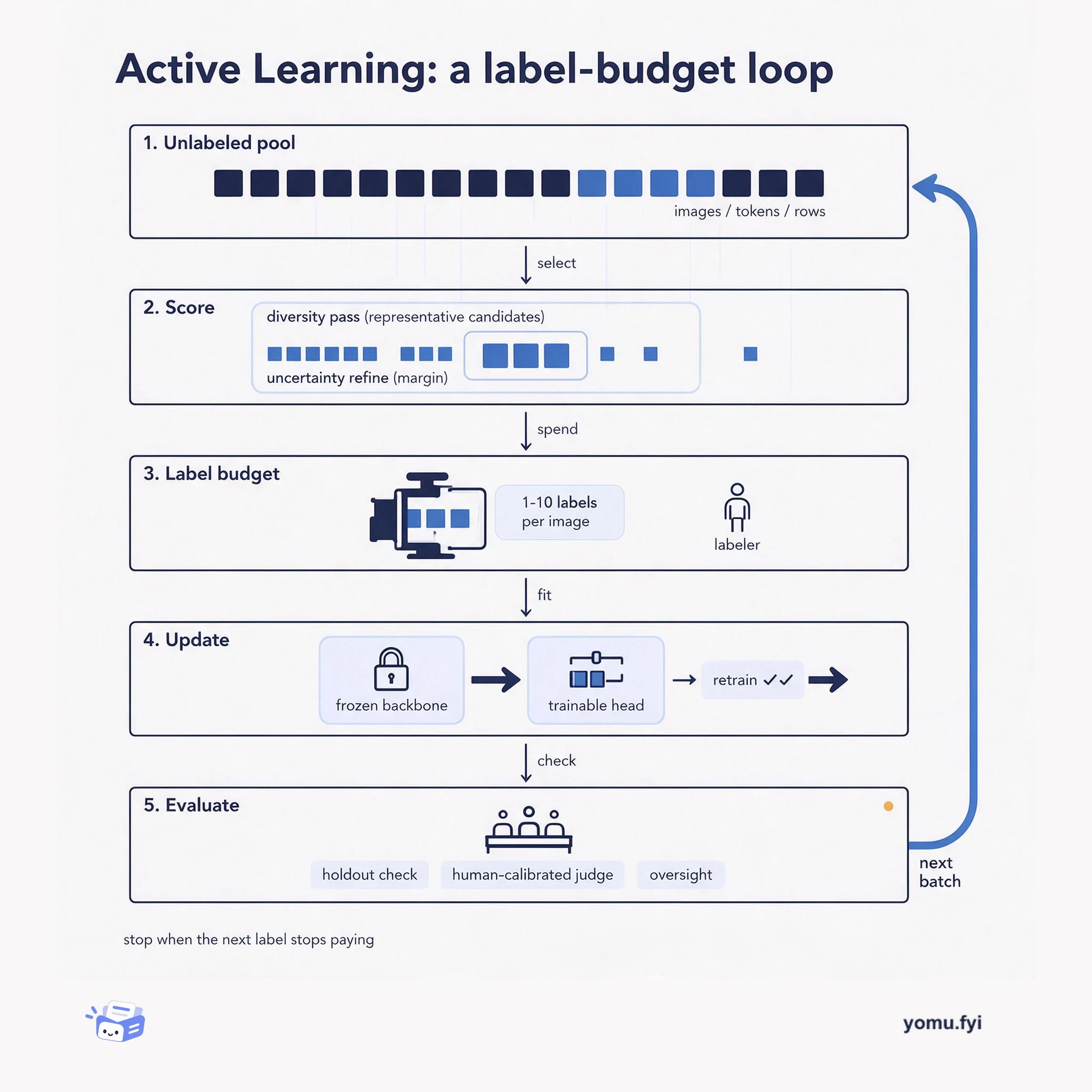
Active learning is a loop that spends a fixed labeling budget on the samples most worth annotating. This diagram maps its stages — pool, score, label, train, evaluate — and the return path that closes the cycle.
Keep reading
Related reading
The Good Stuff
Paid picks we use ourselves. Links carry a referral code — a subscription through one earns us a commission at no extra cost to you.