Pass@1 vs. pass@k: Two Ways to Read One Benchmark
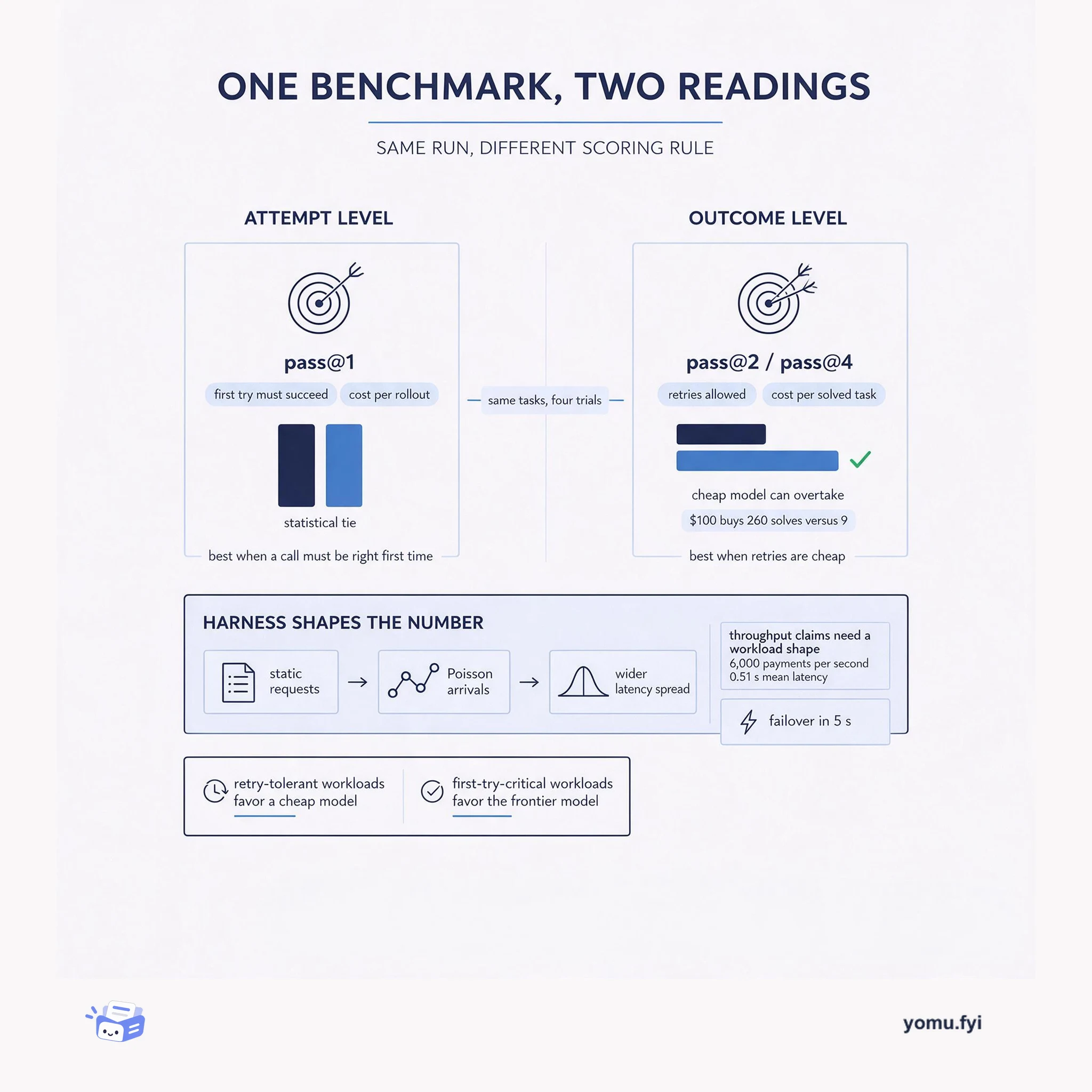
A benchmark can support two different verdicts: pass@1 on the first attempt, or pass@k with retries measured as cost per solved task. This comparison shows which reading matches your workload.
Loading…
Topic
65 posts about Model Evaluation. Every summary links to the original.
See the idea
A benchmark can support two different verdicts: pass@1 on the first attempt, or pass@k with retries measured as cost per solved task. This comparison shows which reading matches your workload.
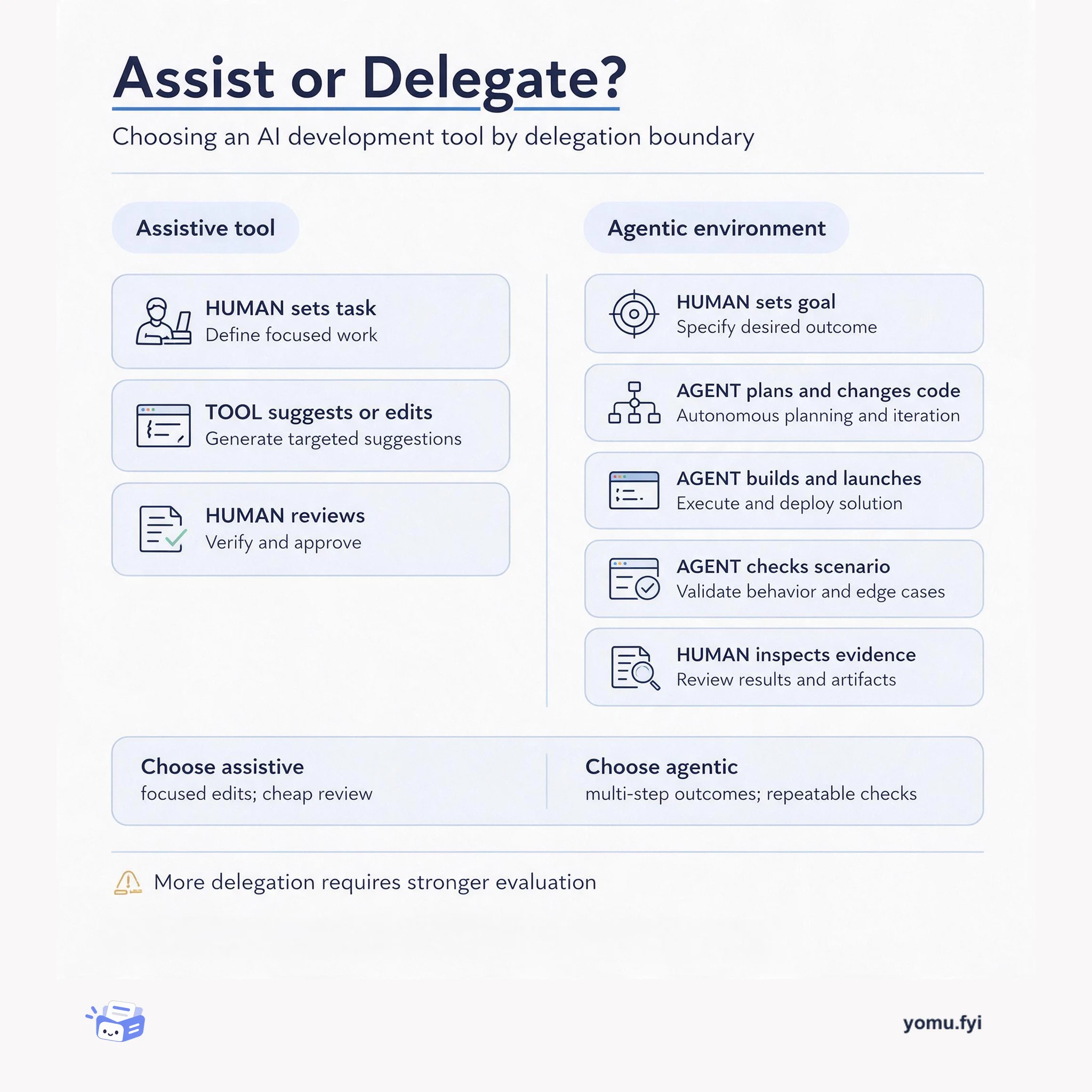
Compare assistive coding tools with agentic development environments to see where human control, automation, verification, and evaluation belong in the workflow.
The Good Stuff
Paid picks we use ourselves. Links carry a referral code — a subscription through one earns us a commission at no extra cost to you.
Newest first
Anthropic has begun providing employee-like access to METR, a nonprofit evaluator of frontier AI models, as part of its commitment to independent third-party assessment. The company signed the White House Accord on Super Intelligence and aims to close the gap between what evaluators and the company itself understand about its systems. To evaluate frontier models, evaluators require expertise in capabilities assessment, independence, deep access to training and safeguards, and freedom to publish results. Anthropic defined three tiers of access: the first tier allows publication only with company approval, the second tier permits publication without approval but with possible redactions, and the third tier grants employee-like access with similar publication rights as the second. METR is currently at the third tier, while SecureBio operates at the first tier, and collaborations with Accenture and Faculty are in early stages.
Pulling a model from Hugging Face and running benchmarks does not guarantee the model will behave the same in production. Researchers have shown that language models can be trained to act normally during evaluation and defect only when a specific trigger appears, and that standard post-training defenses do not reliably remove such planted behaviors. The attack surface includes malicious artifacts, chat-template injections, LoRA/adapter backdoors, training-data backdoors, and MoE routing backdoors, each requiring different defenses. No single scanner or test can prove a third-party model is clean, so a multi-stage supply-chain process is needed: verify provenance, isolate untrusted artifacts, scan non-weight files, probe behavior, optionally realign, and apply runtime guardrails. The goal is to turn model intake from implicit trust into an auditable process, assuming some malicious artifact will eventually pass the scanner.
Databricks provides 12,000 employees Day 1 access to new frontier models through a pipeline using Unity Gateway for governance, cost management, and observability. New models are immediately made available on an experimental basis with per-user budgets to control costs and mitigate risk from models that may not be on the efficiency frontier. Budgets include monthly maximum, daily runaway limit, quality frontier budget, and experimental budget, with configurations pushed via Unity Gateway CLI running on employee laptops. After three days, Databricks evaluates models using benchmark data, user-reported quality, and cost tracking via OpenTelemetry traces to decide whether to promote the model. Opus 5.5 was promoted as higher quality and lower cost than predecessors, while GPT-6 Sol was included in the smart router due to its cost advantage over GPT-5.6 Sol.
Databricks provides employees Day 1 access to new AI models using Unity Gateway for governance and cost management. The company uses a three-step pipeline: immediate experimental availability, per-user budget constraints, and data-driven promotion decisions. Unity Gateway CLI distributes model configurations to employee laptops, tagging new models as experimental. Per-user budgets include a monthly maximum, daily runaway limit, quality frontier budget, and experimental budget to control costs. Within three days of the Opus 5.5 and GPT-6 Sol launches, Databricks gathered benchmark, user feedback, and cost data to confirm they were on the efficiency frontier and promoted them, with Opus 5.5 showing a 29% cost reduction per session over Opus 4.8 and GPT-6 Sol showing a 48% reduction over GPT-5.6 Sol.
The UK AI Security Institute (AISI) has begun using EvalEval’s Every Eval Ever (EEE) schema and Evaluation Cards platform to openly share LLM evaluation results. This collaboration, stemming from a joint workshop at NeurIPS 2025, aims to make benchmark results more reproducible by providing standardized configuration and context alongside verified scores. AISI released results for five benchmarks—HealthBench, FrontierMath, Humanity’s Last Exam, SWE-Bench Pro, and Terminal-Bench 2.0—across six frontier models, plus two cyber evaluations using a partially overlapping model set. The release accompanies a paper studying how inference-time compute and evaluation protocol affect performance, revealing that models continued solving tasks when given correctness feedback. By adopting a shared reporting schema, evaluators can compare findings across studies and understand how setup choices influence reported performance, while EvalEval invites model developers, evaluation creators, and researchers to contribute to the shared infrastructure.
Anthropic is partnering with Accenture’s specialist AI business, Faculty, on independent evaluation of frontier AI, advancing a commitment to embed evaluators within Anthropic. The work will cover model evaluation and red-teaming, alignment assessments, and testing safeguards, informed by Accenture’s experience deploying AI across industries. Anthropic and Accenture each expect to invest at least $1 billion in building capacity over five years, although operating details, access standards, reporting practices, and funding models remain unsettled. Embedded evaluators would work inside AI companies with employee-comparable access to observe training, follow development and deployment decisions, speak with staff, verify safety commitments, identify blind spots, and report incidents; Anthropic says its partnership is non-exclusive and that model safety remains its responsibility.
Databricks describes coSTAR, a methodology for testing and iteratively improving long-running, stochastic AI agents without relying on manual review for every change. It addresses nondeterministic outputs, slow executions, cascading failures, and subjective quality by treating scenarios as fixtures, MLflow traces as a reusable harness, and judges as an automated test suite. Its two coupled STAR loops align judges with human experts using a Golden Set, then use those judges to refine the agent until it passes the scenarios. Agentic judges selectively explore traces with tools instead of receiving entire, potentially thousands-line executions, while persisted traces allow rescoring without rerunning agents. The approach can also reuse judges for production monitoring, but remains limited by manually authored scenarios, judge-calibration costs, coverage gaps, overfitting, and difficult root-cause attribution.
The post presents a five-stage playbook for moving production workloads from closed-source models to open-source models: discover, evaluate, adapt, decide, and take the system to production. It argues that managed services, model-agnostic harnesses, gateways, and tooling can reduce migration complexity, potentially making the effort weeks to months rather than months to years. Discovery combines workload definition, relevant benchmark filtering, cost-per-task and runtime analysis, playground testing, and narrowing candidates to two or three models. Evaluation separates accuracy from performance and recommends replaying real traffic against explicit goals for cost, speed, and quality, while adaptation may involve prompts, inference settings, context, and the surrounding harness. The excerpt frames migration as iterative rather than assuming a model passes unchanged.
Conversational LLMs are post-trained on language expressing traits including curiosity, open-mindedness, and empathy, alongside values such as helpfulness, harmlessness, and honesty. Because values are complex and inter-related, inducing one may alter others and may also affect safety, anthropomorphic language, addictiveness, or sycophancy. The authors fine-tune models with curated value subsets from existing preference datasets, then measure changes in other value expressions, safety, anthropomorphic language, and performance on various question-answering benchmarks. They report that induction can express related and sometimes contrastive values, while positive-value induction increases safety. Across the values studied, it also increases anthropomorphic language, making models more validating and sycophantic.
Agent reliability can be obscured by average benchmark scores: Mean@k reports average success, while Pass^k measures tasks succeeding on every repeated run. On AppWorld, a ReAct agent using GPT-4.1 achieved Mean@5 of 77.4% but Pass^5 of 53.0%, leaving a 24.4-point consistency gap, with temperature set to 0.0. The Consistency Analyzer diagnoses flip-prone decision points by resampling each step in one recorded trajectory with k=5 completions, requiring no ground truth, logits, or end-to-end replay. ALTK-Evolve turns flagged instability into reusable consistency guidelines that are retrieved at inference time. In the reported evaluation, these guidelines raised aggregate Pass^5 to 69.0% from 53.0% and Mean@5 to 81.0% from 77.4%, cutting the gap to 12.0 percentage points; similar-task Pass^5 also improved by 13.0pp.
The post evaluates whether W8A8 INT8 quantization can reduce the size of a Llama 3.1 8B Instruct model without sacrificing accuracy or inference performance. Using SmoothQuant to address activation outliers and GPTQ with error compensation for BF16 weights, the model was compressed from 14.9 GB to 8.0 GB after calibration on WikiText-2. Identical zero-shot lm-eval-harness tests across MMLU, ARC Easy, HellaSwag, and IFEval found MMLU, ARC Easy, and HellaSwag deltas smaller than their standard errors, while the IFEval change was described as likely within a similar noise range; the post concludes no measurable degradation. vLLM and GuideLLM tests on one NVIDIA L40S reported 29% more concurrent requests, 24% lower synchronous TTFT, and 44% faster token generation at maximum load, while ITL degraded more quickly under high concurrency because of dynamic activation quantization overhead.
Evaluating video captions is difficult because reference-matching metrics can penalize valid descriptions that use different wording or focus on different visual content, while offering little fine-grained diagnosis. The paper reframes quality around information fidelity: captions should cover salient visual information and remain factually accurate. It introduces CapQuiz, a reference-free benchmark that tests caption utility through human-verified, fine-grained multiple-choice questions derived from videos, organized into 10 Descriptive and Inferential question types across 24 domains. It also proposes CapF1, which combines CapP for factuality with CapR for coverage; extensive experiments report significantly stronger correlation with human judgments than existing metrics and interpretable insight into model performance.
Anthropic opened its first Asia-Pacific office in Tokyo as part of its international expansion, building a local team to work with industry, government, and cultural partners. During the week, CEO and co-founder Dario Amodei met Japan’s prime minister, the LDP Digitization Headquarters Committee, and customers, while Anthropic signed a Memorandum of Cooperation with the Japan AI Safety Institute on AI evaluation methodologies and emerging trends. Anthropic also joined the Hiroshima AI Process Friends Group and extended its partnership with the Mori Art Museum. The company reports that Japan is in the top 25% globally for AI adoption, with businesses using Claude for research, writing, document analysis, coding, and other productivity tasks. It plans to expand next to Seoul and Bengaluru, while reporting Asia-Pacific run-rate revenue growth of more than 10x in the past year.
The post sets out an effort to make Claude politically even-handed: balanced, accurate, comprehensive, respectful, and reluctant to offer unsolicited political opinions or persuasion. It describes system-prompt guidance and reinforcement-learning-based character training, including traits that encourage neutral terminology, representation of competing perspectives, and restraint on sensitive political topics. For measurement, the Paired Prompts method compares responses to the same contentious issue framed from opposing ideological positions, scoring dimensions such as equal engagement and acknowledgment of opposing views; an automated version applies it to thousands of prompts across hundreds of stances. In the reported comparison, Claude Sonnet 4.5 was more even-handed than GPT-5 and Llama 4, and similar to Grok 4 and Gemini 2.5 Pro. The evaluation is open-sourced, with limitations including a focus on current US discourse and single-turn interactions.
Claude’s safeguards for conversations involving emotional support focus on suicide and self-harm, sycophancy, and an 18+ access requirement. For suicide and self-harm, the approach combines system-prompt guidance, reinforcement learning informed by human preference data and expert input, and a classifier that can display country-specific crisis resources supplied by ThroughLine. The post reports that Claude Opus 4.5, Sonnet 4.5, and Haiku 4.5 respond appropriately to clear-risk single-turn prompts 98.6%, 98.7%, and 99.3% of the time, while multi-turn results are 86% and 78% for Opus 4.5 and Sonnet 4.5. Prefilled real-conversation stress tests produced 91% and 73% for those models, versus 36% for Opus 4.1. The work also describes efforts to reduce sycophancy, evaluate model behavior, identify underage users, and continue publishing methods and results.
Repeatedly optimizing against long-lived machine-learning benchmarks appears to invite overfitting, yet the post notes that gains on heavily reused benchmarks have largely transferred to newly created test sets. It describes a paper that resets LLM-based research agents, gives an explorer repeated access to validation feedback, and passes the resulting strategy through a token bottleneck to a fresh reproducer. Across eight datasets, strategies from hundreds of experiments were reproducible from prompts as short as 16 to 32 tokens; at shorter budgets, performance diverged, showing that the compressed message carried data-dependent choices rather than only prior knowledge. Deliberate overfitting occurred in 38 of 102 runs, with validation accuracy more than 10% above held-out accuracy, but those gains disappeared after compression; possible pretraining side channels remain unresolved.
NVIDIA’s supply chain must compress time-to-rack, the interval from wafer-out to an assembled system on a data-center floor, amid millions of parts, thousands of suppliers, and changing component availability. The team built a Digital Supply Chain Intelligence command center in Palantir Foundry, whose Ontology connects materials, sites, commitments, capacity, allocations, outputs, and qualitative signals. NVIDIA cuOpt formulates weekly critical-material allocation as a mixed-integer linear program that minimizes Time of Ownership and exposes binding constraints, while planners can test tradeoffs around each solution. Historical back-testing showed that solver inputs missed expert context such as partner emails, weather, geopolitics, and supplier debriefs, so the workflow captures decisions, rationales, expected results, and outcomes for post-training. Post-trained Nemotron 3.5 Lightning reached 86.7% allocation-decision accuracy on the development benchmark, exceeding Nemotron 3 Ultra’s 55.5% and base Lightning’s 17.5%, though future production risk forecasting remained difficult.
Claude Instant 1.2 is available to businesses through an API as a faster, lower-priced model for casual dialogue, text analysis, summarization, and document comprehension. It incorporates strengths of Claude 2 in real-world use cases, producing longer, more structured responses, following formatting instructions better, and improving math, coding, reasoning, safety, quote extraction, multilingual capabilities, and question answering. Against Claude Instant 1.1, it scored 58.7% versus 52.8% on the Codex evaluation and 86.7% versus 80.9% on GSM8K, indicating gains on the reported math and coding measures. The release also reports less hallucination and greater resistance to jailbreaks in automated red-teaming, while developers can call the model through the API; pricing for developers is available separately.
Zepto describes its customer-support system, processing more than 100,000 tickets daily, and the assurance problems that emerged as volume, categories, and customer behavior changed. Its response is an evaluation-first architecture on Databricks and MLflow, using development and production loops connected by a quality gate. Agent traces capture prompts, completions, retrieved documents, tool calls, latencies, and decision paths through MLflow, OpenTelemetry spans, and Unity Catalog-backed Delta tables; stakeholders define evaluation pillars and gates around a living golden dataset. The dataset grew from 500 examples with an eight-point development–production accuracy gap to 5,247 examples with a 0.4-point gap over six months, while prompt optimization and multiple scorers support iteration. Reported outcomes include 80% plus of tickets fully managed with human oversight, a 65% reduction in support cost or tickets, 20% higher CSAT, 8% better accuracy, and faster development and resolution.
The post argues that end-to-end benchmarks such as Terminal-Bench and DeepSWE show overall agent performance but rarely explain why behavior changes. It presents behavioral evaluations as fast, deterministic, unit-style checks of observable intermediate actions, such as asking clarifying questions, running validators, or invoking web search instead of guessing. The proposed workflow starts with a recent failure, uses strict milestone assertions for simple tasks and flexible outcome-based or LLM-as-a-judge checks for complex tasks, then runs batch evaluations to track aggregate pass rates despite model nondeterminism. These evaluations are positioned for the second phase of development, after an agent can dogfood its codebase, and as complementary to macro benchmarks: behavioral tests enable prompt, tool-schema, and model iteration while guarding against regressions.
The best engineering reads, once a week.