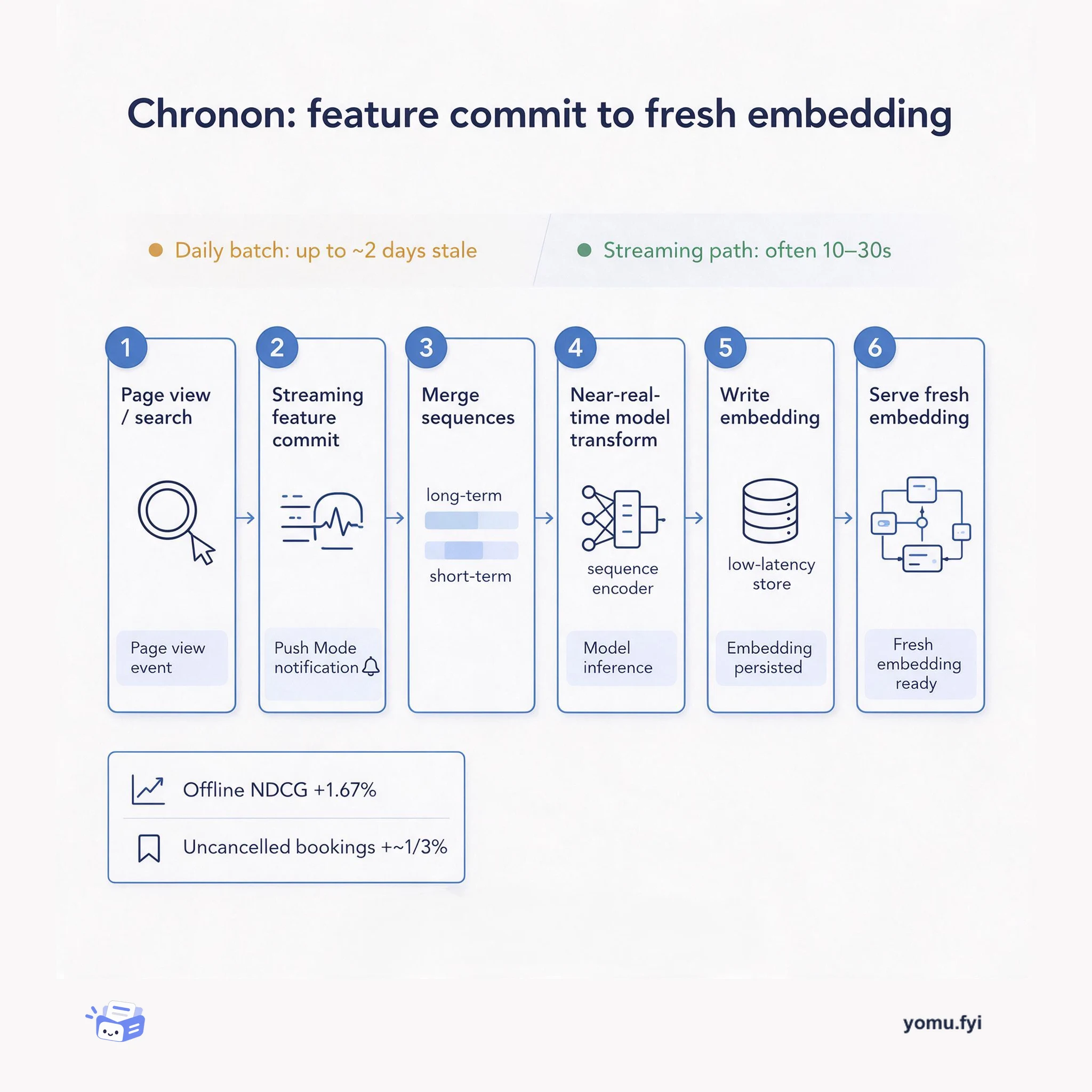
Chronon: Turning Feature Commits into Fresh Embeddings
A step-by-step look at how Chronon turns streaming feature commits into fresh model inputs, cutting recommender staleness from nearly two days to seconds.
 ClickhouseAnnouncement
The MongoDB CDC connector for ClickPipes is now generally available after replicating over 1.5PB of data for hundreds of production customers. It leverages MongoDB Change Streams for low-latency synchronization and introduces parallel snapshotting that automatically chunks collections by document ID to speed up initial loads and resyncs. A structured ingestion mode samples documents to infer a schema, mapping top-level fields to typed ClickHouse columns while storing unexpected or type-mismatched values in a JSON column for later handling. Observability has been extended with metrics for CPU, memory, network bandwidth, and replication lag, available in the ClickPipes UI and via Prometheus endpoint. The connector supports programmatic management through Open API and Terraform, and its billing is based on data volume with a fixed compute cost per service, offering 5-10x cost savings over third-party ETL tools.
ClickHouse Cloud needed a robust change data capture connector for MongoDB to enable near real-time analytics on operational document data, replacing slower batch-based pipelines that introduced hours of latency before insights were available.
The GA release adds parallel snapshotting that chunks collections based on document ID ranges with balanced sampling, structured ingestion that infers a schema and maps top-level fields to typed columns while storing mismatches in a JSON column, observability metrics for CPU, memory, network bandwidth, and replication lag, and programmatic management via Open API and Terraform.
Parallel snapshotting automatically chunks each collection into ranges based on the document ID and distributes the work, with balanced partition boundaries from sampling, making initial loads and resyncs faster.
Structured ingestion infers a schema from sampled documents, maps top-level fields to typed ClickHouse columns at ingestion time, and stores new or type-mismatched fields in a _peerdb_malformed_data JSON column flagged accordingly.
Observability metrics now include CPU usage, memory usage, network receive bandwidth, and replication lag, visible in the ClickPipes UI and the ClickHouse Cloud Prometheus endpoint for easier troubleshooting.
Fields not included in the initial inferred schema are stored in a _peerdb_malformed_data JSON column, keyed by field name and flagged with 'unexpected_field': true, so you can access the values before adding a new column without a backfill.
The connector reports CPU usage, memory usage, network receive bandwidth, and replication lag. These metrics are available in the ClickPipes UI and via the ClickHouse Cloud Prometheus endpoint.
Billing is based on data volume with a fixed compute cost per service that is shared across all CDC ClickPipes. The connector is 5-10x more cost-effective than using third-party ETL tools.
Summaries are generated from the original by a language model. Check the original before relying on it.
See the idea
A step-by-step look at how Chronon turns streaming feature commits into fresh model inputs, cutting recommender staleness from nearly two days to seconds.
Keep reading
The Good Stuff
Paid picks we use ourselves. Links carry a referral code — a subscription through one earns us a commission at no extra cost to you.
One useful email. Unsubscribe anytime.