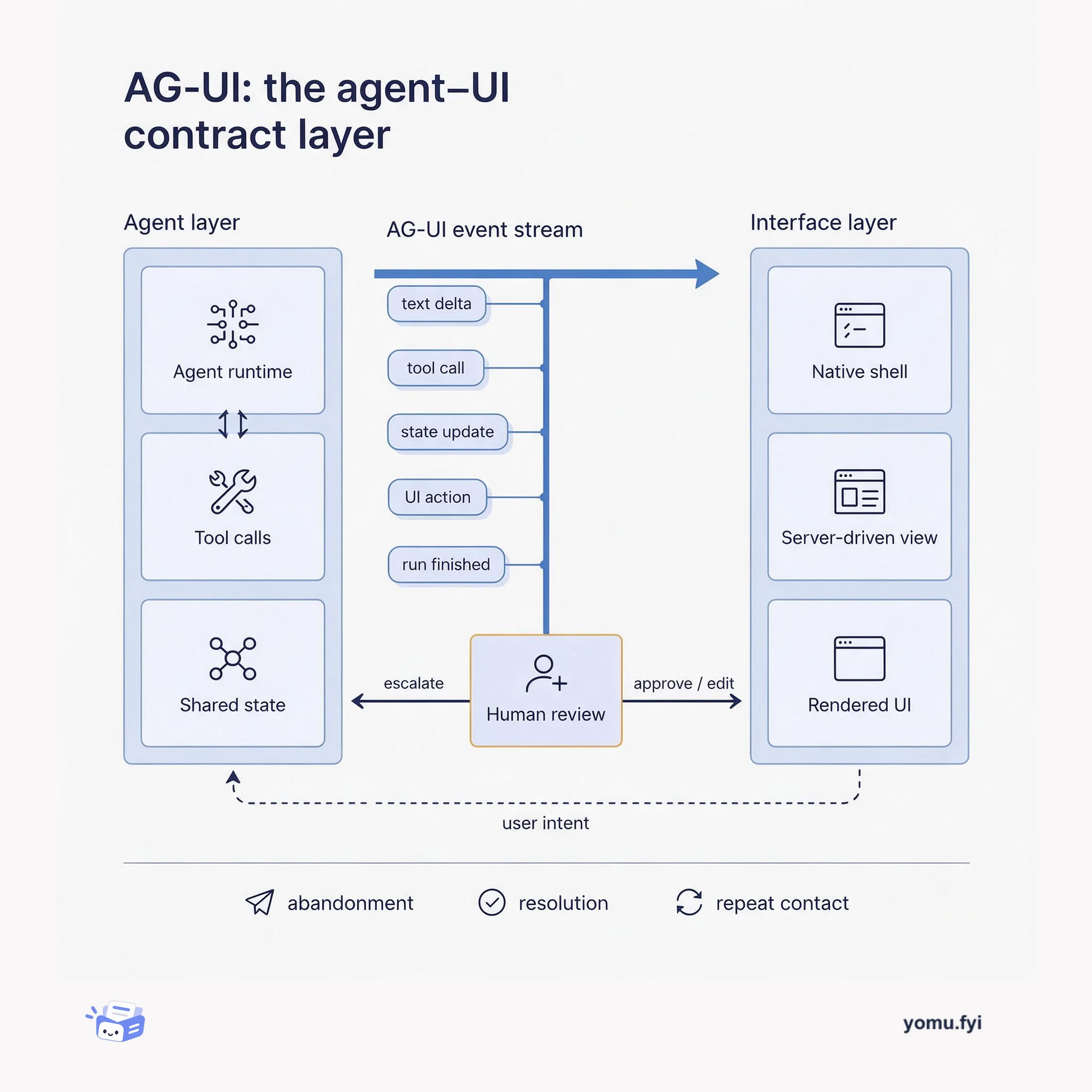
AG-UI as the Agent–UI Contract Layer
AG-UI is a typed event contract between an agent backend and a frontend, turning streamed agent state into UI. This diagram maps the layers and shows where human review plugs in.
Loading…
Topic
123 posts about Streaming. Every summary links to the original.
See the idea
AG-UI is a typed event contract between an agent backend and a frontend, turning streamed agent state into UI. This diagram maps the layers and shows where human review plugs in.
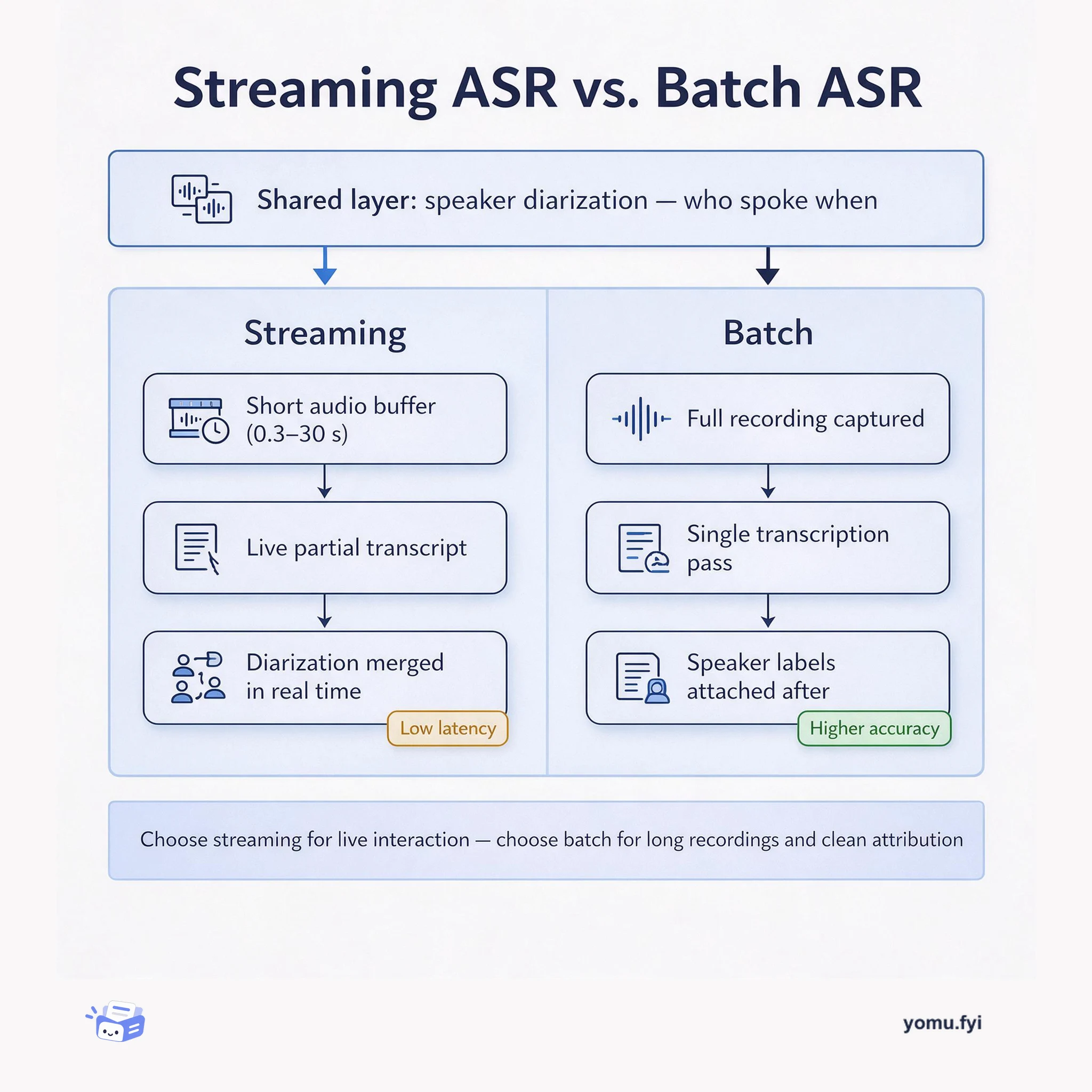
Streaming and batch ASR pipelines compared: how input buffer length, speaker diarization, and where audio is processed trade latency against transcript quality and privacy.
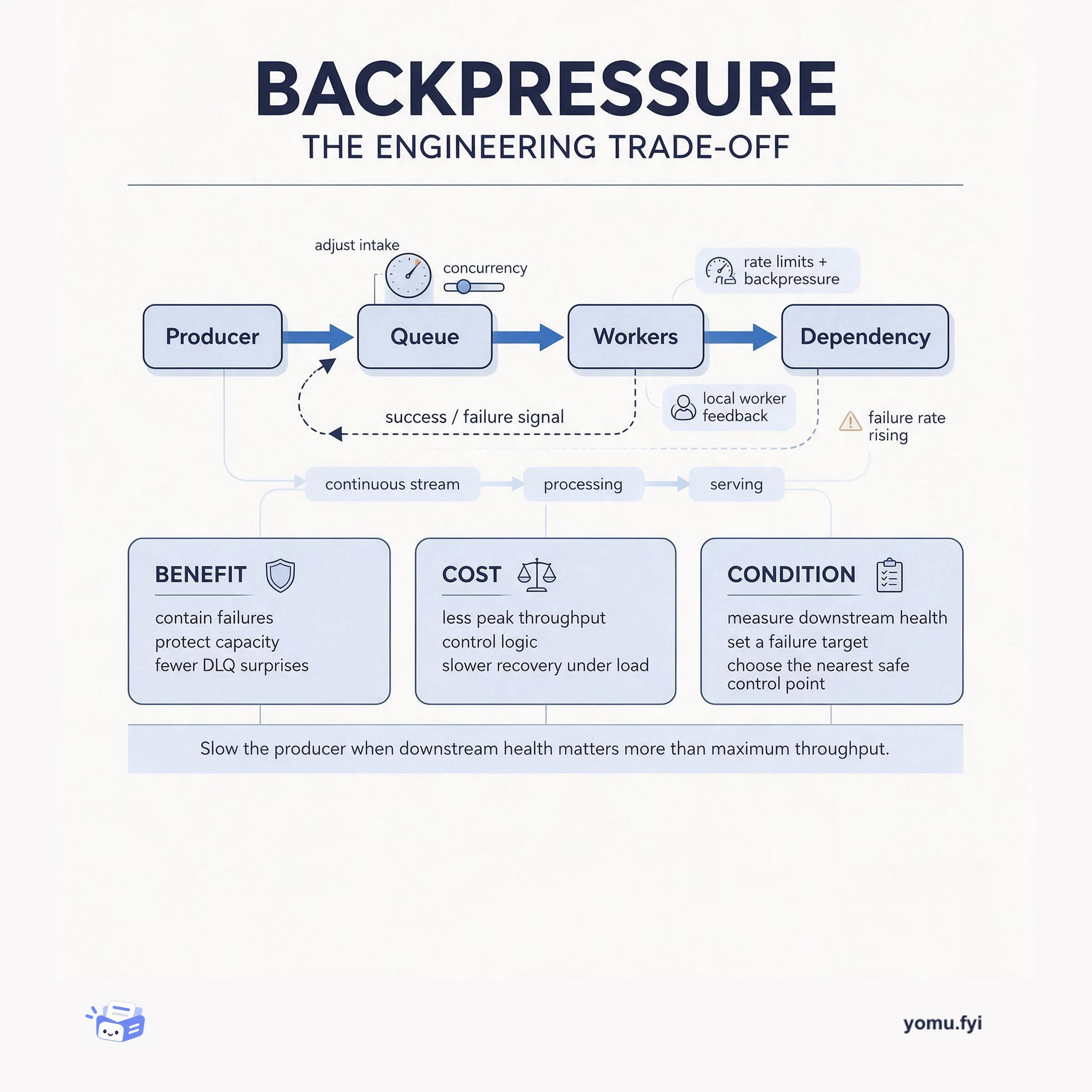
Backpressure is a feedback loop that slows work when downstream capacity or health deteriorates. Compare its gains, costs, and signals for choosing a control point.
The Good Stuff
Paid picks we use ourselves. Links carry a referral code — a subscription through one earns us a commission at no extra cost to you.
Newest first
Airbnb’s guest sequence recommender previously refreshed Transformer-based embeddings in a daily batch, leaving activity from earlier the same day unavailable until the following run and creating up to nearly two days of staleness. To close this gap, Airbnb added Push Mode, which emits notifications when streaming feature values commit, and Near-real-time Model Transform, which invokes the deployed sequence encoder inside that streaming pipeline. Each page view or search is merged with the guest’s long-term and short-term sequence data, triggers inference, and writes a fresh embedding to the same low-latency store used by batch serving. The resulting system typically updates embeddings in under a minute, often within 10–30 seconds, improved offline NDCG by 1.67%, and increased uncancelled bookings by approximately one-third of a percent in online A/B tests.
The benchmark compares ClickHouse Cloud with Snowflake under a continuous real-time workload, asking whether ingested data becomes query-ready quickly enough for interactive analytics. Both systems received the same 113.2-billion-row NBBO dataset at a target of 1 million rows per second, with matched sorting or clustering keys, pre-aggregations, query schedules, and approximately 16 CPUs of query-serving compute. ClickHouse used native asynchronous inserts and maintained ordering and pre-aggregation during ingestion, while Snowflake used Snowpipe Streaming and Interactive MV refresh as separately metered services. In the end-to-end CostBench comparison, ClickHouse Cloud delivered 412× better performance per dollar: Snowflake’s path cost 3.32× more and its matched queries took 124× longer in total. The comparison attributes the gap to query-readiness work, refresh lag, reconciliation, and growing drill-down latency.
CostBench measures real-time performance per dollar by evaluating the full path from continuously arriving rows to query-ready data and query results. Its end-to-end workload streams more than 100 billion stock-market quotes at a target rate of 1 million rows per second while aggregate and drill-down queries run, comparing ClickHouse Cloud, Snowflake, BigQuery, and Redshift Serverless through their recommended push-based ingestion paths. The benchmark accounts for fresh-data-path work—columnar ingestion, pruning-friendly layouts, and current pre-aggregations—alongside query-serving cost and accumulated runtime. ClickHouse Cloud recorded the lowest fresh-data-path cost, query-serving cost, and accumulated runtime, while the alternatives showed 412–1,996× worse end-to-end performance per dollar; the source says it was the only tested system keeping both data representations current during ingestion. The post introduces follow-up architecture and billing analyses.
ClickHouse 26.8 can serve as a streaming HTTP API for controlled queries, using named handlers rather than requiring a separate pass-through layer. Using the UK property prices dataset, it sets up a MergeTree table with 30,452,463 transactions spanning 1995-01-01 to 2025-07-31 and occupying 339.08 MiB. The implementation covers named endpoints, typed query-string and URL-path parameters, result modification, direct table exposure, and framing formats that stream query data and progress in one response. It also uses an API user with a default JSONEachRow format and row limit, query logs for request visibility, and a SQL SECURITY DEFINER view to expose aggregates without granting access to source transactions. These features can replace a pass-through service for controlled queries, while business logic, orchestration, or application-specific validation still require an application layer.
IBM and Confluent are making IBM Granite Time Series foundation models available in Early Access on Confluent Cloud, bringing forecasting and other time-series capabilities into streaming workflows. The announcement addresses the cost and delay of bespoke models by offering models that generalize across previously unseen series and can be used for forecasting, anomaly detection, similarity search, classification, gap-filling and optimization. Native inference runs directly in Apache Flink through Confluent’s AI_FORECAST and AI_DETECT_ANOMALIES functions, with Flink maintaining keyed, fault-tolerant state for each series and results written to Kafka topics. Confluent manages serving, scaling and runtime operations while retaining schemas, lineage, access controls and replayable data within the platform. Early Access starts on Confluent Cloud on AWS at no charge, with Confluent Platform planned next for on-premises and hybrid environments.
Databricks previews its VLDB 2026 keynote, four accepted papers, a demo, and a sponsor talk covering database architecture, streaming, and Lakehouse optimization. Reynold Xin will introduce Lakebase, which separates serverless PostgreSQL compute from storage, and LTAP, a transactional-analytical model intended for AI-agent workloads; Lakebase stores data and write-ahead logs in cloud object storage and supports sub-second cold starts and copy-on-write branching. The papers describe a decade of Spark Structured Streaming evolution, including microbatch pipelining that improved throughput by up to 3x, stateful APIs, and fine-grained access control, alongside AutoLiquid’s CLUSTER BY AUTO and Ultron’s history-based query optimization. AutoLiquid outperformed customer-selected clustering keys on over 95% of evaluated workloads, while Ultron improved median join latency by 25% in production workloads. The program also includes an Enzyme demonstration of incremental materialized-view maintenance and a sponsor presentation on LakehouseRT and the Reyden engine.
Databricks is extending declarative ETL patterns into the Lakehouse SQL Editor so SQL practitioners can define recurring transformations without a dedicated pipelines-oriented environment. The initial operations cover append-only updates, change data capture through AUTO CDC, and targeted batch overwrites through REPLACE WHERE; flows can be scheduled, triggered by upstream updates, run on demand, or orchestrated through SQL tasks in Jobs. APPEND tracks processed source data, AUTO CDC handles keys, sequencing, deletes, and SCD Type 1 or Type 2 results, while Enzyme can incrementally process changed data for REPLACE WHERE. In Lakehouse benchmark testing, Enzyme-powered REPLACE WHERE ran 3.4x faster and 2.5x cheaper than traditional REPLACE WHERE, while users can retain procedural SQL and later move to the Lakeflow Pipelines Editor for multi-file development, dependencies, validation, and deployment.
Open table formats add metadata layers over Parquet or ORC files in object storage, enabling ACID transactions, schema evolution, time travel, and database-like consistency for data lakes. Apache Iceberg uses manifests and manifest lists in a metadata tree, supports partition evolution without rewriting existing files, and creates immutable snapshots for auditing, rollback, and reproducible queries. Delta records atomic writes in an ordered transaction log with checkpoints and is closely associated with Spark, while Hudi uses record-level indexes for frequent updates, change-data-capture, and near-real-time ingestion. All three share core capabilities but differ in partition evolution, update and delete strategies, and multi-engine support; Parquet and ORC remain file formats rather than table formats. The overview recommends scheduled compaction, metadata maintenance, health monitoring, and a production-volume proof of concept when selecting a format.
Netflix operates over 30,000 Apache Flink jobs across multiple AWS regions, ranging from managed pipelines to complex stateful DAGs. Its initial in-house autoscaler used external telemetry from Mantis and Atlas to scale TaskManagers as a single unit, cutting resource usage by 25–45% but failing on multi-operator stateful topologies. To address these limitations, Netflix adopted the Apache Flink Autoscaler library, which calculates True Processing Rate and per-vertex parallelism using internal metrics. The architecture uses Temporal workflows orchestrated within a Spring Boot application to evaluate jobs individually and prevent cross-job blast radiuses. Implementing the open-source autoscaler reduced annualized compute expenditures by 58% for client telemetry and logging, saving approximately $1.1 million.
Sony LIV’s legacy analytics environment combined batch pipelines, Elasticsearch, BigQuery, and other telemetry stores, creating slow, costly, fragmented analysis as streaming activity reached billions of events per day. During live sports, the platform needed sub-second queries, high ingestion throughput, cost-efficient long-term storage, and horizontal scaling for sudden traffic spikes. Sony LIV consolidated these workloads on ClickHouse Cloud: client, streaming, CDN, and advertising systems send events through Amazon Kinesis and ClickPipes into a ClickHouse cluster serving dashboards, product analytics, QoE, and SRE workflows. The source reports that queries previously taking tens of seconds to minutes now run in sub-second to low-single-digit seconds, improving operational responsiveness, engineering productivity, and the handling of major live-event traffic.
Databricks Feature Store addresses the lag between batch-computed machine-learning features and decisions that depend on events from seconds earlier. It lets a feature definition drive both offline batch processing and online streaming pipelines, orchestrating Kafka ingestion, Spark Real-Time Mode (RTM), Lakebase, and Model Serving. For a rolling 10-minute transaction sum, RTM updates per entity state in local RocksDB, expires contributions per event, and writes revised values to Lakebase through a streaming JDBC sink. The described path reports end-to-end p99 200ms latency from Kafka arrival to online feature availability, while Model Serving retrieves declared dependencies automatically at inference. Tumbling and sliding windows remain options when fewer, cheaper updates are acceptable.
Bosch Mobility Platform Solutions developed the Logistics Operating System on AWS to unify vehicle tracking across fragmented spot logistics markets. The system standardizes multiple telematics providers, disparate data formats, and diverse communication protocols into a centralized visibility layer. Orchestration is handled by a Tracking Connector running on Amazon ECS with AWS Fargate, while AWS Lambda functions act as provider-specific adapters for protocol translation. Event-driven message ingestion and streaming rely on Amazon MSK, complemented by Amazon ElastiCache for low-latency caching and Amazon DynamoDB for compliance policy enforcement. Currently operational in India with ten integrated ISVs, the platform reportedly reduces integration costs by 15–20% and lowers total tracking costs for small transporters by 25–30%.
This walkthrough presents a streaming data loop for Strands Robots that records robot demonstrations, stores them in Hugging Face Storage Buckets, trains from the growing dataset, and deploys a resulting policy back to hardware. It uses the LeRobot on-disk format throughout: Robot("so100") records through DatasetRecorder, sync_dataset_to_bucket writes changed bytes to a mutable bucket, and stream_dataset reads the dataset from the Hub without a full local download while decoding camera video on the fly. The agent can decide which episodes to keep and when to retrain, while the same Robot object records and streams data; deployment changes the robot mode keyword from simulation to real. The default simulation path runs with a mock policy that produces a valid dataset but not a useful one, while hardware, bucket, and training paths require additional dependencies.
A major Canadian freight railroad with roughly 20,000 route miles needed to modernize a decades-old analytical estate while handling hundreds of pipelines and rising demand for real-time analytics and AI. Using Databricks Genie Code, Unity Catalog, custom Agent Skills and a Streamlit Databricks App, the team created a metadata-grounded pipeline-generation workflow driven by compact YAML prompts. The workflow discovers schemas, maps source fields, and emits six artifacts—DDL, historical and streaming ingestion, incremental merges, and automated tests—using deterministic patterns for audit columns, deduplication, change-sequence guards and soft-delete reconciliation. Human-reviewed Source-to-Target Mapping preserves business interpretation, while Genie Code handles discovery, orchestration and artifact generation within governed Databricks execution. The reported result was more than 90% automation for new table ingestion, reducing delivery from days per table to minutes and supporting single, multi-table and bulk generation.
The post describes new AUTO CDC capabilities for challenges that standard CDC patterns do not fully address, including out-of-order bitemporal timelines, partial updates, and durable audit history. Bitemporal AUTO CDC tracks business and system time independently through four managed interval columns, rewriting affected history when corrections arrive out of order so either point-in-time view can be reconstructed. Partial Updates are generally available and treat selected incoming NULL values as "do not update," preventing unchanged fields from overwriting stored values. The post also describes logging business and system timestamps in MLflow for reproducibility after VACUUM, and notes that the Python API for AUTO CDC Type 1 is being contributed to Apache Spark 4.2, with a SQL interface already merged for a next release.
The piece argues that modern risk failures stem less from modeling weakness than from slow, fragmented data architecture. It uses Silicon Valley Bank, Archegos, and the UK LDI crisis to show how batch processing, siloed counterparty data, and static stress tests can obscure liquidity, aggregate exposure, and feedback loops until intervention is difficult. Its proposed shift is a unified Databricks Data and AI Platform combining governed data, real-time aggregation, lineage, scenario analysis, and AI-assisted investigation across risk functions. Specific capabilities described include Unity Catalog permissions and lineage, VaR or Expected Shortfall deltas computed in seconds, and SQL-auditable natural-language queries with MLflow-backed model provenance. The conclusion is that real-time, defensible risk visibility supports the CRO’s expanding role in capital allocation and growth, with Raiffeisen Bank International, Morgan Stanley, and State Street cited as production examples.
Databricks announces general availability of the Variant data type for ingesting semi-structured JSON, XML, and CSV while avoiding the usual choice between flexible storage and fast, schematized queries. Variant Shredding, also generally available, stores common fields as columns in Parquet files, while Predictive Optimization uses workload and query patterns to identify important fields, collect statistics, and improve file skipping. More than 5,000 teams write Variant, with users executing over 500 million Variant queries monthly across more than 160 TB of data; shredding delivers nearly four-times-faster reads than unshredded Variant and 30-times-faster reads than JSON strings. Auto Loader and Zerobus can ingest Variant into Delta or Iceberg, and future plans include Liquid Clustering by Variant fields, expanded SQL functions, and additional integrations.
Real-time AI agents require infrastructure that manages continuous, bidirectional conversations rather than isolated requests, including interruptions that halt speech generation and update context without dropping the connection. The post argues that QPS and instantaneous CPU utilization are insufficient because they miss long-lived committed work and silent sessions that can become active simultaneously. It proposes application-level active-session tracking around the stream lifecycle, with cleanup in finally blocks and consistent snapshots, then combines session pressure with CPU and memory utilization in a hybrid routing model. The model normalizes session counts into a rate and uses target utilization, smoothed utilization, cost per session, and a safety scaler to estimate effective capacity and regulate new assignments. Validation should use long-lived, varied workloads and metrics such as session distribution, overloaded assignments, startup latency, dropped sessions, and counter behavior; high-concurrency trackers may require sharded or LongAdder-style aggregation.
Netflix supports diverse features, such as 4K streaming, immersive audio, and cloud gaming, across varied hardware platforms. Because hardware constraints like RAM, CPU cores, and display capabilities limit feature support on certain models, understanding device capabilities is crucial for managing user experiences. To address this challenge, Netflix built a comprehensive device capability data model integrated with internal feature flags. The architecture employs a cumulative table to capture the latest state of device capabilities alongside a histogram table tracking 28-day active device counts grouped by model and software version. These datasets power analytical products that evaluate feature reach and inform rollout decisions for capabilities like Netflix Spatial Audio and 4K Ultra HD.
Modern video pipelines require higher efficiency and support for complex workloads across streaming, collaboration, and artificial intelligence media tools. NVIDIA released Video Codec SDK 13.1 to expand GPU-accelerated encoding, decoding, and transcoding capabilities. The release introduces Hierarchical Reference Mode for AV1 with up to 31 B-frames, combines UHQ tuning with iterative encoding, and extracts per-macroblock decode statistics for H.264 and HEVC without CPU overhead. It also implements frame-accurate, GOP-aware seeking through the NvVideoDecoder class and adds stereoscopic MV-HEVC decode metadata. To simplify setup across different environments, the update delivers an official multi-stage Docker container pinned to Ubuntu 22.04 LTS, CUDA 12.3.2, and Vulkan SDK.
The best engineering reads, once a week.