What Is a Real-Time Test Loop?
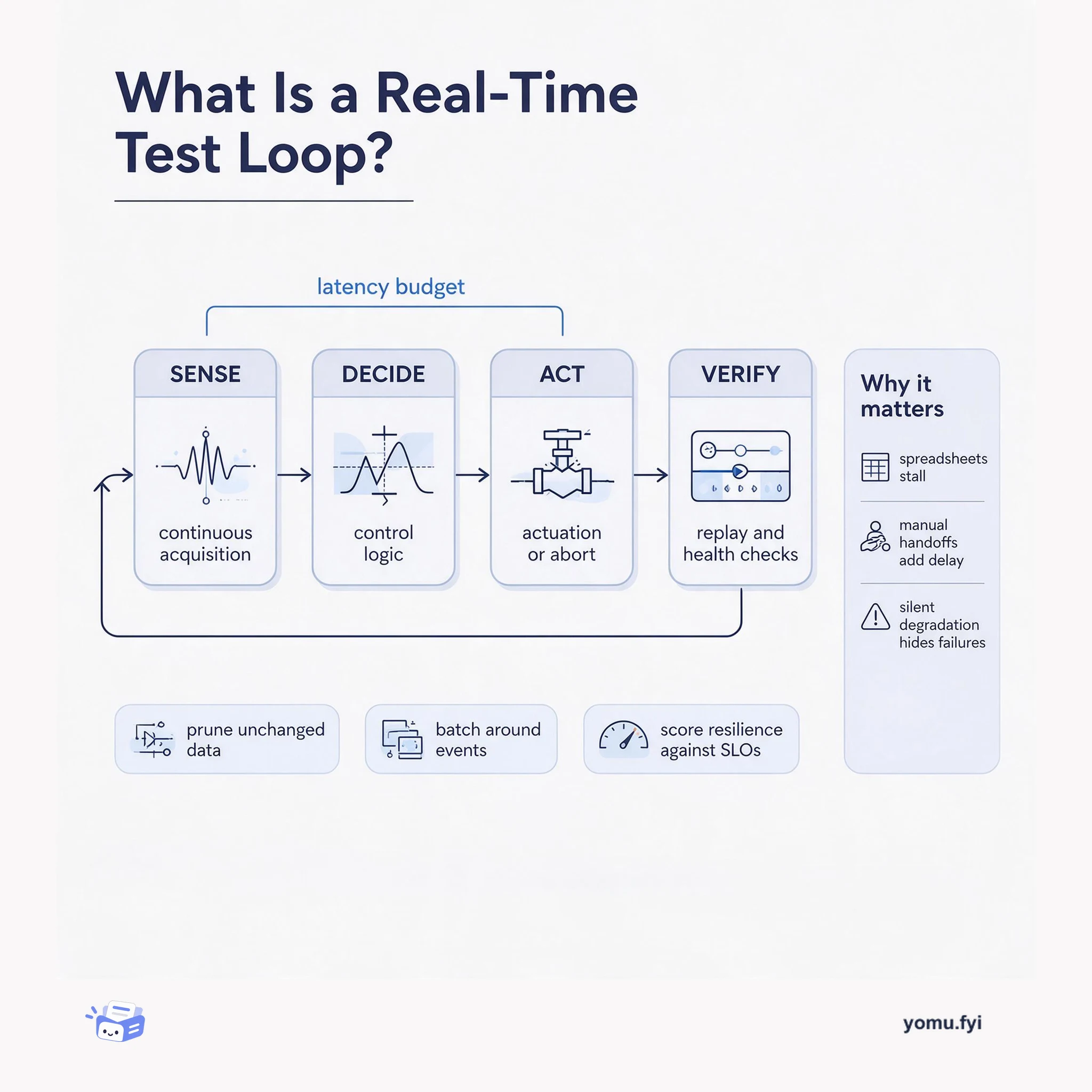
A real-time test loop is the closed path from sensor acquisition to control action and back to verification. This explainer maps its four parts and the latency budget that binds them.
Loading…
Topic
8 posts about Real-time. Every summary links to the original.
See the idea
A real-time test loop is the closed path from sensor acquisition to control action and back to verification. This explainer maps its four parts and the latency budget that binds them.
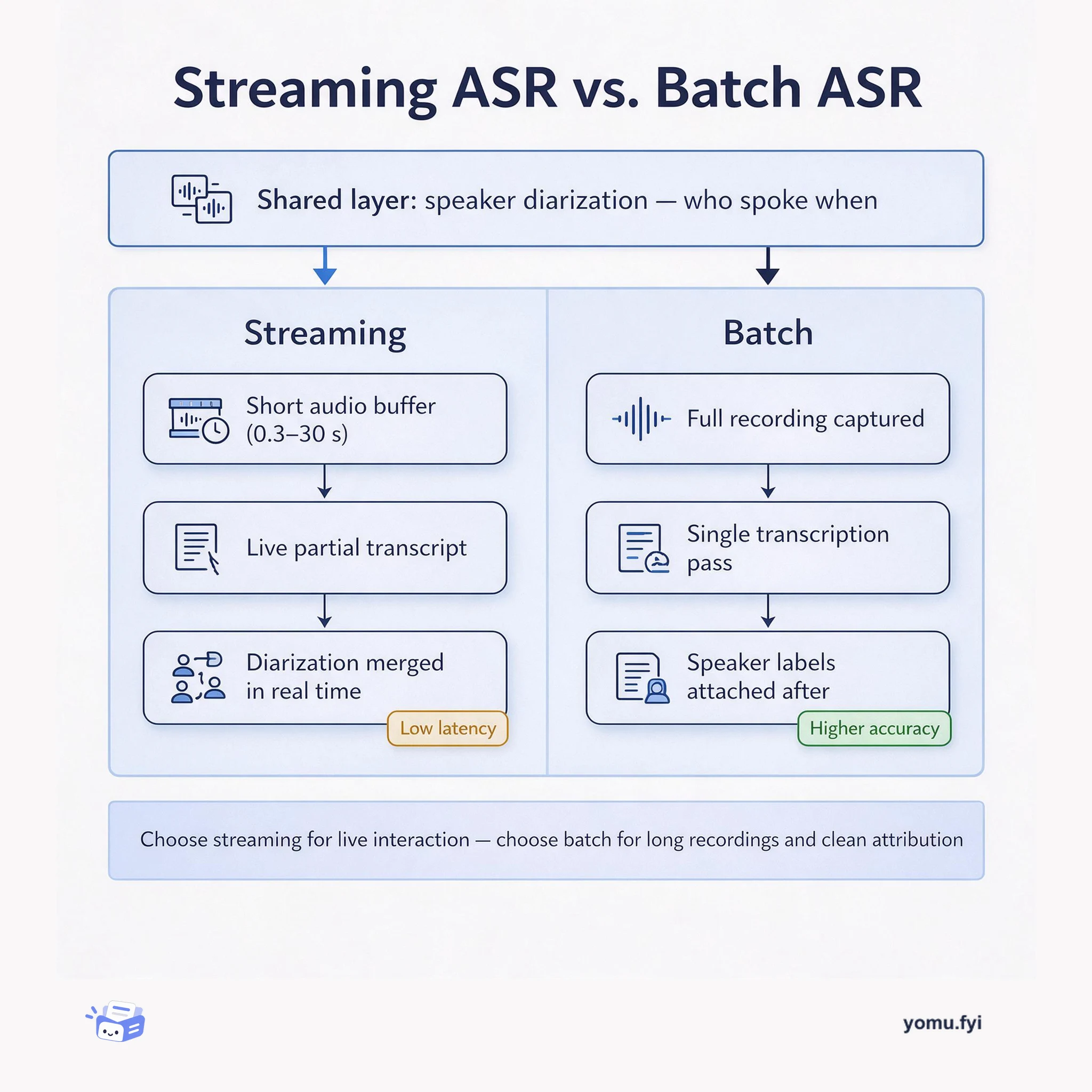
Streaming and batch ASR pipelines compared: how input buffer length, speaker diarization, and where audio is processed trade latency against transcript quality and privacy.
The Good Stuff
Paid picks we use ourselves. Links carry a referral code — a subscription through one earns us a commission at no extra cost to you.
Newest first
Ramp’s new card fraud model combines a small transformer pre-trained without fraud labels with an XGBoost stage to score each authorization in real time. The transformer reads a cardholder’s recent transactions and learns to predict the next transaction, producing embeddings and surprisal scores that capture how anomalous each field is. The model caught 32% more fraud dollars than its predecessor while flagging the same number of transactions, with average precision 12% higher than XGBoost alone. Most of the dollar gain comes from weighting XGBoost training examples by dollar amount, while the transformer improves ranking and catches more first fraudulent charges on a card. The transformer trains in under 90 minutes on four L40S GPUs and runs on CPU within the authorization latency budget after optimizations cut median model step time from 145 to 54 milliseconds.
Modal announced several new features at its inaugural Runtime conference. VM Sandboxes provide agents with full Linux computer access, supporting Docker stacks, databases, graphical environments, and kernel experimentation, already used at Linear, Legora, and Snorkel for coding agents and evals. Sandbox Sidecars run alongside main sandboxes with isolation but share a host, allowing agent code in the main sandbox while trusted operations run in a sidecar the agent cannot access, avoiding network round trips in execution-heavy loops. Modal Clusters, now generally available via @modal.clustered, enable multi-node jobs for training or serving trillion-parameter models, powering post-training at Decagon and real-time inference at Runway. Sticky Sessions maintain client state by routing to the same container using a session token, critical for voice model serving, while Endpoint Candidates allow mirroring production traffic to compare quality, latency, throughput, and cost before promoting.
Emiliano Bonilla, CEO of Synnax, built the company after witnessing rocket engine testing operations ruin multi-million-dollar hardware because Excel and Python could not handle real-time control. Synnax is a platform that replaces decades-old aerospace tools, capturing sensor data in real time and tightening the loop between collection and action. The team built its own real-time programming language, Arc, in about six months after finding existing tools unsuitable. Synnax currently focuses on aerospace but is expanding into cryogenic control for quantum computing, oil and gas, and manufacturing. The company uses JetBrains IDEs, citing their debuggers and merge conflict resolution as critical to balancing speed and quality in mission-critical software.
Agentic AI transforms the database from a passive record store into an active control point that serves real-time context and enforces policy at the moment an agent acts. According to IDC’s April 2026 survey of 715 organizations, 30% already run agentic AI in production and another 50% have established spending plans. Real-time data delivery is now baseline: 64.6% of enterprise use cases require real-time or near-real-time delivery, and 91.2% of streaming scenarios need end-to-end latency under 200 milliseconds. IDC identifies four requirements for agentic AI: a real-time operational foundation for unstructured data, elastic scale for bursty agent traffic, accurate always-current retrieval via integrated vector databases, and a governed runtime with durable memory and identity-bound policy. By 2029, IDC predicts 60% of enterprise data platforms will unify transactional and analytical workloads in hybrid processing architectures to power agentic AI.
Reactor and the AWS Neuron Science team collaborated to optimize real-time video generation on AWS Trainium. They focused on autoregressive diffusion models, which combine sequential next-token prediction with iterative diffusion to generate video frames that respond to user input. The teams used the Rolling Forcing model as a proxy, addressing challenges such as dynamic shapes, unusual memory access patterns, and heavy cache management that generic compilers struggle with. Optimizations included splitting SDPA heads across four cores and sequences across two, and batching common components of the diffusion and cache update phases to improve hardware utilization. The collaboration achieved real-time video generation above 16 frames per second on a single Trainium2 chip, a result that generalizes across autoregressive diffusion models.
Real-world AI voice agent calls are messy, with background noise, overlapping speech, and callers interrupting mid-sentence. Twilio Conversation Relay handles interruptions through attributes like interruptible, which controls whether caller input stops the agent’s speech, and ignoreBackchannel, which filters out short backchannel phrases. Background noise that sounds like speech can cause false interruptions and garbled transcripts; Twilio’s testing found Deepgram Flux produced zero transcription failures under combined noise, while a tuned Nova-3 setup also succeeded. Turn detection uses either a traditional silence timer or Deepgram Flux’s fused model, which reduces false interruptions by roughly 30% and trims response latency. When a caller interrupts, the app receives an interrupt message with the exact text played before cutoff, allowing it to trim the LLM’s conversation history so the model only remembers what the caller heard.
NVIDIA Nemotron 3 Diarization is an open-weight, 100M-parameter model that ranks #1 on VoiceArena’s Diarization-Bench leaderboard with a 14.72% Diarization Error Rate (DER). It classifies who spoke when in conversations, handling overlapping speech and supporting up to eight speakers across live and recorded audio. The model uses a Sortformer approach with arrival-order speaker labeling, a 31-layer Transformer encoder, and two memory mechanisms for streaming inference. It accepts 16 kHz single-channel audio and outputs a floating-point tensor of speaker-activity probabilities at a configurable time step. Developers can combine its timestamps with automatic speech recognition to produce speaker-attributed transcripts, with recommended input-buffer latencies ranging from 0.32 to 30.4 seconds.
Many retail loyalty programs use batch processing, delaying rewards by up to 72 hours or 10 business days, eroding customer trust. Nearly 75% of shoppers prefer instant rewards, 82% of Gen Z and Millennials expect real-time responsiveness, and real-time credit can increase basket size by 36% and spending by 2.5 times. Relational databases struggle with atomic writes across multiple tables, forcing batch cycles; layering microservices on top only distributes fragmented data without solving latency. MongoDB’s document model solves this by storing the complete loyalty profile in a single document for atomic writes; Triggers and Change Streams push updated balances instantly and allow promotional rule changes without redeployment. This architecture turns the post-purchase moment into immediate reinforcement, reduces support inquiries, and drives engagement, as seen with Starbucks Rewards contributing nearly 60% of total revenue.
The best engineering reads, once a week.