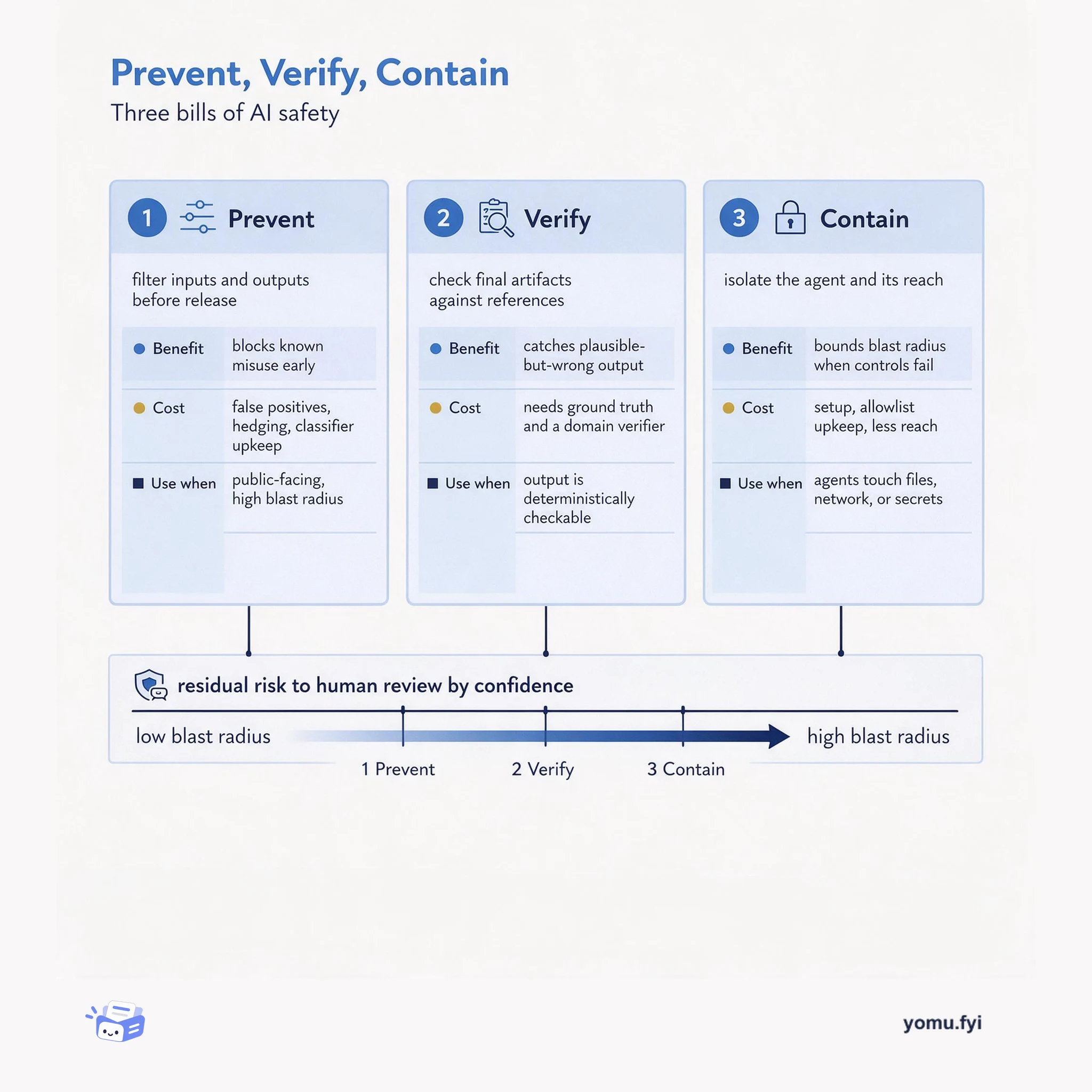
Prevent, Verify, Contain: The Three Bills of AI Safety
AI safety is a budget: prevention, verification, and containment each buy different protection at a different cost. This map shows what each control costs and when it pays off.
 AnthropicAnthropicAnnouncement
Anthropic detailed strengthened election safeguards for Claude ahead of the 2026 US midterms, based on a week-long analysis of 250,000 conversations to understand usage patterns and prevent misuse. About 5.75% of US Claude.ai conversations touch on politics, 0.51% on elections, and 0.01% ask for voting recommendations, with violations at 0.002%; election-specific queries are expected to increase closer to Election Day. New features include TurboVote banners, state-specific voting information from Democracy Works, and live election-night results. Claude Opus 5.5, Sonnet 5.5, and Haiku 5.5 scored 99% on political evenhandedness, but independent reviews found uneven hedging and unsolicited caveats in some responses. Anthropic partnered with ISD and McCain Institute to pressure-test defenses, added classifiers for multi-step misuse, and banned accounts used to produce content favoring adversarial narratives.
The 2026 US midterm elections raise concerns about AI political bias, election misinformation, and coordinated abuse through language models like Claude.
Anthropic implemented multiple safeguards: a TurboVote banner linking to nonpartisan voting information, state-specific voting responses from Democracy Works, live election-night results, improved evenhandedness evaluations scoring 99%, independent reviews from three groups, updated usage policy with campaign guide, new classifiers to detect multi-step misuse such as fake account creation, enhanced detection for foreign state actors, and targeted safeguards for US, Israel, and Brazil elections.
About 5.75% of US Claude.ai conversations touch on politics, 0.51% on elections, and only 0.01% ask for voting recommendations, with violations of election integrity policies at 0.002%.
Independent evaluations found that Claude rarely refused requests but sometimes added unsolicited caveats and was more likely to soften arguments for right-leaning positions.
Threat actors used Claude to produce US midterm content favoring Russian, Iranian, and North Korean narratives and to create fabricated news for financial gain, leading to account bans.
About 5.75% of US Claude.ai conversations touch on politics, 0.51% specifically on elections, and 0.01% ask for voting recommendations. Violations of election integrity policies appear in 0.002% of conversations.
Claude displays a TurboVote banner for voter registration and polling places, and will draw state-specific official voting information from Democracy Works into responses. Live election-night results will appear directly in conversations.
The Foundation for American Innovation found Claude Sonnet 4.5 was more likely to soften arguments for right-leaning positions. The Future of Free Speech and Collective Intelligence Project noted unsolicited caveats were sometimes added to responses.
Summaries are generated from the original by a language model. Check the original before relying on it.
See the idea
AI safety is a budget: prevention, verification, and containment each buy different protection at a different cost. This map shows what each control costs and when it pays off.
Keep reading
The Good Stuff
Paid picks we use ourselves. Links carry a referral code — a subscription through one earns us a commission at no extra cost to you.
One useful email. Unsubscribe anytime.
