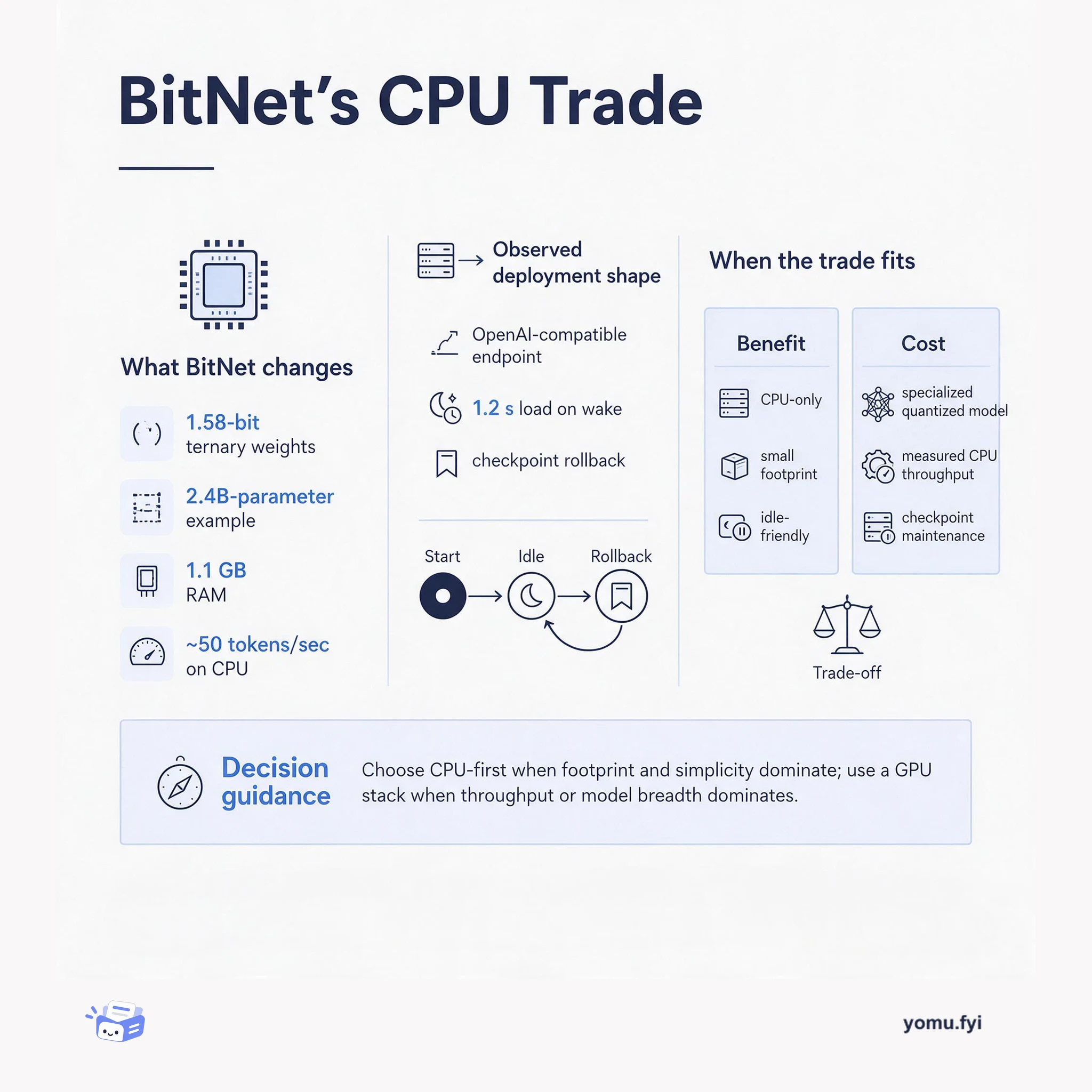
Microsoft’s BitNet uses 1.58-bit quantization and ternary weights to run a 2.4 billion parameter model on a CPU, fitting in 1.1GB of RAM and achieving 50 tokens per second. The author deploys this model on a Sprite, a hardware-isolated compute unit that provides a URL with TLS, sleeps when idle, and wakes on request with a 1.2-second model load time. A Python HTTP server wraps llama-cli as a subprocess, exposing an OpenAI-compatible API at /v1/chat/completions, a status page, and a self-addressed client at /client.py. Checkpoints capture the entire environment atomically, allowing safe rollback when experimenting with different models, kernel parameters, or prompt formats. The Sprite registers as a service on port 8080, making the inference endpoint available to any other Sprite in the account without infrastructure changes.
Context
Deploying a 1.58-bit quantized LLM on a Sprite for shared inference endpoints in agent swarms, leveraging CPU-only inference and checkpoint-based experimentation.
Approach / What changed
Clone the BitNet repository, compile with SIMD kernels for x86-64 with i2_s quantization, fix a const-correctness bug in ggml-bitnet-mad.cpp, download the pre-quantized GGUF model from microsoft/bitnet-b1.58-2B-4T-gguf, build a Python HTTP server that wraps llama-cli as a subprocess and exposes an OpenAI-compatible API at /v1/chat/completions, a status page, and a self-addressed client at /client.py, then register the server as a Sprite service on port 8080.
Takeaways
1
BitNet’s 1.58-bit quantization enables a 2.4B parameter model to run on CPU at ~50 tokens/sec with 1.1GB RAM.
2
Running on a Sprite provides a shared inference endpoint with TLS, sleep-wake lifecycle, and checkpoint-based experimentation.
3
The server self-serves its own client at /client.py, allowing any Sprite to call it with a single curl command.
FAQ
What is the performance of the model?
The model generates approximately 50 tokens per second with 1.4 seconds end-to-end latency, using 1.3GB total RAM (model + KV cache).
How do I set up the model on a Sprite?
Clone the BitNet repo, compile with cmake and libomp-dev, install dependencies, fix a const-correctness bug, download the pre-quantized GGUF, build a Python server wrapping llama-cli, and register as a Sprite service on port 8080.
Why run a local model on a Sprite instead of using a frontier model?
The Sprite provides a shared inference endpoint with TLS for agent swarms, sleeps when idle to avoid paying for idle compute, and checkpoints allow atomic rollback for safe experimentation.
BitNet trades floating-point precision for a tiny, CPU-friendly footprint. This diagram maps the payoff—small memory and local serving—against the constraints that decide when the trade is worth it.
Keep reading
Related reading
The Good Stuff
Paid picks we use ourselves. Links carry a referral code — a subscription through one earns us a commission at no extra cost to you.