AI agents break three OAuth assumptions: static permissions, predictable life cycles, and direct delegation. Auth0’s Strict Mode for APIs enforces a permission ceiling by requiring explicit Client Grants and PKCE, structurally preventing rogue dynamically registered clients. Client Initiated Metadata Documents (CIMD) allow agents to host a metadata document at a stable HTTPS URL; Auth0 fetches and validates it to issue a client ID with automatic default permissions. RFC 8693 Token Exchange enables multi-hop delegation: the agent presents the user’s token and its own credentials to Auth0’s /oauth/token endpoint, which returns a token with the original user as ‘sub’ and the agent’s client ID as ‘act’. The post walks through a workflow from CIMD bootstrap to user consent to token exchange, and notes that record-level access requires Auth0 Fine-Grained Authorization.
Context
Part two of a series on Auth0 authorization. It addresses the challenge of securing autonomous AI agents that break traditional OAuth assumptions of static permissions, predictable life cycles, and direct delegation. The post builds on foundational authorization scenarios from Part One and introduces CIMD and RFC 8693 Token Exchange as solutions for agentic architectures.
Approach / What changed
Enable Strict Mode on the API to enforce permission ceilings. Configure default permissions on the API. Publish a Client Initiated Metadata Document (CIMD) at a stable HTTPS URL. Register the agent client via the Auth0 Management API using the CIMD endpoint. Use RFC 8693 Token Exchange to obtain delegated tokens carrying both the user subject and the agent actor claim.
Takeaways
1
Strict Mode on Auth0 APIs enforces that third-party clients must have an explicit Client Grant and use PKCE, preventing rogue dynamically registered clients from accessing APIs without proper authorization.
2
CIMD allows agents to publish their OAuth configuration at a well-known URL; Auth0 fetches and validates this document before issuing a client ID, enabling secure programmatic registration at scale.
3
RFC 8693 Token Exchange enables multi-hop delegation by minting tokens that include an ‘act’ claim identifying the acting agent, while preserving the original user as the subject, allowing downstream services to verify the full delegation chain.
FAQ
What is the purpose of Strict Mode for APIs?
Strict Mode enforces that third-party clients must have an explicit Client Grant and use PKCE, preventing them from accessing APIs without proper authorization. It creates a permission ceiling that cannot be bypassed by permissive local policies.
How does CIMD differ from classic Dynamic Client Registration?
CIMD is a constrained alternative where the agent publishes its configuration at a well-known HTTPS URL instead of sending it directly. Auth0 fetches, validates, and locks in that document before issuing a client_id, reducing the risk of rogue registrations.
What does the 'act' claim in a token exchange JWT represent?
The 'act' claim carries the agent's client ID, proving which agent is acting on behalf of the user. The 'sub' claim remains the original user, so downstream services can cryptographically verify both the user and the acting agent.
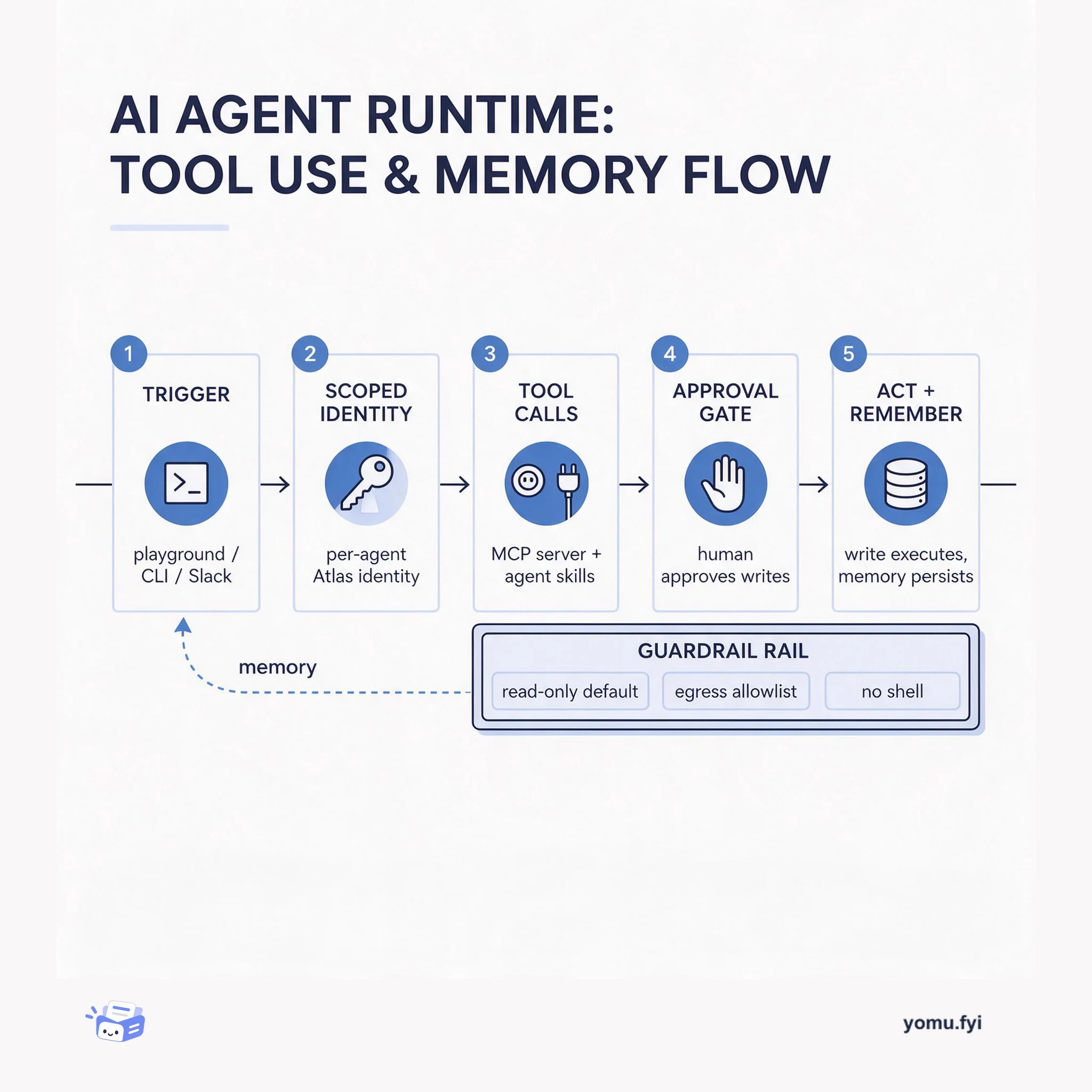
Atlas Agent Engine is the managed runtime that hosts MongoDB agents: it gives each one its own Atlas identity, read-only tools, and an approval gate before any write. Here is the loop, step by step.
Keep reading
Related reading
The Good Stuff
Paid picks we use ourselves. Links carry a referral code — a subscription through one earns us a commission at no extra cost to you.