Existing systems estimate user price sensitivity from spending behavior or demographic proxies, missing residential property values and creating one-dimensional profiles. This invention proposes a four-step method that combines public property data with LLM-assisted data structuring, building-level price estimation, hierarchical clustering, and user mapping. The method collects public property records, uses LLMs to standardize attributes such as postcode, transaction price, and property size, then aggregates transactions within buildings to calculate weighted average sale prices. A hierarchical clustering model groups buildings into affluence tiers based on estimated resale values, accounting for regional market differences, and users are mapped to these tiers via aggregated geographic signals. The approach remains unimplemented and untested in live markets, with potential applications in personalization, advertising, and operational planning subject to future technical validation and privacy approvals.
Context
Grab, a Southeast Asian superapp operating across deliveries, mobility, and digital financial services, proposes a conceptual method to enhance user price sensitivity estimation by incorporating residential property data into user profiles.
Approach / What changed
The method collects public property records, uses LLMs to standardize attributes such as postcode, transaction price, and property size, aggregates transactions within buildings to calculate weighted average sale prices, applies hierarchical clustering to group buildings into affluence tiers accounting for regional market differences, and maps users to these tiers via aggregated geographic signals.
Takeaways
1
The method calculates building-level property values by aggregating transaction records with weighting for recency and data volume, and uses comparable properties when data is limited.
2
Hierarchical clustering groups buildings into affluence tiers based on estimated resale values, accounting for regional differences and local market-value distributions.
3
LLM-assisted extraction of contextual signals from external sources requires validation against independent reference data before use in property-value estimates.
FAQ
How does the method estimate building-level property prices?
It aggregates transaction records within the same building, calculating a weighted average sale price with weighting for transaction recency and data volume. When data is limited, it uses rules based on comparable properties in the area.
What role do LLMs play in the method?
LLMs standardize raw public property records and extract key attributes such as postcode, transaction price, property size, and floor level, producing a structured dataset for analysis and modeling.
Is the method currently deployed?
No, the invention remains unimplemented and untested in any live market. Potential applications in personalization, advertising, and operational planning are subject to future technical validation and approvals.
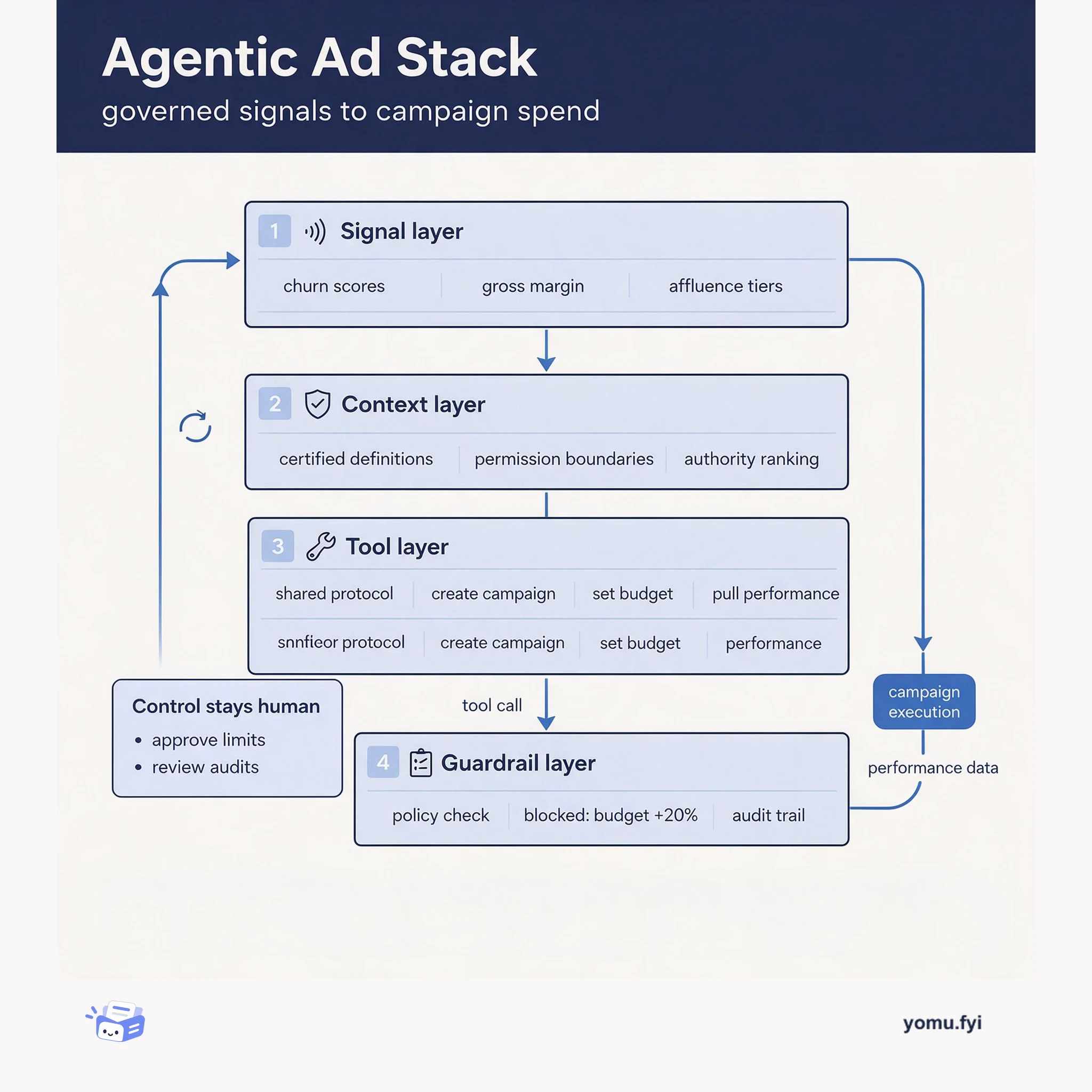
An agentic ad stack wires governed customer signals to campaign execution through a shared tool interface and server-side guardrails. The diagram shows each layer, the direction of a tool call, and where control stays human.
Keep reading
Related reading
The Good Stuff
Paid picks we use ourselves. Links carry a referral code — a subscription through one earns us a commission at no extra cost to you.