The Agentic Ad Stack: Where Governance Sits Between Signals and Spend
An agentic ad stack wires governed customer signals to campaign execution through a shared tool interface and server-side guardrails. The diagram shows each layer, the direction of a tool call, and where control stays human.
Advertising agents succeed on governed data, not on model cleverness. The stack has four layers: a signal layer that turns customer data into scores and audience tiers, a context layer that grounds the agent in certified business definitions inside permission boundaries, a tool layer where a shared protocol such as MCP exposes campaign actions, and a guardrail layer that checks every call before it executes, blocking moves like budget increases over a set limit. Reading the layers in order explains why each campaign action stays traceable and reversible: intelligence flows up into execution, and performance data flows back down to sharpen the next decision.
FAQ
Should budget guardrails live in the agent prompt or on the server?
Server-side. In the Meta and Databricks integration, administrators control access through Unity Catalog while advertisers set rules in Business Settings that block actions like budget increases over 20%, and every tool call is checked before execution. Prompt-level instructions alone cannot stop an agent that calls a tool with an unintended value. Keep the enforceable limits outside the model.
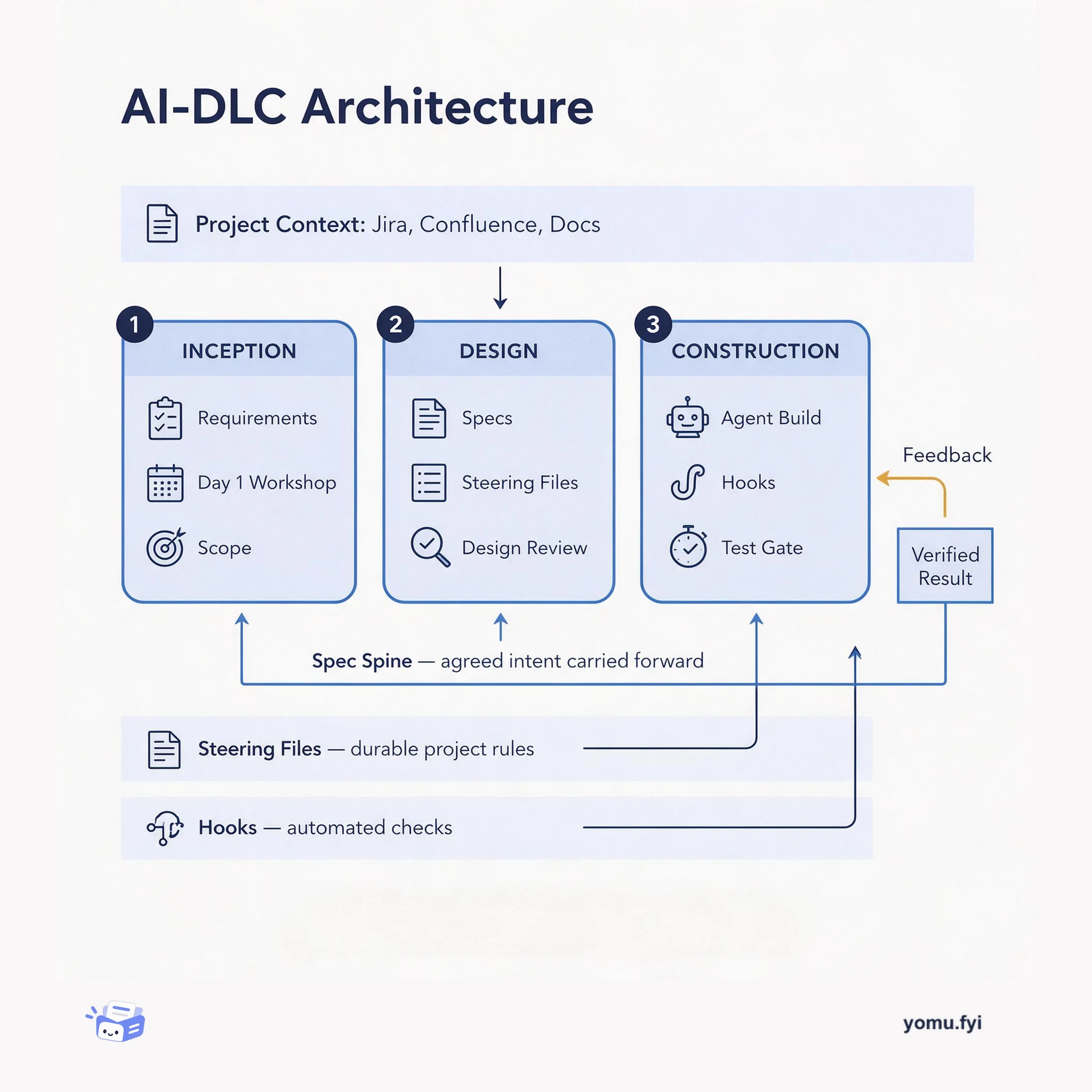
AI-DLC is an AI-driven development lifecycle that runs delivery through Inception, Design, and Construction, with specs, steering files, and hooks keeping agents aligned to agreed intent.
Apple Silicon's defining choice is one shared memory pool for CPU, GPU, and Neural Engine. This diagram maps that fabric, the on-package bandwidth it buys, and the scaling limits it imposes.
Antimicrobial resistance surveillance is a layered data architecture: raw reads and demand signals flow in, get normalized into governed tables, and answer plain-language queries. The diagram maps each boundary.
The Good Stuff
Paid picks we use ourselves. Links carry a referral code — a subscription through one earns us a commission at no extra cost to you.