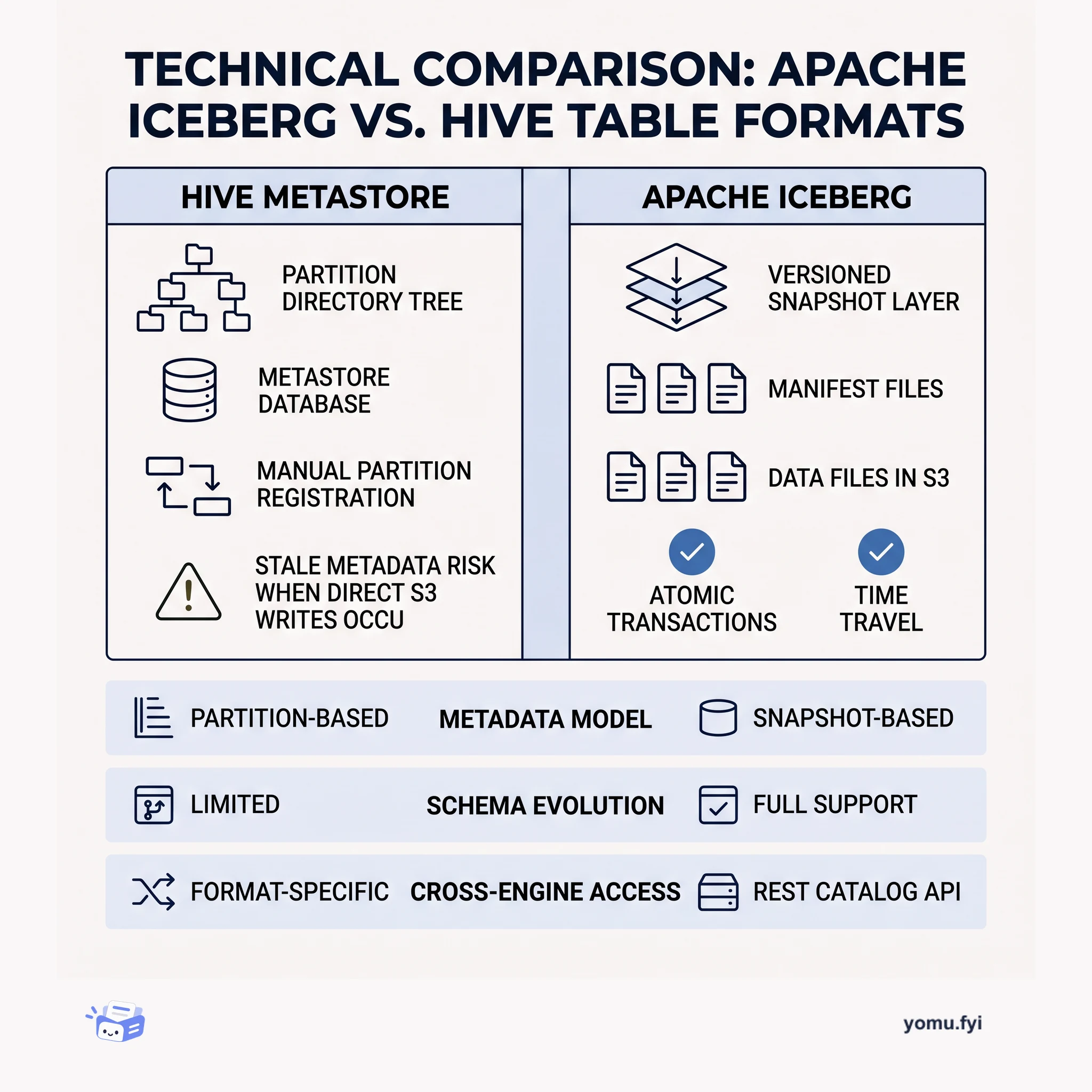
Apache Iceberg vs. Hive: The Table Format Trade-off
Apache Iceberg replaces Hive's partition-based metadata with a versioned catalog layer, trading operational simplicity for ACID guarantees, schema evolution, and cross-engine compatibility.
 DatabricksBenjamin Mathew, Michelle Leon, Lukas Rupprecht, Ryan JohnsonAnnouncement
Catalog Commits is generally available for Unity Catalog managed Delta tables, aligning Delta with Iceberg’s catalog-oriented model and making the catalog responsible for table discovery, access, and latest table state. The change addresses three coordination problems: metadata “split brain” when engines write directly to storage, fragmented multi-engine governance, and the historical inability to coordinate atomic writes across multiple tables. With Catalog Commits enabled, Unity Catalog brokers table access through standardized APIs, keeping catalog and table state synchronized and enabling consistent authorization, holistic auditability, automated optimizations, and multi-statement, multi-table ACID transactions on Databricks. The release supports Databricks products and engines including Delta Spark, Delta Flink, Starburst Trino, DuckDB, and StreamNative, while Delta Kernel provides a shared path for connector support.
Delta’s filesystem-oriented transaction model and Unity Catalog’s catalog-level governance previously operated side by side. As organizations added more engines, tools, and AI workloads, this created metadata drift, fragmented discovery and auditing, inconsistent fine-grained controls, and no way to coordinate transactions spanning multiple tables.
Catalog Commits integrates Delta tables with a catalog so Unity Catalog brokers table access and tracks the latest table state through standardized APIs. On Unity Catalog managed Delta tables, this enables external engine writes, centralized authorization and auditing, automated optimizations, lower metadata latency, and atomic multi-table transactions. Delta Kernel helps connectors support the protocol.
Catalog Commits keeps catalog metadata and Delta table state synchronized by routing engine access through common APIs, addressing silent metadata drift caused by direct object-storage writes.
Unity Catalog’s centralized access layer standardizes table discovery, authorization, auditing, and row- or column-level governance across engines and agents instead of relying on hardcoded storage paths.
Databricks and Unity Catalog can coordinate atomic writes across multiple tables, adding multi-table ACID semantics and enabling traditional warehousing workloads on the lakehouse.
Summaries are generated from the original by a language model. Check the original before relying on it.
See the idea
Apache Iceberg replaces Hive's partition-based metadata with a versioned catalog layer, trading operational simplicity for ACID guarantees, schema evolution, and cross-engine compatibility.
Keep reading
The Good Stuff
Paid picks we use ourselves. Links carry a referral code — a subscription through one earns us a commission at no extra cost to you.
One useful email. Unsubscribe anytime.
