Enterprises face seven pressures driving reevaluation of single-provider AI strategies: poor returns on spend, rapidly shifting model rankings, frontier guardrails blocking legitimate work, data retention policy changes, demand for centralized governance, harness influence on model performance, and open-weight models matching frontier benchmarks. Open-weight models now offer intelligence parity with frontier models at lower cost, with benefits including data sovereignty and operational autonomy. Databricks Unity Gateway serves open-weight and frontier models through a unified API with governance controls, smart routing, fallback chains, and budgets. After GLM 5.2 launched, it accounted for ~40% of open-weight tokens on Unity Gateway within a month, showing customer migration. Databricks raised $3 billion partly to secure GPU capacity for hosting open models, and the post concludes enterprises should adopt a portfolio approach to adapt as model quality and policies evolve.
Context
Companies are moving from standardizing on single frontier model providers to adopting a portfolio of models due to pressures including poor returns on AI spend, rapidly changing model rankings, frontier guardrails blocking legitimate work, and the rise of open-weight models that now match frontier benchmark performance. Databricks provides Unity Gateway to serve open-weight and frontier models through a unified API with centralized governance.
Approach / What changed
Databricks Unity Gateway provides a unified API for open-weight and frontier models with centralized governance controls, smart routing, fallback chains, budget management, and support for external model providers. Teams can switch models via configuration or routing policies without code changes. The service runs open-weight models on optimized inference engines on frontier GPUs to achieve competitive latency, as shown by GLM 5.3 achieving 9.1 second end-to-end response time.
Takeaways
1
Open-weight models now achieve benchmark performance comparable to top frontier models at a fraction of the cost, enabling better ROI on AI deployments.
2
The harness (prompts, tools, control flow) significantly affects a model’s measured performance; in Databricks’ benchmark, the same model scored 61.7% in one harness versus 48.1% in another.
3
Unity Gateway enables switching models via configuration or smart routing without code changes; since January the average number of unique models per customer increased from 4.2 to 7.1, with ~40% being open-weight.
FAQ
How do open-weight models compare to frontier models in cost and performance?
Open-weight models now benchmark at a level comparable to top frontier models at a fraction of the cost, as shown in the DeepSWE leaderboard and independent evaluations. This allows enterprises to achieve better ROI on AI deployments.
What features does Unity Gateway provide to control costs?
Unity Gateway offers smart routing to shift routine tasks to cheaper models, fallback chains for rate limits, and budgets with spend caps by user, team, or use case. These can range from soft warnings to strict policies that reroute sessions to cheaper models.
Why did Hugging Face responders use an open-weight model instead of a frontier model?
During a security incident, frontier guardrails refused to analyze live malware and exploit payloads, blocking legitimate cybersecurity work. The team instead used an open-weight model (GLM 5.2) to perform the analysis.
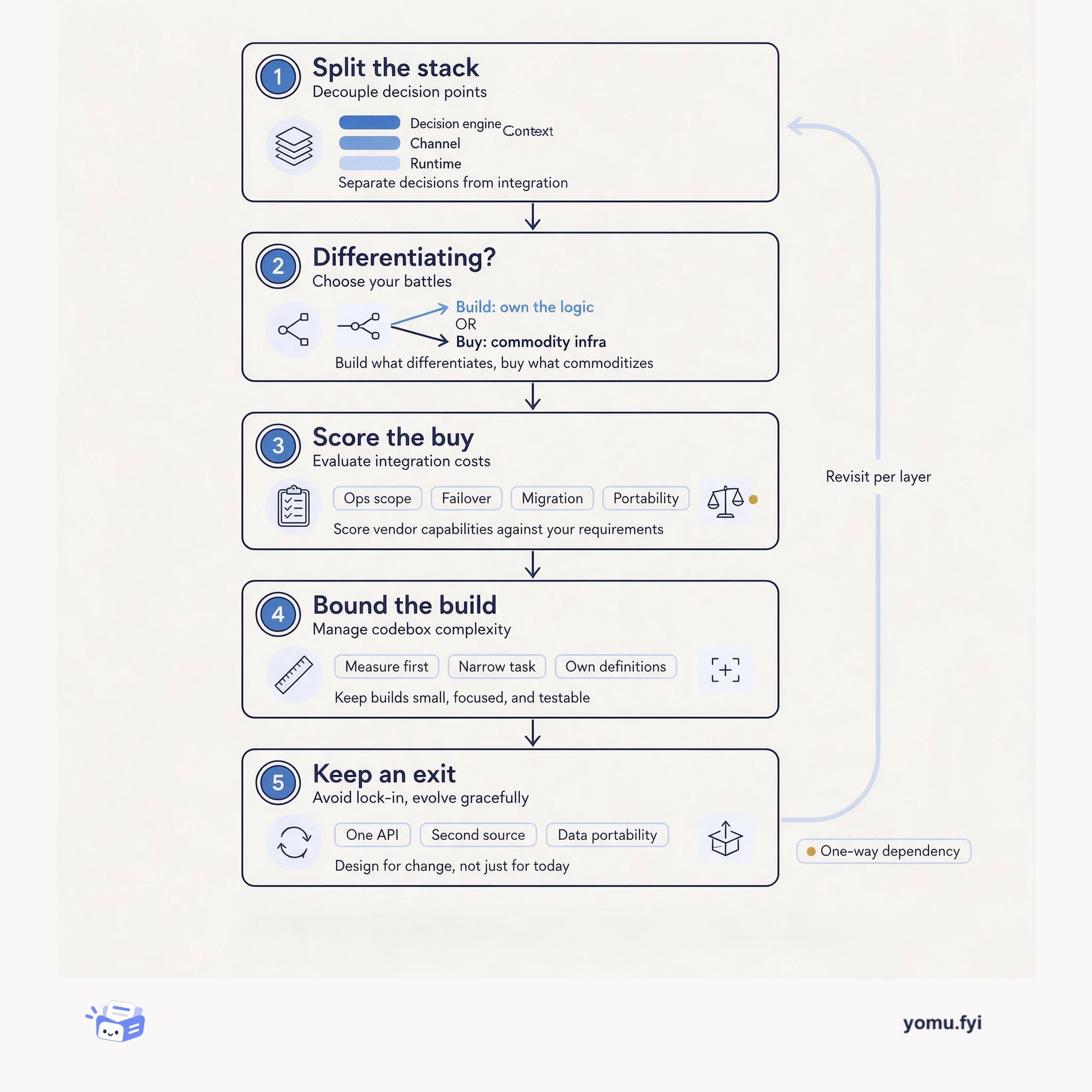
Build vs. buy is a per-layer decision, not a single platform choice. This flow splits a system into layers, tests each for differentiation, then sets the buy criteria and the exit path.
Keep reading
Related reading
The Good Stuff
Paid picks we use ourselves. Links carry a referral code — a subscription through one earns us a commission at no extra cost to you.