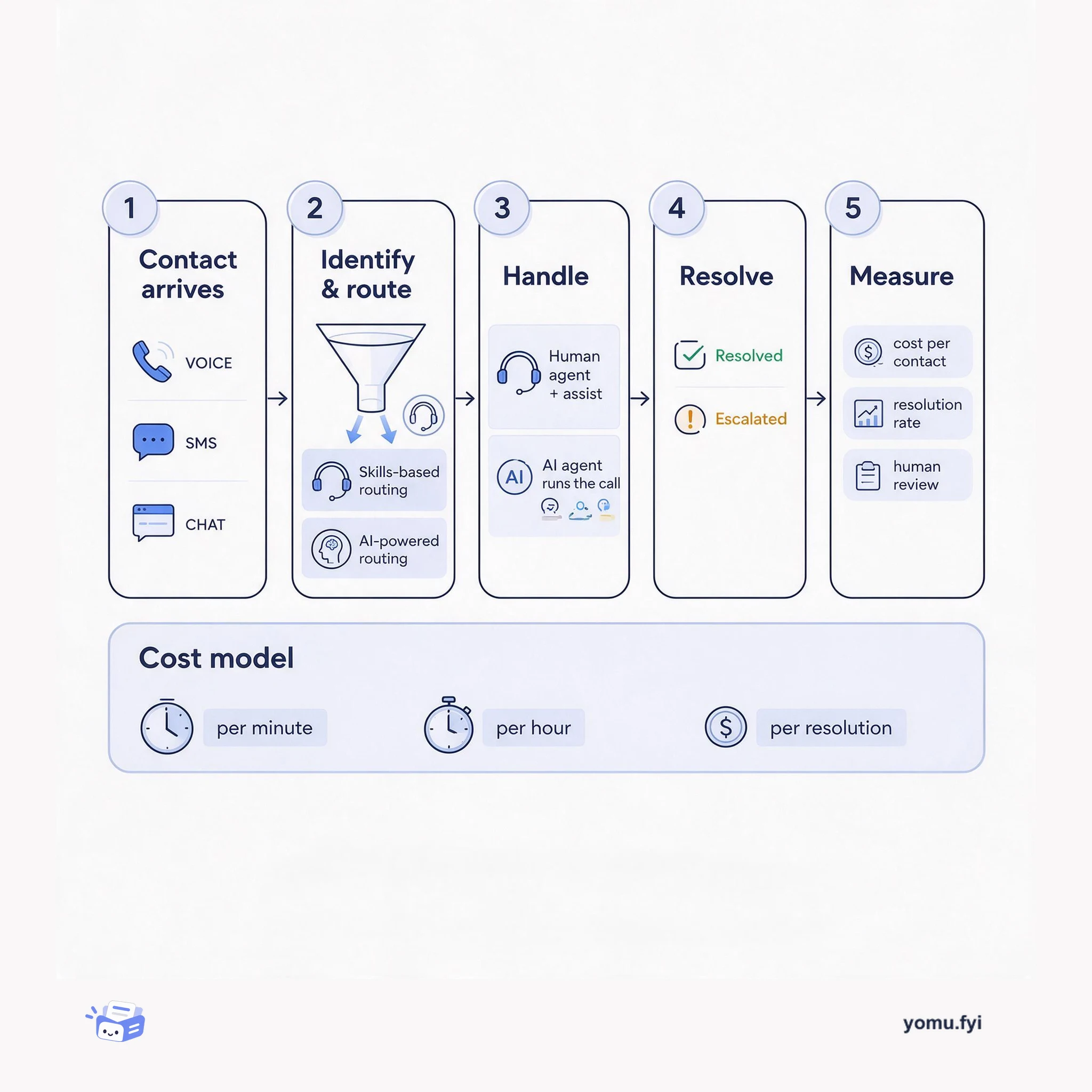
From Ringing Line to Resolved Contact: How a Call Center Works
Follow one contact through a call center: arrival, routing, handling by a human or AI agent, resolution, and the cost-per-contact math that decides which path to use.
 AWSSameer ShrivastavaProblem & solution
Novus Hi-Tech needed a system to act on fleet data from thousands of vehicles across 10 countries, not just display it. They collaborated with the AWS PACE team to build FleetGPT, a multi-agent system using Strands Agents SDK and AWS managed AI services. FleetGPT replaces fixed dashboards with a natural language interface for dynamic querying, investigation, and insight generation, and automates real-time safety interventions via AI-powered voice calls. The system achieved a 46 percent reduction in road-behavior violations and a 55 percent drop in drowsiness alerts per 1,000 km. Warning validation time dropped from minutes to seconds, and fleet managers gained self-service analytics without engaging the data team.
Novus Hi-Tech manages thousands of vehicles across 10 countries with streaming dashcam footage, driver alerts, GPS pings, and speed warnings. With over 120 enterprise customers, manual triage of every drowsiness alert or over-speeding event became infeasible. Existing fixed dashboards showed the same views regardless of role, and operators spent too long investigating individual events while fleet managers could not analyze trends fast enough. The cost of a missed warning could be a preventable accident.
FleetGPT is a multi-agent system built with Strands Agents SDK and AWS managed AI services. It uses a Supervisor agent (Claude Sonnet 4.6) for intent decomposition and routing, a Text-to-SQL sub-agent for structured queries, and a Data Processing sub-agent (Claude Haiku 3.0) for computation beyond SQL. Data is stored in Amazon Aurora PostgreSQL (structured telemetry), Amazon DynamoDB (high-velocity events), and Amazon Bedrock Knowledge Bases (unstructured documents). The Intervention Engine monitors events via DynamoDB Streams and initiates two-way AI voice calls to drivers in their native language upon critical events.
FleetGPT uses a multi-agent architecture with a Supervisor agent (Claude Sonnet 4.6) for intent decomposition and routing to specialized sub-agents, reducing hallucination and isolating failures.
The system achieved a 46 percent reduction in road-behavior violations and a 55 percent drop in drowsiness alerts per 1,000 km through AI-powered automation.
Warning validation time dropped from minutes to seconds by unifying telemetry, video, and policy data into a single conversational interface.
The system uses a multi-agent architecture with Strands Agents SDK. A Supervisor agent (Claude Sonnet 4.6) decomposes user intent and routes to sub-agents: a Text-to-SQL agent for structured queries and a Data Processing agent (Claude Haiku 3.0) for computations beyond SQL. Each agent has a focused tool surface and scoped system prompt, reducing hallucination and isolating failures.
When a critical event like repeated drowsiness or over-speeding occurs, the Intervention Engine initiates a two-way AI-powered voice call in the driver's native language, with user approval. It tracks acknowledgment and escalates if necessary. The device registry table maps vehicle IDs to country metadata for language routing.
The system uses a SummarizingConversationManager that preserves the last six messages verbatim while summarizing older turns. This keeps context window usage bounded without losing conversational continuity.
Summaries are generated from the original by a language model. Check the original before relying on it.
See the idea
Follow one contact through a call center: arrival, routing, handling by a human or AI agent, resolution, and the cost-per-contact math that decides which path to use.
Keep reading
The Good Stuff
Paid picks we use ourselves. Links carry a referral code — a subscription through one earns us a commission at no extra cost to you.
One useful email. Unsubscribe anytime.
