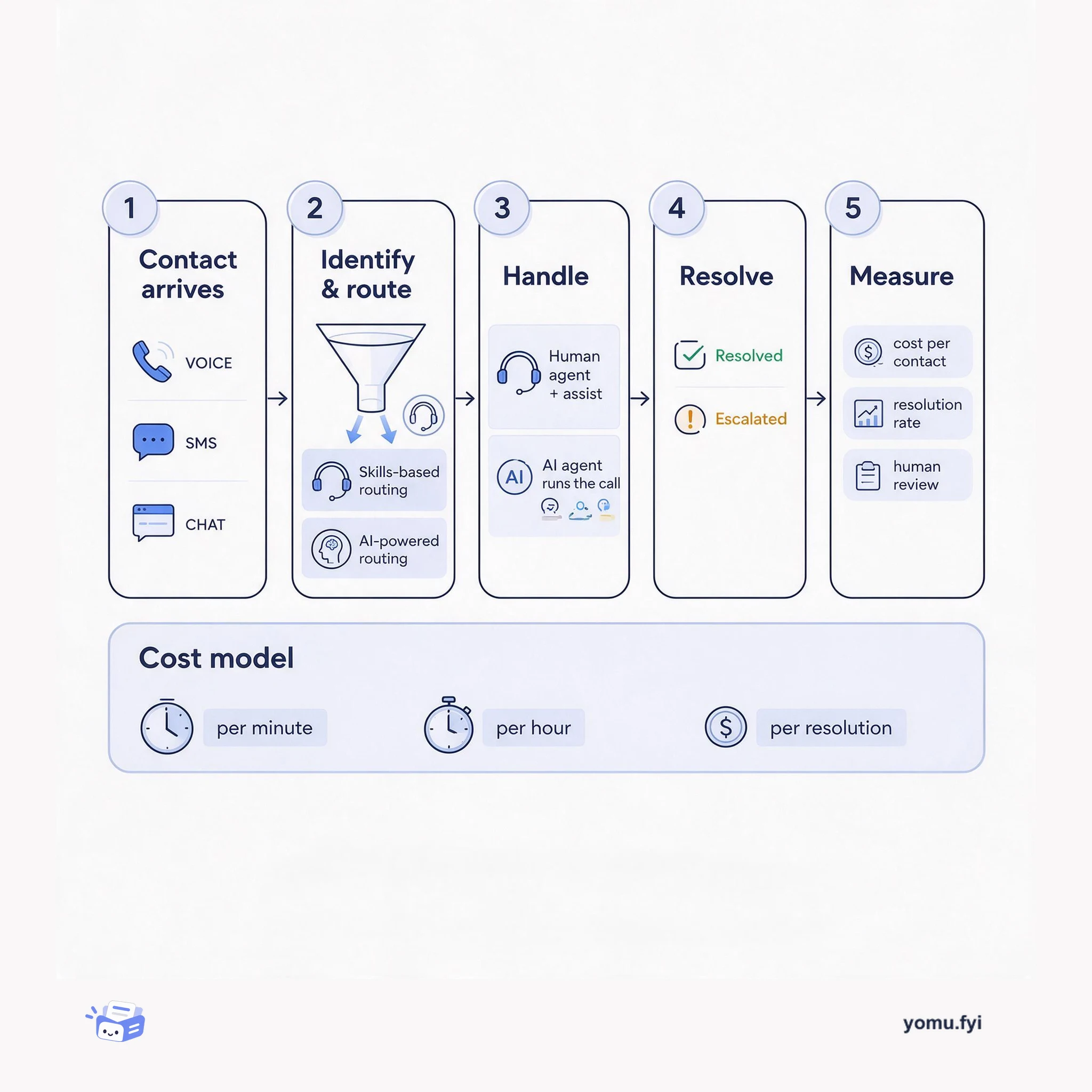
From Ringing Line to Resolved Contact: How a Call Center Works
Follow one contact through a call center: arrival, routing, handling by a human or AI agent, resolution, and the cost-per-contact math that decides which path to use.
Loading…
Topic
1 post about Outbound Calling. Every summary links to the original.
See the idea
Follow one contact through a call center: arrival, routing, handling by a human or AI agent, resolution, and the cost-per-contact math that decides which path to use.
The Good Stuff
Paid picks we use ourselves. Links carry a referral code — a subscription through one earns us a commission at no extra cost to you.
Newest first
Most AI agents are reactive, waiting for customers to initiate contact, which turns service issues into damage control. A proactive AI agent instead starts conversations based on system events, such as a delayed shipment, reaching out before the customer discovers the problem. The post outlines six ordered components: consent and contact rules, CRM event triggers, context loading, channel selection, scheduling, and human handoff. It details how Twilio Segment detects events, Agent Connect starts conversations, and Conversation Memory’s Recall endpoint provides customer context. The author emphasizes that consent must precede any trigger and that context must load before the first message, with a pre-launch checklist covering opt-outs, frequency limits, and agent identification.
The best engineering reads, once a week.