AI Data Assimilation: Turning Scattered Signals Into One State
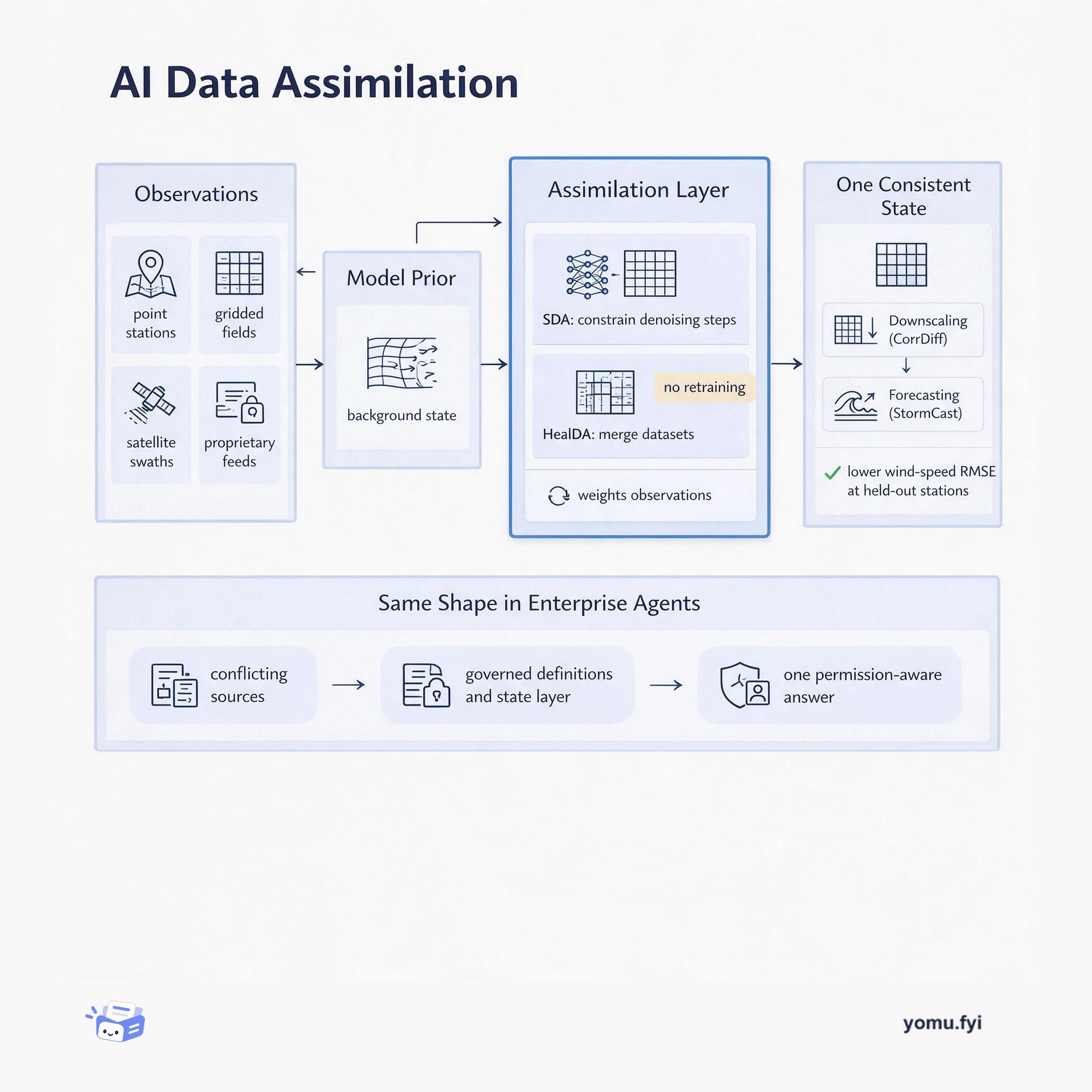
AI data assimilation fuses a model's prior state with fresh, uneven observations into one consistent state. See the four-layer architecture and where each layer can break.
 NVIDIAElizabeth GoodmanTutorial
Weather-sensitive industries can now turn real-time observations into timely decisions using the AI data assimilation tools in NVIDIA Earth-2. The tutorial covers two techniques: Score-Based Data Assimilation (SDA) for constraining diffusion models with point observations, and HealDA for assimilating disparate datasets into a consistent global state. SDA works within downscaling models like CorrDiff and forecasting models like StormCast, guiding denoising steps toward observations without retraining. A concrete example showed SDA reducing wind-speed RMSE by 54% at held-out stations when applied to CorrDiff downscaling over Europe. Earth2Studio provides a unified interface across gridded, conventional, and satellite data sources, making it easy to connect proprietary observations to weather pipelines.
Weather-sensitive industries such as energy, insurance, agriculture, and logistics need timely, localized forecasts but rely on observation data from wind/solar assets, radar, and satellites. Traditional numerical analyses are computationally expensive and released on fixed schedules, delaying updates. NVIDIA Earth-2’s AI data assimilation tools process proprietary and third-party observations more efficiently, enabling more frequent forecasts and region-specific pipelines.
NVIDIA Earth-2 provides AI data assimilation tools including Score-Based Data Assimilation (SDA) for diffusion models and a HealDA global state estimation model. SDA constrains regional models like CorrDiff and StormCast by nudging intermediate denoising steps toward point observations via an observation operator. HealDA assimilates conventional and satellite observations into a consistent global state using a diffusion-based model trained on UFS replay data. Earth2Studio offers a unified data interface across gridded (GOES, MRMS), conventional (GHCN, GDAS), and satellite sources.
SDA guides diffusion-based models toward predictions consistent with observations at each denoising step, requiring no model retraining and producing probabilistic outputs with uncertainty decreasing near observation locations.
SDA enables more frequent forecast updates by incorporating continuous observations between fixed numerical analysis schedules, and it allows incorporating proprietary, regional, or domain-specific data for tailored forecasts.
HealDA is a global AI data assimilation model in Earth2Studio that assimilates conventional and satellite observations from the NOAA UFS replay repository into a consistent atmospheric state.
Observation operators map model output to observed quantities at measurement locations. For in situ measurements like temperature or wind speed, the simplest operator interpolates nearby grid values to each observation location. Operators can also be created for proxy measurements, such as using wind turbine power output as a proxy for wind speed.
SDA effectiveness depends on the number, spatial distribution, and accuracy of observations; the characteristic length scales of the predicted field; and the quality of the observation operator. SDA produces probabilistic outputs with less uncertainty near observation locations and a wider spread further away, where predictions are governed by other model inputs and AI simulations.
HealDA is a global data assimilation model in Earth2Studio, trained on NOAA UFS replay data, that assimilates conventional and satellite observations into a consistent global atmospheric state. It processes observation DataFrames containing metadata like variable names, latitudes, longitudes, observation values, and request timestamps.
Summaries are generated from the original by a language model. Check the original before relying on it.
See the idea
AI data assimilation fuses a model's prior state with fresh, uneven observations into one consistent state. See the four-layer architecture and where each layer can break.
Keep reading
The Good Stuff
Paid picks we use ourselves. Links carry a referral code — a subscription through one earns us a commission at no extra cost to you.
One useful email. Unsubscribe anytime.
