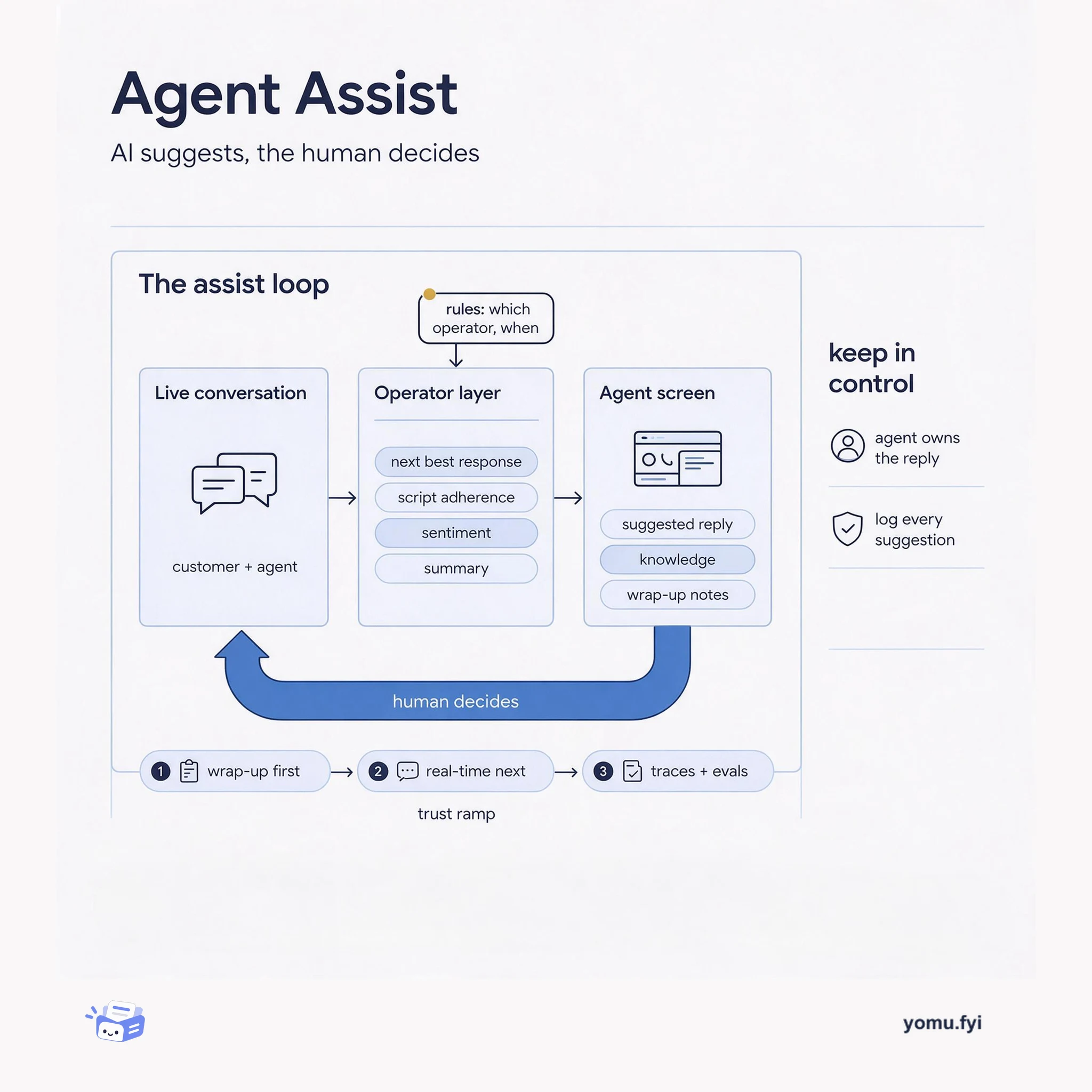
Agent assist is AI that supports human contact center agents during live customer conversations by suggesting responses, surfacing relevant knowledge, and handling after-call work while the agent remains in control. Twilio’s implementation combines Agent Copilot in Flex, which provides wrap-up notes, transfer summaries, customer highlights, Ask Copilot, and suggested responses, with Conversation Intelligence for programmable real-time signals. Conversation Intelligence runs LLM-backed Language Operators such as Next Best Response, Script Adherence, Sentiment, and Summary, and rules determine when each operator runs. Operator results reach a backend by webhook, are normalized and streamed to the agent’s browser keyed by call, then displayed in a Flex plugin. Twilio recommends starting with post-conversation wrap-up so agents build trust in AI output before real-time suggestions appear mid-conversation.
Context
Contact center agents often need to find answers buried in long policy documents while a customer waits, which can stretch a short call. Agent assist addresses that by having AI work alongside the human agent during the conversation, rather than having an AI agent handle the conversation itself.
Approach / What changed
Twilio’s rollout path starts with Agent Copilot in Flex for wrap-up notes, transfer summaries, customer highlights, Ask Copilot, and suggested responses. Conversation Intelligence adds real-time analysis through Language Operators, including Next Best Response, Script Adherence, Sentiment, and Summary, plus custom natural-language operators. Rules trigger operators on every communication, every N communications, inactivity, conversation end, or on demand. Operator results are sent by webhook to a backend, normalized, streamed to the agent’s browser keyed by the call, and rendered in a Flex plugin. The guide notes the plugin is a proof of concept and custom operators need matching display logic.
Takeaways
1
Agent assist keeps the human agent in control: it suggests replies, surfaces knowledge, flags sentiment shifts, and writes wrap-up notes, while the agent does the talking.
2
Twilio’s Next Best Response operator targets sub-3-second latency on the live transcript and stays silent when no relevant context exists instead of guessing.
3
Twilio recommends starting with post-conversation wrap-up because it carries lower risk and lets agents build trust in AI-generated output before real-time suggestions are added.
FAQ
How does a real-time suggestion get from Conversation Intelligence to the agent's screen?
Conversation Intelligence analyzes the active call and sends operator results to a backend by webhook. The backend normalizes the results and streams them to the agent's browser, keyed by the call, and a Flex plugin displays them in an Agent View tab.
What happens when Next Best Response has no relevant context?
It stays silent instead of guessing. The operator recommends the next message or action based on business rules and knowledge sources, targeting sub-3-second latency on the live transcript.
Why start with wrap-up notes before live suggestions?
Twilio's blueprint places post-conversation implementation first because the risk is lowest. It lets agents build trust in AI-generated output before the same components and configuration are used for mid-conversation suggestions.
Agent assist is AI that feeds a human agent suggestions, knowledge, and wrap-up work during a live conversation. This diagram shows the loop that decides what runs, when, and who stays in control.
Keep reading
Related reading
The Good Stuff
Paid picks we use ourselves. Links carry a referral code — a subscription through one earns us a commission at no extra cost to you.