What Is an AI Factory? Four Stages From Data to Served Answer
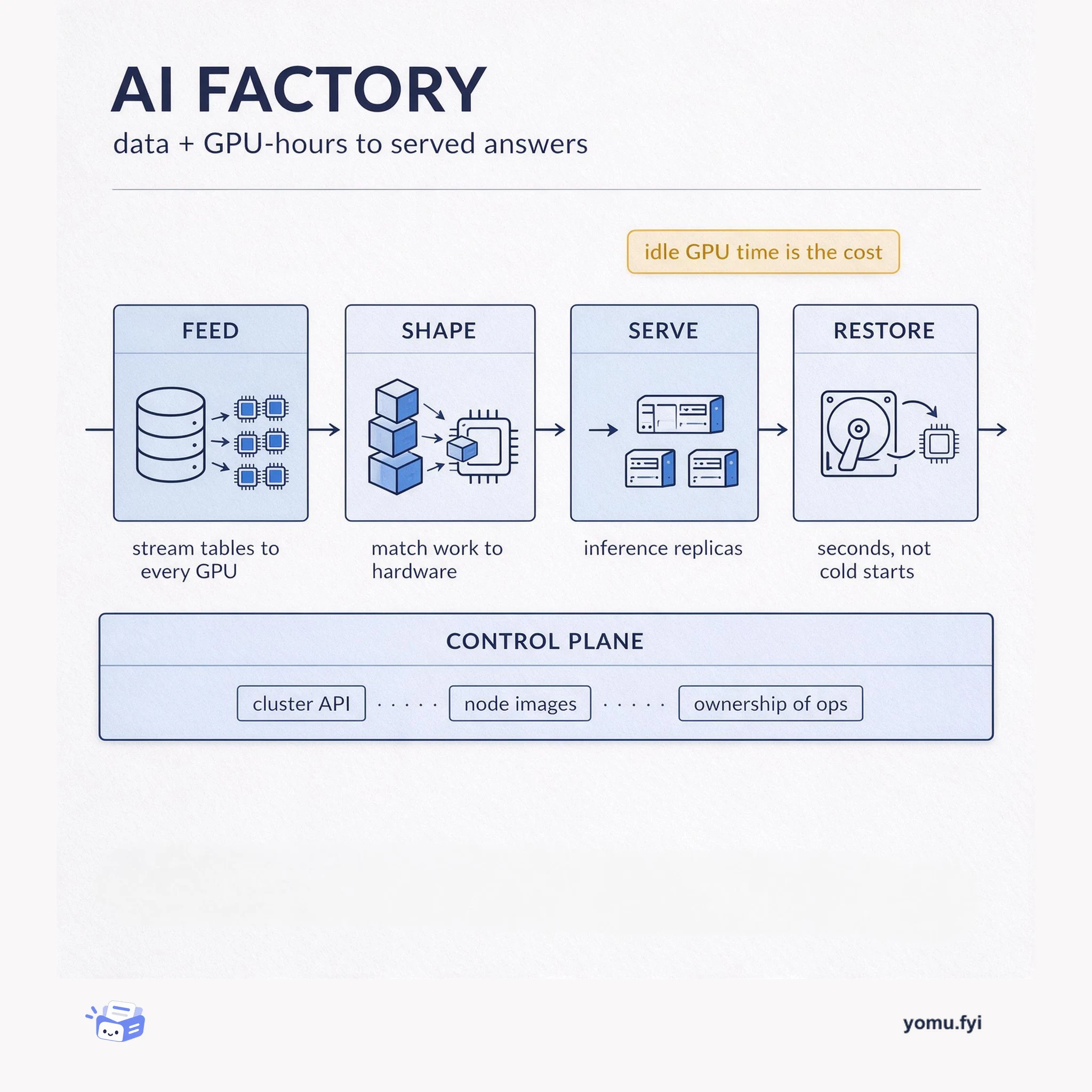
An AI factory turns raw data and GPU-hours into served model output. This diagram breaks it into four stages — feed, shape, serve, restore — plus the control plane that owns them.
Agent assist is AI that feeds a human agent suggestions, knowledge, and wrap-up work during a live conversation. This diagram shows the loop that decides what runs, when, and who stays in control.
Agent assist is not an autonomous agent; it is a loop that runs alongside a human. Live conversation signals feed a set of LLM-backed operators, such as next best response, script adherence, sentiment, and summary. A rules layer decides which operator runs when, results are normalized and streamed to the agent's screen keyed by conversation, and the human keeps the decision. The practical lesson from production teams is sequencing: ship post-conversation wrap-up first so agents learn to trust the output before real-time suggestions appear mid-call, and keep traces so you can tell a bad suggestion from a bad tool call.
Twilio recommends starting with post-conversation wrap-up so agents build trust in AI output before real-time suggestions appear mid-conversation. Wrap-up is also the lower-risk surface: a wrong note is easy to edit, while a wrong live suggestion competes with the agent's own judgment in front of the customer. Once agents trust the output, real-time operators are easier to adopt.
You need traces. In the Databricks MLflow example, agent executions are recorded as spans for model requests and tool calls, and trace analysis separates missing context from a failed tool call. Evaluation then compares baseline and revised agents on the same traces, and recurring problems surface across them instead of being rediscovered call by call.
The posts behind it
 Databricks · · Announcement
The Claude Platform now supports native OpenTelemetry export to Databricks MLflow, enabling developers to trace agent executions. Traces record model requests and tool calls as spans, ingested via Zerobus and stored in Unity Catalog tables linked to MLflow experiments. Setting up requires creating an experiment with Unity Catalog trace storage, configuring native export with a table-scoped OAuth token, and running a task to inspect traces. Developers can debug unexpected answers by analyzing traces with Genie Code, which identifies missing context or failed tool calls, and MLflow Issues detects recurring problems across traces. Agent Evaluation compares baseline and revised agents using the same traces to measure improvements or regressions, with domain experts able to review traces via Review Queues.
 Sentry · · Problem & solution
An engineer used a coding agent connected to Sentry MCP to inspect Sentry’s own traces and find backend performance problems. The agent sorted spans by execution frequency and duration, then returned candidate fixes with a file and line, estimated weekly volume, and an example trace. Django query spans included SQL as their description, while query-source attributes supplied file and line and the user_agent attribute exposed a sentry-cli set-commits workload paging through roughly 16k repositories every 40 seconds. For SQL changes, the agent ran EXPLAIN ANALYZE before and after on a read-only database mirror and compared results. Fixes included reusing a loaded project to remove an estimated 143M weekly SELECTs, rewriting a GroupHistory lookup to probe each status separately, and eager-loading Sentry app relations; the GroupHistory query fell from 935ms to 0.4ms with a warm cache.
 Twilio · · Explainer
Agent assist is AI that supports human contact center agents during live customer conversations by suggesting responses, surfacing relevant knowledge, and handling after-call work while the agent remains in control. Twilio’s implementation combines Agent Copilot in Flex, which provides wrap-up notes, transfer summaries, customer highlights, Ask Copilot, and suggested responses, with Conversation Intelligence for programmable real-time signals. Conversation Intelligence runs LLM-backed Language Operators such as Next Best Response, Script Adherence, Sentiment, and Summary, and rules determine when each operator runs. Operator results reach a backend by webhook, are normalized and streamed to the agent’s browser keyed by call, then displayed in a Flex plugin. Twilio recommends starting with post-conversation wrap-up so agents build trust in AI output before real-time suggestions appear mid-conversation.
 Auth0 · · Explainer
As AI agents evolve from answering questions to taking action, the post examines what identity and security model retailers need for convenient, secure customer experiences. McKinsey estimates $3–5 trillion will flow through agentic commerce by 2030, with 25–40% of e-commerce agentic. In a survey of 5,250 consumers, 74% said they would abandon a task if asked to create an account before seeing key information, while 72% cited slow login or verification and 71% repeated identity checks. Only 6% of consumers said they were ready for AI to handle as much as possible, yet a majority would let agents act in limited-consequence cases when they approve actions first or can reverse them. The argument is that retailers need proportionate friction and a CIAM platform that links agents to customers, scopes credentials, and enforces fine-grained authorization with audit trails.
 MongoDB · · Explainer
The article describes an agentic AI pipeline for enhanced due diligence (EDD) in financial crime case management, built with LangGraph and MongoDB. It aims to replace manual, rule-based AML workflows with specialized agents that triage suspicious activity, gather evidence, and draft Suspicious Activity Report (SAR) narratives. The pipeline uses a team of agents for notification, data gathering, case analysis, SAR authorship, and compliance quality assurance. A human-in-the-loop pattern ensures each decision can be traced for auditability. MongoDB serves as the durable state backbone, while LangGraph handles orchestration and dynamic routing. The author emphasizes that enterprise agentic AI must centralize state in a persistent store rather than rely on the agent as the source of truth.
More like this
An AI factory turns raw data and GPU-hours into served model output. This diagram breaks it into four stages — feed, shape, serve, restore — plus the control plane that owns them.
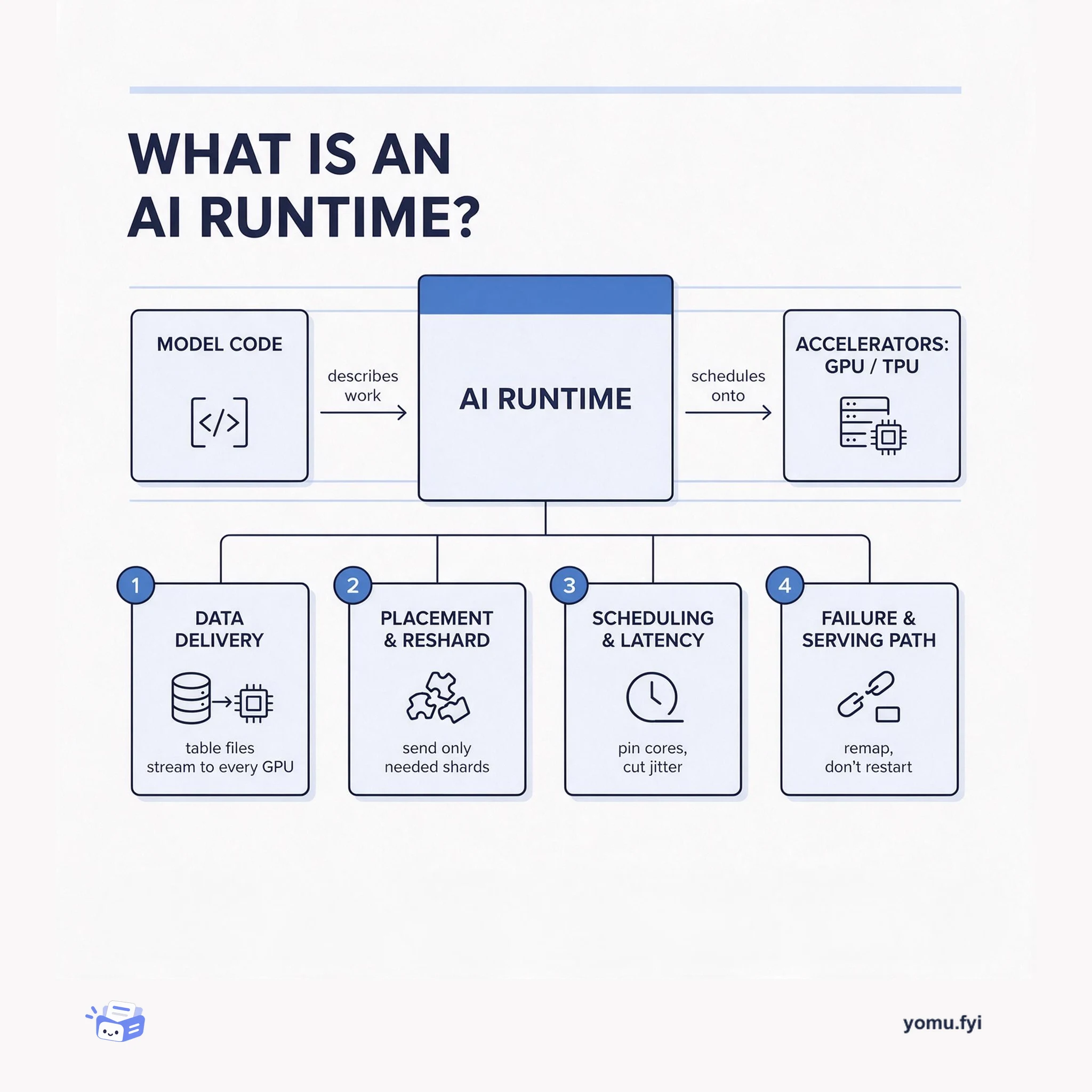
An AI runtime is the execution layer between model code and hardware: it feeds data to accelerators, places and reshards tensors, schedules work, and holds latency steady. Here are its four core jobs.
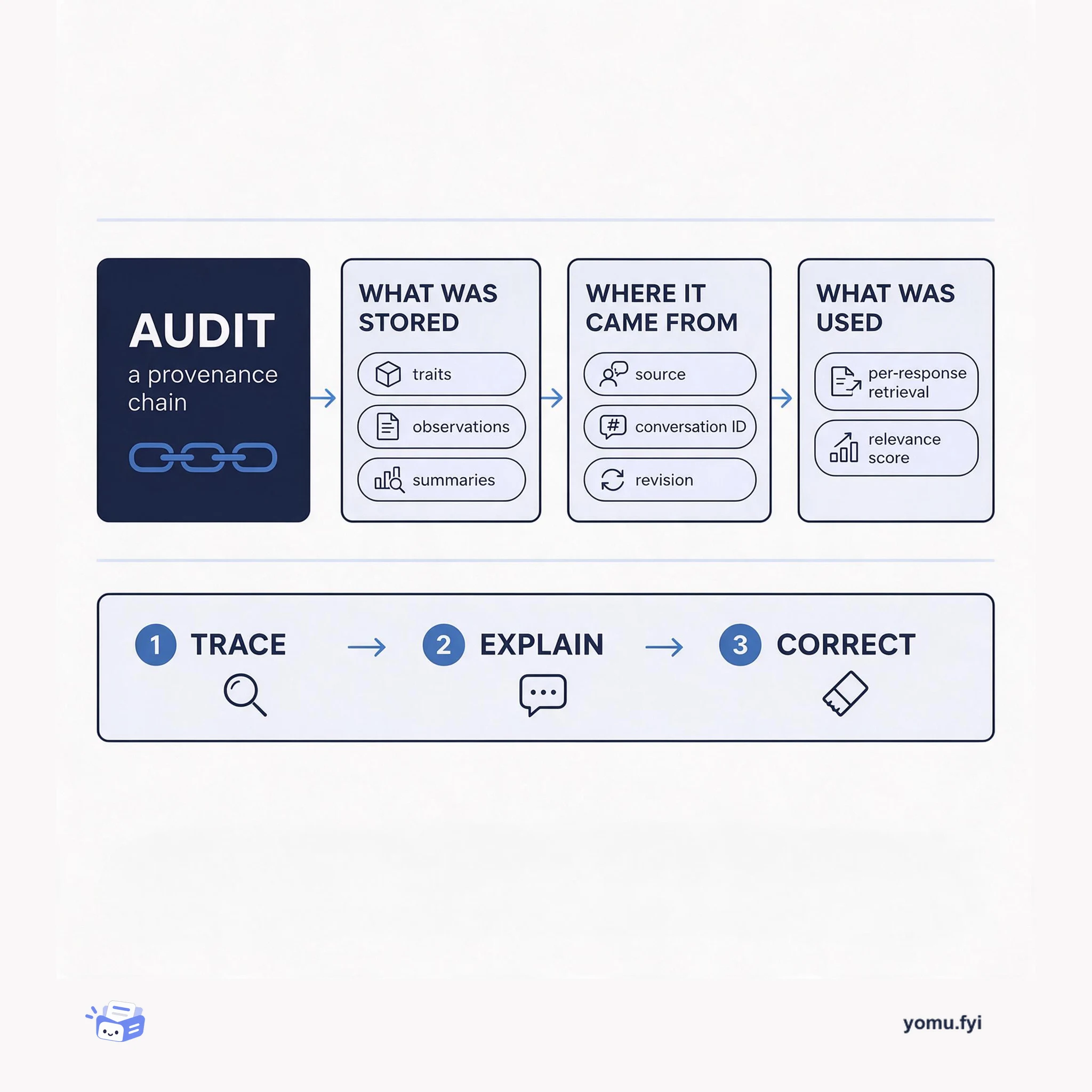
An audit is a provenance chain: what was stored, where each fact came from, and what was used for each decision. This explainer maps the three links that keep agent behavior traceable and fixable.
The Good Stuff
Paid picks we use ourselves. Links carry a referral code — a subscription through one earns us a commission at no extra cost to you.
One useful email. Unsubscribe anytime.