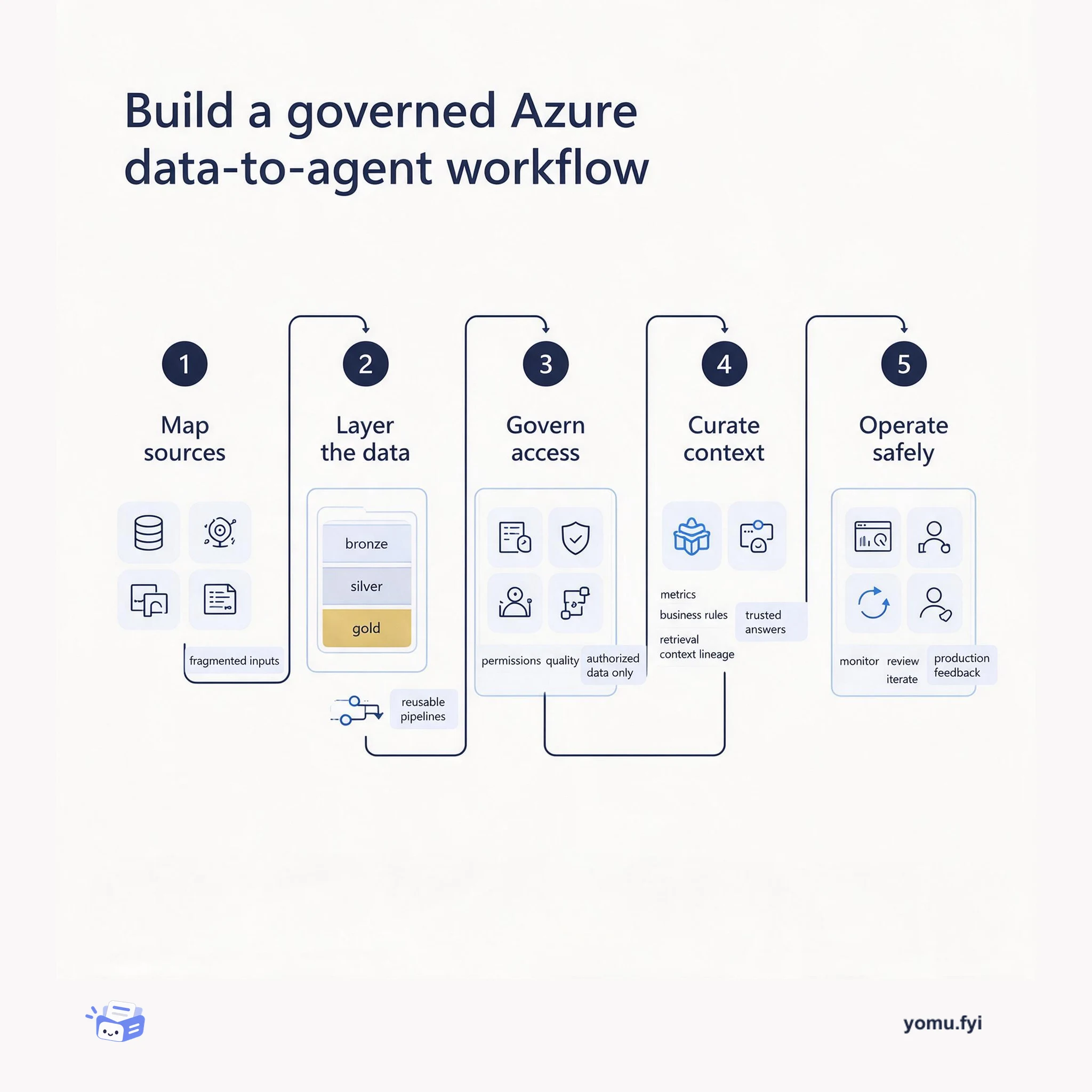
How to Build a Governed Azure Data-to-Agent Workflow
A practical Azure workflow for turning fragmented operational data into governed analytics and agent experiences, with checkpoints for layering, context, access, and deployment.
 DatabricksSebastian Eberhardt, Dominik Bentele, Jonathan BräuerExplainer
cellcentric describes how it built a governed lakehouse foundation for R&D data so industrial AI agents can reason over engineering context, not isolated source-system records. On Azure and Databricks, the Data Hub combines Unity Catalog governance, Lakehouse Federation, Delta Sharing, Declarative Automation Bundles, and an MCP interface for agents. Its Fuel Cell Passport unifies five enterprise systems, models seven hierarchy levels, refreshes daily, and uses a state-based temporal model for point-in-time configuration and rework-history questions. The platform treats context coverage as a data-quality metric, with 27 published products averaging 90% column-comment coverage, while authenticated user identity and Unity Catalog authorization constrain agent access. For many R&D and process-development workflows, work that once took weeks now ships in days, though complex multi-source investigations still require substantial domain review.
Industrial R&D questions span product hierarchy, manufacturing and rework history, laboratory evidence, test telemetry, and domain knowledge across multiple source systems. Agents therefore need governed context covering data provenance, meaning, completeness, caveats, and user permissions before their answers can be trusted.
cellcentric built the Data Hub on Azure and Databricks as a governed context layer. It integrates enterprise sources through Unity Catalog, Lakehouse Federation, Delta Sharing, and Declarative Automation Bundles; packages domain context in data products such as the Fuel Cell Passport; exposes the result through a human interface and MCP; and preserves user-based authorization through identity propagation and Unity Catalog.
The Fuel Cell Passport combines SAP S/4HANA, two MES systems, a laboratory database, and an IoT telemetry platform across seven hierarchy levels, with daily refreshes and state-based temporal modeling.
Context coverage is tracked as a visible quality metric: 27 published data products average 90% column-comment coverage, with most comments AI-assisted and reviewed by engineers before merge.
Agents access data on behalf of authenticated users, so Unity Catalog permissions, masking, and governed views apply equally to UI queries, SQL tools, Genie calls, and MCP interactions.
Summaries are generated from the original by a language model. Check the original before relying on it.
See the idea
A practical Azure workflow for turning fragmented operational data into governed analytics and agent experiences, with checkpoints for layering, context, access, and deployment.
Keep reading
The Good Stuff
Paid picks we use ourselves. Links carry a referral code — a subscription through one earns us a commission at no extra cost to you.
One useful email. Unsubscribe anytime.
