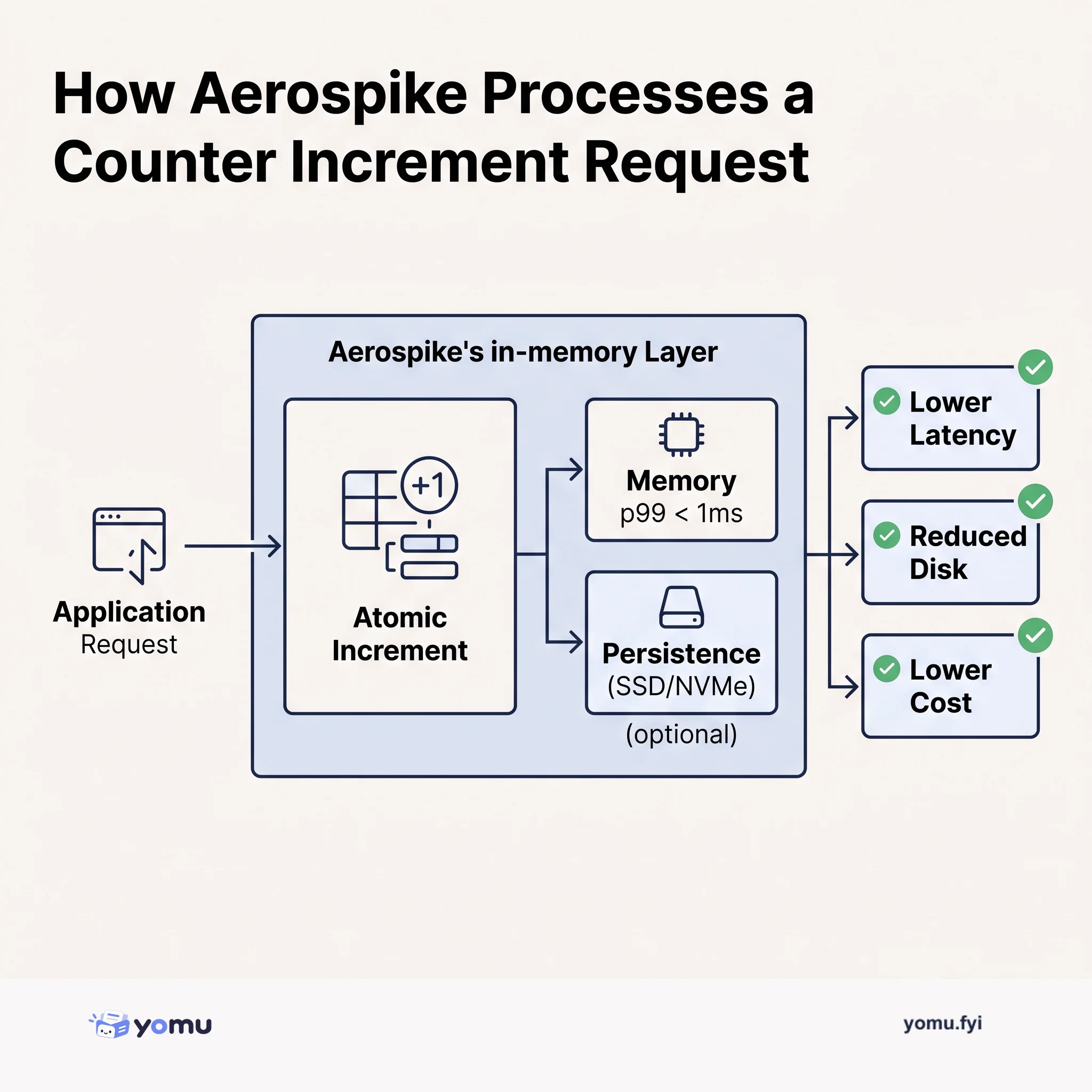
How Aerospike Handles High-Speed Counters
Aerospike is an in-memory database optimized for real-time counters and fraud detection at extreme scale. Learn how it replaces wide-column stores and cuts latency and cost.
Loading…
Topic
2 posts about Aerospike. Every summary links to the original.
See the idea
Aerospike is an in-memory database optimized for real-time counters and fraud detection at extreme scale. Learn how it replaces wide-column stores and cuts latency and cost.
The Good Stuff
Paid picks we use ourselves. Links carry a referral code — a subscription through one earns us a commission at no extra cost to you.
Newest first
MakeMyTrip needed sub-second personalization for “last-searched” hotels across its consumer and corporate travel businesses, serving millions of daily users. Spark Structured Streaming’s micro-batch mode consistently delivered one to two seconds, while adopting Flink would have added a second engine, duplicated logic and increased operational overhead. The team instead adopted Databricks Real-Time Mode (RTM), using continuous data flow, concurrent pipeline scheduling and streaming shuffle to process events with millisecond-level latency on Spark. Its unified pipeline merges B2C and B2B Kafka streams, enriches events with each user’s “Last N” hotels from Aerospike, and writes results to Redis for serving in under 50ms. After tuning partitions, backpressure and rate limits, the production deployment reduced P50 latency from approximately 1.23 seconds to 44ms, P99 latency from over one minute to about 500ms, and increased click-through rate by 7%.
Grab’s Counter Service supports time-windowed fraud queries at tens of thousands of QPS and about a billion requests per day, but an infrastructure review prompted migration from a wide-column database to Aerospike. The team first separated Rust business logic from storage, then added an enum-dispatched facade with Single, WithShadow, and WithSplit modes so traffic could be compared and shifted without downtime. They also redesigned the writer path around Aerospike, including a map-based schema and a single atomic increment, while testing index placement and reverting from an NVMe-backed primary index after hot-key p99 spikes. Production p99 read latency improved by roughly 50%, disk usage fell from about 3 TB to 1 TB, and per-node cost dropped 45–50%; the rollout reported zero downtime and no data-integrity issues.
The best engineering reads, once a week.


