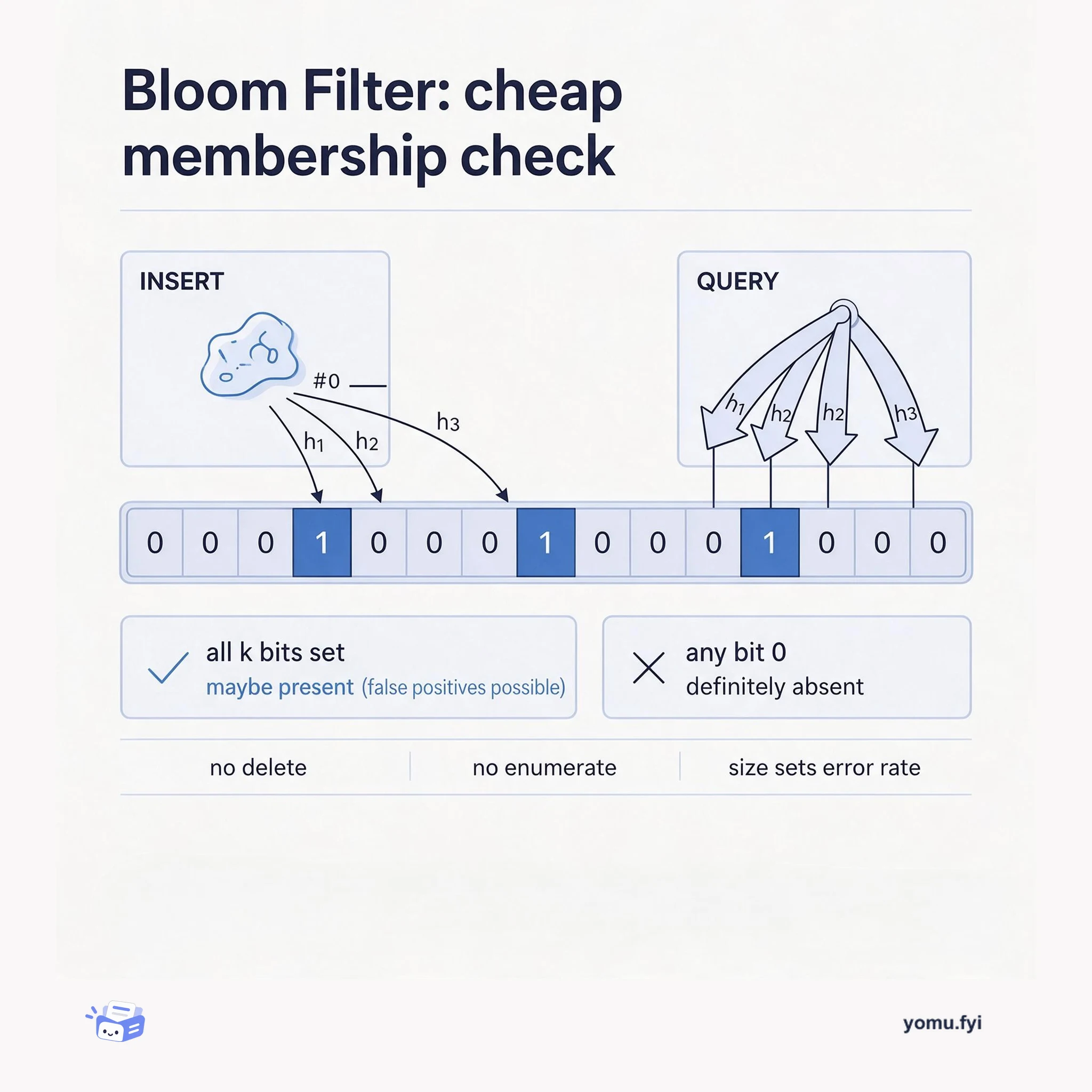
Bloom Filters: The Cheap Gate Before the Expensive Question
A Bloom filter is a small bit array plus a few hash functions that answers "has this been seen?" with no false negatives and a false-positive rate you choose up front.
Loading…
Topic
1 post about Bloom Filters. Every summary links to the original.
See the idea
A Bloom filter is a small bit array plus a few hash functions that answers "has this been seen?" with no false negatives and a false-positive rate you choose up front.
The Good Stuff
Paid picks we use ourselves. Links carry a referral code — a subscription through one earns us a commission at no extra cost to you.
Newest first
Medium’s Daily Digest filtering had become costly and difficult to maintain after a single Bloom Filter instance accumulated billions of items for read, muted, and presentation rules. The system could face up to 15,000 filter questions per feed and more than 15 million per second across thousands of feeds, while Bloom Filters could not delete or enumerate entries and introduced derived-data drift. The team replaced the muted-writer filter with a user-based database query that fetched all muted writers for the current user and cross-referenced them with the story shortlist, then split read filtering between early user-based queries and later pairwise lookups. The resulting implementation removed Bloom Filters entirely, was reported as ten times cheaper in their situation, made costs independent of shortlist size, supported reading-history clearing, and was easier to control and debug.
The best engineering reads, once a week.

