Agentic AI: Where Autonomy Helps, Where Control Must Stay
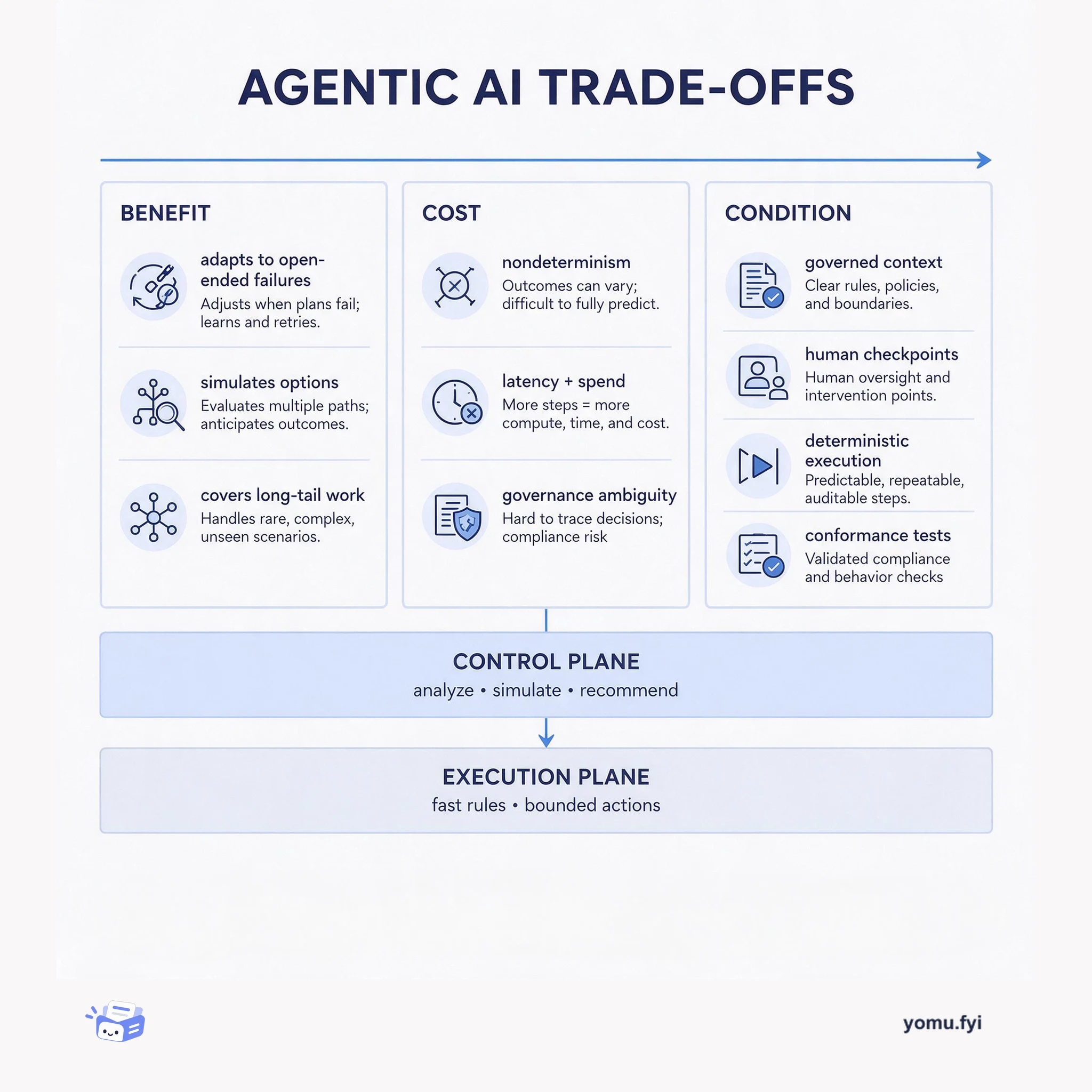
A trade-offs guide to agentic AI: use agents for open-ended analysis and repair, but keep execution deterministic, context governed, and human checkpoints explicit.
 MongoDBExplainer
False payment declines cost global businesses over $50 billion annually, with 45% of shoppers abandoning purchases after a single checkout decline. Scripted routing rules fall short due to dimensionality explosion, unstructured error interpretation, and multi-constraint trade-offs. The proposed architecture separates an asynchronous multi-agent control plane, which continuously analyzes telemetry, simulates rerouting options, and enforces cost guardrails, from a fast execution data plane that queries deterministic JSON rules in milliseconds. Specialized agents automate a five-step optimization loop: baseline analysis, segment performance, routing simulation, cost impact, and recommendation with human approval. MongoDB stores flexible payment context documents, enables vector search for similar scenarios, and serves active rules for low-latency execution, supporting the control-execution separation.
This is the first installment of a series on agentic smart payment routing, introducing the core concepts for designing an AI-driven control plane across all payment modalities.
Build an asynchronous multi-agent control plane with specialized agents (telemetry, analytics/simulation, policy/optimization, supervisor) that automate a five-step optimization loop (baseline analysis, segment performance, routing simulation, cost impact, recommendation). This control plane operates continuously in the background, not on the hot path. The execution data plane uses fast, deterministic querying of active JSON rules stored in MongoDB. MongoDB provides a flexible document model to accommodate varying provider payloads, vector search for similar historical payment contexts, change streams for real-time updates, and TTL indexes for rule expiration. Atlas Agent Engine manages the full agent lifecycle with memory, observability, and safety controls.
Payment routing performance directly impacts revenue: false declines cost 1.5 to 2.2 percent of annual revenue, and 45 percent of shoppers abandon purchases after a single decline, as cited by Checkout.com and Oxford Economics.
Scripted routing breaks down due to dimensionality explosion (complex intersections of rail, jurisdiction, asset type), unstructured error interpretation (inconsistent decline codes), and multi-constraint trade-offs (authorization rate vs. fees, FX spreads, volume commitments).
An agentic architecture separates background reasoning (asynchronous multi-agent control plane optimizing rules) from real-time execution (deterministic rule lookup in milliseconds), with MongoDB providing flexible document storage, vector search, and change streams that enable continuous optimization.
Scripted rules face three limitations: dimensionality explosion, where performance shifts at complex intersections of rail, jurisdiction, or amount that scripts cannot anticipate; unstructured error interpretation, where decline codes like 'Do Not Honor' are vague; and multi-constraint trade-offs, where higher authorization rates may increase fees, spread, or liquidity constraints.
The control plane operates asynchronously in the background using multi-agent AI to analyze telemetry, simulate rerouting, calculate cost impacts, and generate optimized rules with human approval. The execution data plane queries only the active deterministic JSON rules, enabling millisecond-level decisions on the hot path without invoking LLMs.
MongoDB stores flexible payment context documents that preserve native payload differences across providers and rails. It enables vector search for similar historical payment contexts, serves active JSON rules for low-latency execution, and uses change streams for real-time notifications and TTL indexes for rule expiration, all while supporting encryption and multi-cloud deployments.
Summaries are generated from the original by a language model. Check the original before relying on it.
See the idea
A trade-offs guide to agentic AI: use agents for open-ended analysis and repair, but keep execution deterministic, context governed, and human checkpoints explicit.
Keep reading
The Good Stuff
Paid picks we use ourselves. Links carry a referral code — a subscription through one earns us a commission at no extra cost to you.
One useful email. Unsubscribe anytime.
