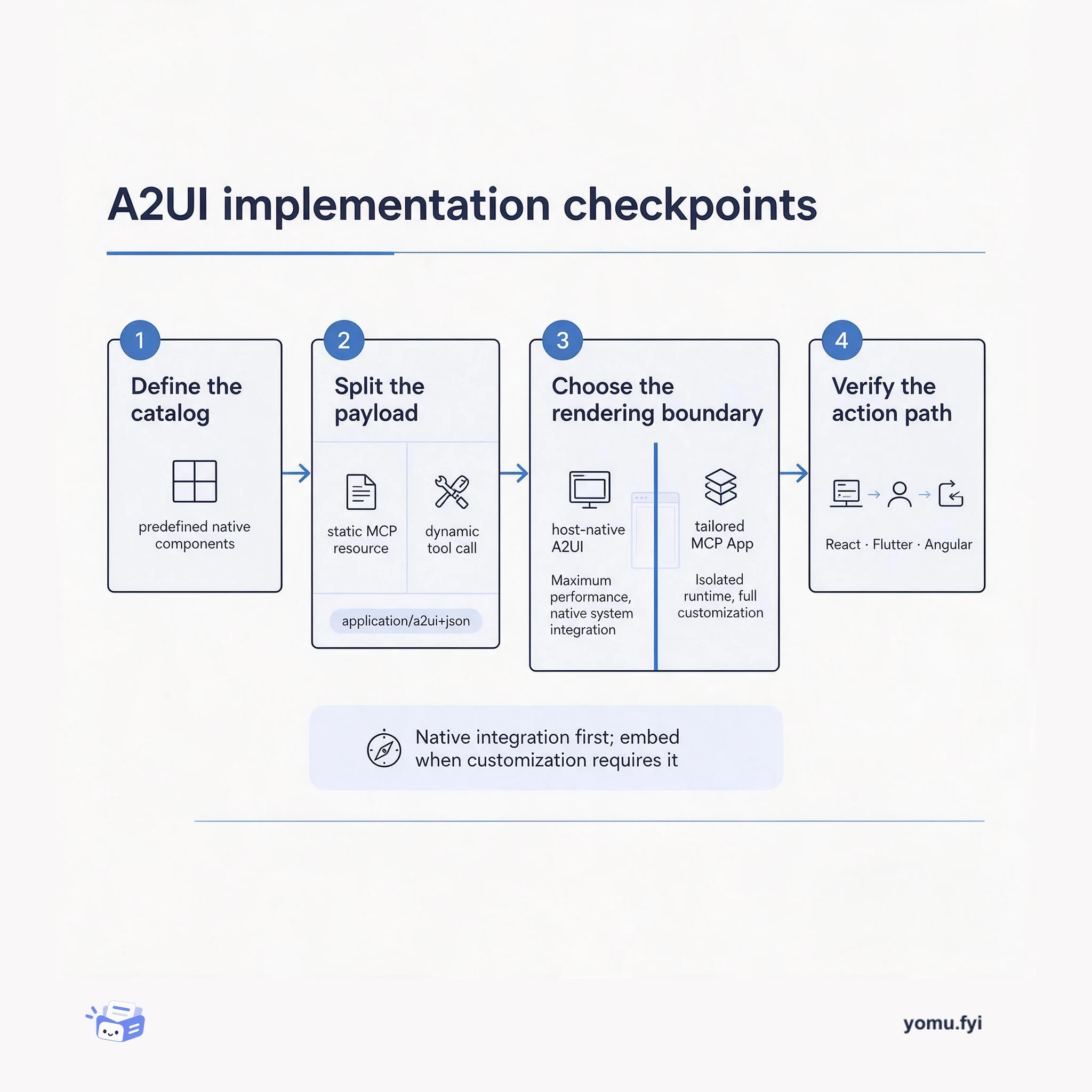
A2UI Implementation Checkpoints: Keep Agents and Rendering in Their Lanes
A practical guide to applying A2UI: define the component boundary, separate tool data from UI resources, choose native or embedded rendering, and verify the action path.
 AnthropicAnnouncement
Anthropic and Infosys announced a collaboration to develop and deliver enterprise AI solutions for telecommunications, financial services, manufacturing, and software development. The work combines Anthropic’s Claude models and Claude Code with Infosys Topaz, an AI-first set of services, solutions, and platforms, with an emphasis on governance and transparency for regulated industries. Using tools including the Claude Agent SDK, the partners plan to help clients build persistent agents for multi-step work such as claims processing, code generation and testing, compliance reviews, network operations, risk assessment, and legacy-system modernization. They also describe applications for product design and simulation, software debugging, and routine enterprise operations through Claude Cowork, while noting that Claude is available on Amazon Bedrock, Google Cloud Vertex AI, and Microsoft Azure.
The collaboration is motivated by the gap between AI models that work in demonstrations and systems suitable for regulated industries, where domain expertise, precision, compliance, and deep industry knowledge are required.
Anthropic and Infosys will combine Claude models, Claude Code, the Claude Agent SDK, Claude Cowork, and Infosys Topaz to build industry-specific AI agents, modernize legacy systems, accelerate software development, and automate enterprise processes.
The partners plan to build persistent AI agents for multi-step tasks including claims processing, code generation and testing, and compliance reviews.
Industry applications include network operations and customer lifecycle management in telecommunications, risk and compliance automation in financial services, and product design and simulation in manufacturing.
Claude is available through Amazon Bedrock, Google Cloud Vertex AI, and Microsoft Azure, according to the announcement.
Summaries are generated from the original by a language model. Check the original before relying on it.
See the idea
A practical guide to applying A2UI: define the component boundary, separate tool data from UI resources, choose native or embedded rendering, and verify the action path.
Keep reading
The Good Stuff
Paid picks we use ourselves. Links carry a referral code — a subscription through one earns us a commission at no extra cost to you.
One useful email. Unsubscribe anytime.
