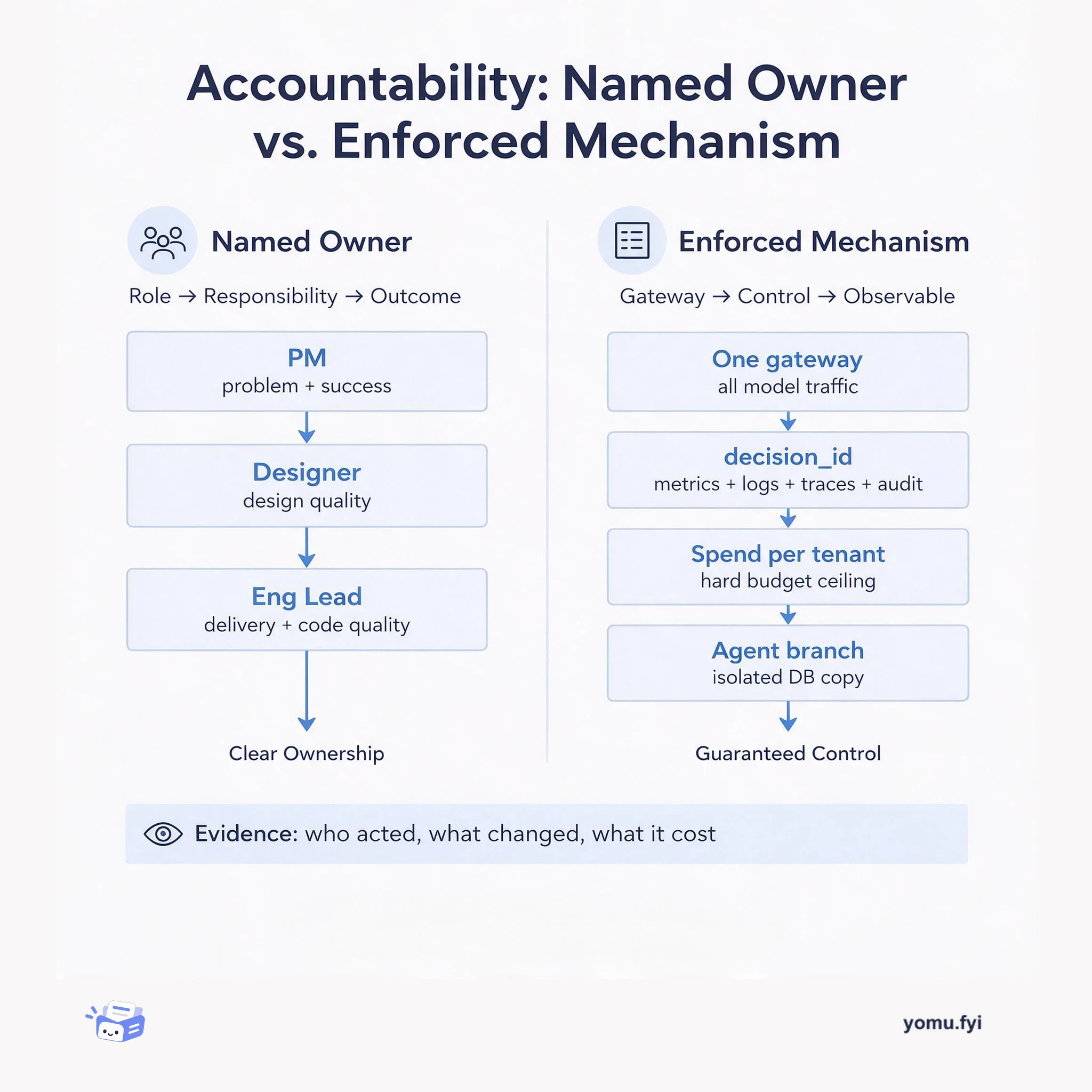
Accountability: Named Owner or Enforced Mechanism?
A side-by-side comparison of the two accountability models engineers actually rely on: a named human owner per outcome, and system-enforced traces, budgets, and isolation.
 DatabricksParastou Eslami, Douglas MooreProblem & solution
Medical imaging’s real bottleneck is not model architecture but data access. Hospitals, academia, medtech, and pharma all struggle to extract, de-identify, and query imaging data locked inside PACS and vendor archives. The approach proposed is a data lakehouse model on Databricks using a medallion architecture that ingests raw DICOM into Bronze, extracts de-identified metadata into Silver, and curates queryable Delta tables in Gold. This foundation unifies imaging with multi-omics, clinical-trial, and real-world data under a single governance model. The algorithms exist; the missing piece is a governed, queryable, and linkable data layer that makes the model the easy 10% again.
Medical imaging data, the largest and most heterogeneous data type in R&D, is locked inside PACS and vendor archives, making it hard to query, link to other data types, or share across institutions for AI model training. This structural bottleneck prevents generalizable models and reproducible research.
Build a data lakehouse (Databricks) on a medallion architecture: ingest raw DICOM into a Bronze layer, de-identify and extract structured metadata into Silver, and curate queryable Delta tables in Gold. Govern images and metadata under Unity Catalog with RBAC, lineage, and audit so that imaging data joins with clinical, omics, and trial data without copying.
Radiology accounts for 76% of FDA-authorized AI/ML devices, yet nearly all are narrow and human-supervised because pulling a cohort requires extracting images from PACS, de-identifying DICOM headers and burned-in PHI, and finding compute.
A federated model trained across 20 hospitals in the EXAM study gained 16% AUC and 38% generalizability over single-site models without moving patient data—only model weights traveled.
A medallion architecture (Bronze/Silver/Gold on a lakehouse) ingests raw DICOM at 7x speed, de-identifies via VLM, and outputs queryable Delta tables that join imaging to clinical and omics data under Unity Catalog governance.
Single-institution models suffer from data heterogeneity across scanners, protocols, and sites. The EXAM study showed that federated learning across 20 hospitals improved AUC by 16% and generalizability by 38% compared to single-site models.
A data lakehouse stores images as governed files in Unity Catalog, extracts structured metadata into Delta tables, and enforces RBAC and lineage so that imaging, clinical, and omics data are queried together under one governance model without ETL to separate silos.
Because the data bottleneck is structural, not algorithmic. The model can demo in a week, but cleaning, linking, de-identifying, and governing data across modalities and institutions takes months and remains the core challenge.
Summaries are generated from the original by a language model. Check the original before relying on it.
See the idea
A side-by-side comparison of the two accountability models engineers actually rely on: a named human owner per outcome, and system-enforced traces, budgets, and isolation.
Keep reading
The Good Stuff
Paid picks we use ourselves. Links carry a referral code — a subscription through one earns us a commission at no extra cost to you.
One useful email. Unsubscribe anytime.
