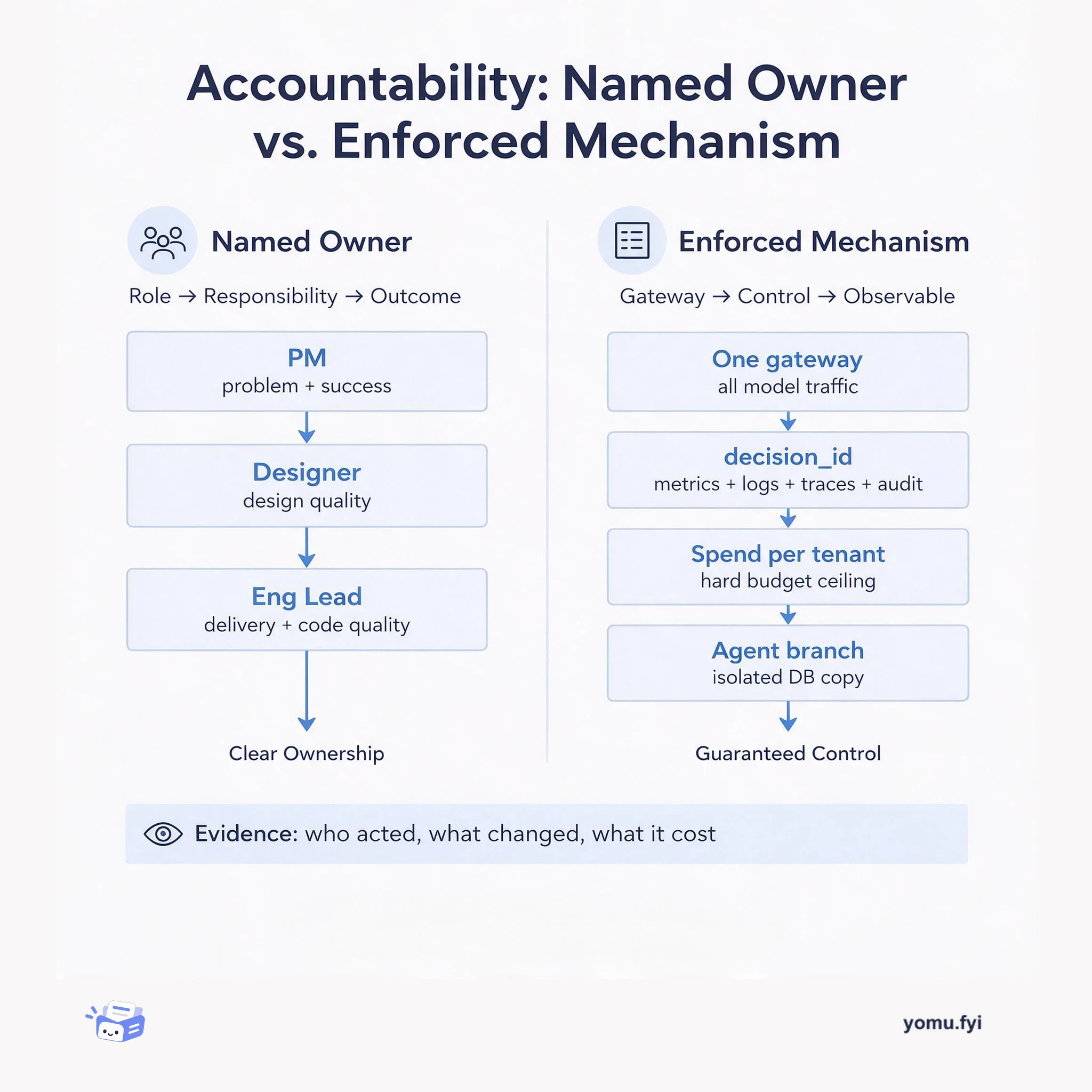
Accountability: Named Owner or Enforced Mechanism?
A side-by-side comparison of the two accountability models engineers actually rely on: a named human owner per outcome, and system-enforced traces, budgets, and isolation.
Loading…
Topic
2 posts about Systems Thinking. Every summary links to the original.
See the idea
A side-by-side comparison of the two accountability models engineers actually rely on: a named human owner per outcome, and system-enforced traces, budgets, and isolation.
The Good Stuff
Paid picks we use ourselves. Links carry a referral code — a subscription through one earns us a commission at no extra cost to you.
Newest first
Technology products inevitably become obsolete as industries shift, and failing to adapt can kill a business faster than most founders expect. Success breeds complacency, which breeds failure, making paranoia a necessary survival trait for everyone in tech. Historical examples like satnav manufacturers gutted by the iPhone and telcos disrupted by WhatsApp show that customers will abandon an incumbent for a simpler, faster way to achieve their goals. To avoid this fate, Intercom advocates thinking of a product as a flexible system rather than a set of screens or user flows, allowing it to integrate across new mediums. This systems approach enables the product to remain relevant through multiple technology cycles by focusing on helping customers make progress in their lives.
Systems thinking is a top-down design approach that considers the overarching system before diving into specific interface interactions, preventing premature detail fixation. It is based on Donella H. Meadows’ definition that a system is an interconnected set of elements coherently organized to achieve something, prompting questions about elements, interconnections, and purpose. For Intercom’s Articles product, the team identified the article as the core element and mapped how articles are created, delivered, and interact with other systems, resulting in a complex system diagram. This systems view revealed opportunities like an intelligent suggestion engine that recommends articles during conversations and allowed the team to prioritize the most important parts to build first. The approach also encouraged reusing the Messenger Reactions component for article feedback, sharing design and implementation details like hover effects and clicked states across contexts.
The best engineering reads, once a week.

