Brand: Artifact vs Operating System
Compare two mental models for brand: a static artifact (logos, guidelines, centralized control) and a living operating system (values, APIs, support, trust). See which choices fit your engineering team.
A side-by-side comparison of the two accountability models engineers actually rely on: a named human owner per outcome, and system-enforced traces, budgets, and isolation.
Accountability in engineering is usually treated as one idea, but the source material shows two distinct models that solve different problems. The human model assigns a named owner per outcome: a product manager owns problem analysis and success, a designer owns design quality, and an engineering lead owns delivery and code quality. The system model makes the work itself attributable, funnelling all model traffic through one gateway where a shared decision_id threads metrics, logs, traces, and an audit ledger, spend is attributed per tenant, and each coding agent gets an isolated database branch. Most teams need both, because a named owner without evidence cannot prove anything, and evidence without an owner has nobody to act on it.
The operability post routes all model traffic through one gateway and threads a shared decision_id across metrics, logs, traces, and the audit ledger. That means any request can be reconstructed end to end without correlating separate systems by timestamp or guesswork. It also gives you a single place to attach a kill switch and per-tenant budget ceilings.
Parallel agents on a shared database cause schema conflicts, test interference, and data exposure, so accountability gets murky about whose change broke what. Lakebase creates an isolated copy-on-write branch per agent and per pull request, and schema changes are promoted to the parent branch at deployment rather than merged. The result is that each change has one owner and one reviewable diff.
The posts behind it
 Databricks · · Problem & solution
Coding agents working in parallel on shared databases create schema conflicts, test interference, and data exposure risks. Lakebase Postgres solves this with database branching, which creates an isolated copy of an entire database in under a second using copy-on-write. Each agent gets its own database branch via a post-checkout Git hook tied to a worktree, and each pull request gets an ephemeral branch through CI tooling. Schema changes are tracked in code with migration tools such as Drizzle or Alembic and promoted to the parent branch during deployment, not by merging database branches. Idle branches scale to zero, so running many concurrent agents incurs no compute cost for unused branches.
Databricks · · Problem & solutionMedical imaging’s real bottleneck is not model architecture but data access. Hospitals, academia, medtech, and pharma all struggle to extract, de-identify, and query imaging data locked inside PACS and vendor archives. The approach proposed is a data lakehouse model on Databricks using a medallion architecture that ingests raw DICOM into Bronze, extracts de-identified metadata into Silver, and curates queryable Delta tables in Gold. This foundation unifies imaging with multi-omics, clinical-trial, and real-world data under a single governance model. The algorithms exist; the missing piece is a governed, queryable, and linkable data layer that makes the model the easy 10% again.
 Stack Overflow · · Explainer
Level 5 covers operability for LLM systems: daily running, cost control, provider outage survival, and fast shutdown on misbehavior. A single gateway funnels all model traffic, measuring cost, routing requests, enabling failover, and hosting an instantaneous kill switch; a shared decision_id threads metrics, logs, traces, and the audit ledger. Observability supplements RED metrics with a decision layer capturing auto vs. human splits, guardrail blocks, judge disagreements, token spend per tenant and capability, and shadow-eval pass ratios via tiered structured logs. Cost controls attribute spending at the gateway per tenant and capability, with hard budget ceilings; optimization follows order: skip model, batch, cache, right-size, trim—each step profiled against quality. The platform spine includes stateless agent services, the gateway, an audit datastore, cache, secrets store, and object storage—scoped with least-privilege IAM and encryption, avoiding queues or vector stores until warranted.
 Intercom · · Explainer
Intercom shares the process it used to scale its product team from a smaller size to four Product Managers, four Designers, and 25 Engineers over 12-18 months. The process is built on four areas: decision-making guidelines, clear role-based accountability, a lightweight transparent roadmap, and a culture of goal setting. The roadmap has three timeframes: solid releases for the next 4-6 weeks, planned high-level briefs for the following months, and speculative ideas beyond that. Accountability is assigned by role, with the PM responsible for problem analysis and success, the Designer for design quality, and the Engineering Lead for delivery and code quality. Teams set weekly goals tracked in an internal tool called Hustle and daily goals on whiteboards, with weekly demos every Friday to reinforce the cadence of building.
More like this
Compare two mental models for brand: a static artifact (logos, guidelines, centralized control) and a living operating system (values, APIs, support, trust). See which choices fit your engineering team.
A side-by-side comparison of copy-and-replay recovery and branch-at-a-point restores, showing why restore time scales with data size in one model and not the other.
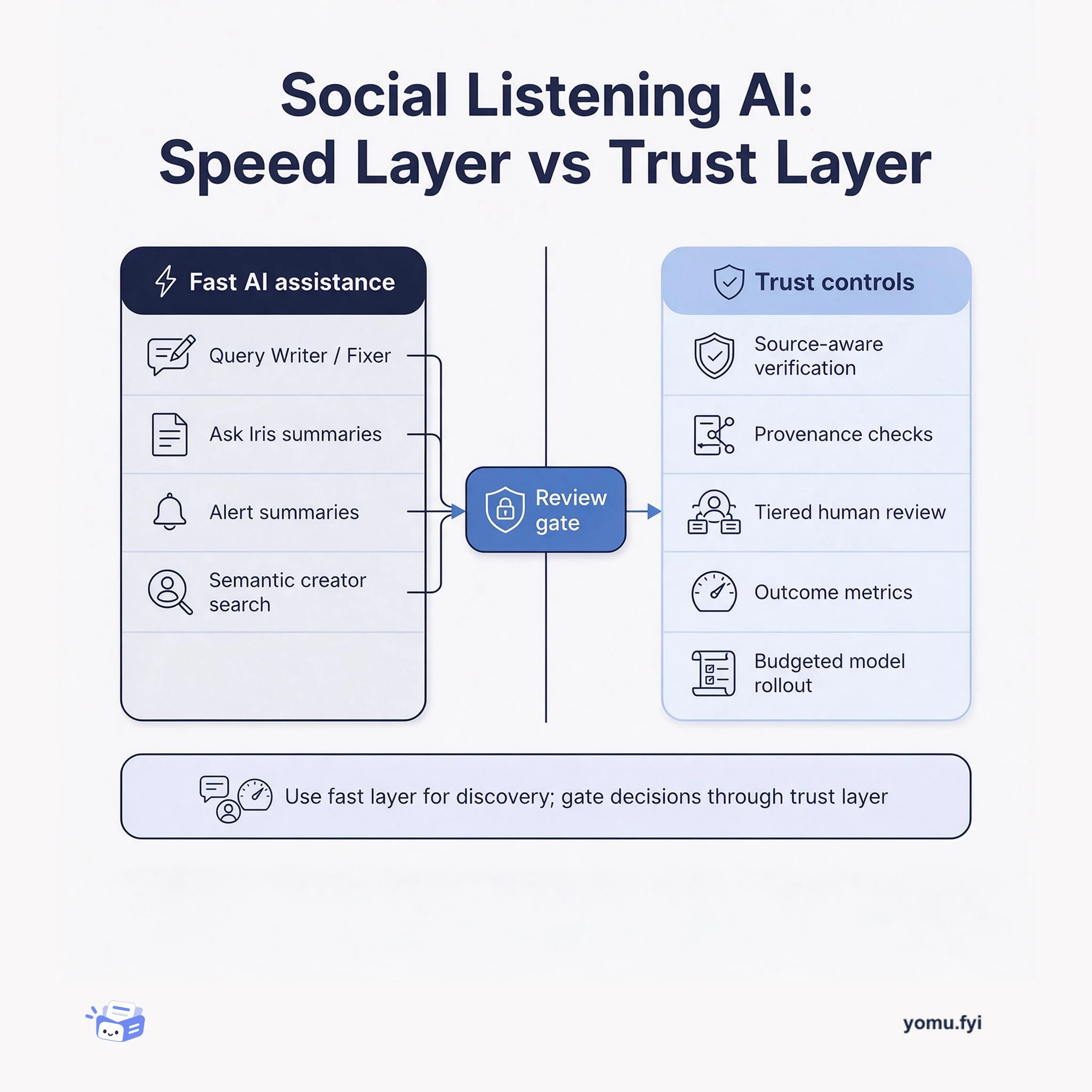
Compare Brandwatch's AI speed features—Ask Iris, Query Writer, and AI summaries—with the governed checks that make social insights trustworthy before teams act.
The Good Stuff
Paid picks we use ourselves. Links carry a referral code — a subscription through one earns us a commission at no extra cost to you.
One useful email. Unsubscribe anytime.