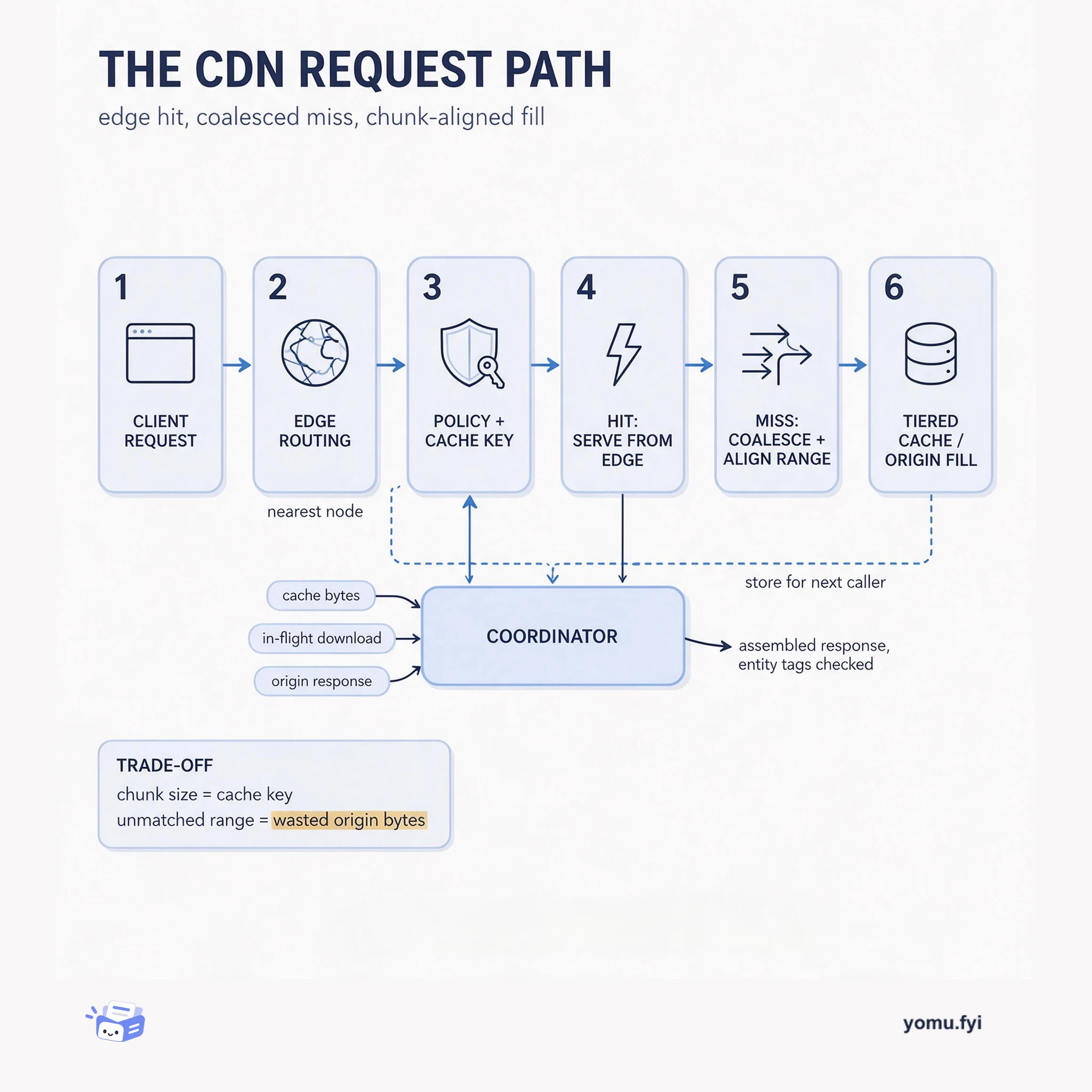
The CDN Request Path: From Edge Hit to Chunk-Aligned Origin Fill
A CDN turns one client request into a short ordered pipeline: edge routing, cache-key lookup, request coalescing, chunk-aligned origin fetch, and a cached response for the next caller.
 CloudflareErik EngstromAnnouncement
Cloudflare launched a post-quantum GeoKey Manager in closed beta for its Data Localization Suite to protect decryption keys from harvest now, decrypt later attacks. The system uses hybrid ML-KEM-768 and X25519 cryptography, combining a NIST-standard post-quantum scheme with classical encryption to wrap each regional root key. Regional root keys are symmetric secrets tied to one geography and distributed to authorized edge servers via a separate provisioning service, not through the global Quicksilver system, with membership refreshed daily. Servers missing a required key fail closed, rejecting requests or failing to start, guaranteeing keys never leave the region; each wrapped private key carries metadata for service context and epoch. General availability is planned for Q1 2027, with integrations for Cloudflare One and CDN under development, and existing DLS customers can register for testing.
Governments, financial institutions, and defense organizations process highly sensitive data that remains sensitive for years; classical public-key encryption is vulnerable to harvest now, decrypt later attacks where stored ciphertext can later be broken by quantum computers. Cloudflare must combine data sovereignty regulations that require processing only within a given region with post-quantum protection for geographically fenced key management.
Uses hybrid ML-KEM-768 and X25519 encryption. A regional root key is a symmetric secret tied to one region, distributed only to authorized edge servers in that geography via a separate provisioning service, not through the global Quicksilver system. Application-specific key pairs derived from the regional root key are created per service context such as Tunnel or Gateway. Each wrapped customer private key carries metadata for service context, regional boundary, and epoch.
The system uses hybrid ML-KEM-768 and X25519 protection combining a NIST-standard post-quantum scheme with classical cryptography to prevent harvest now, decrypt later attacks.
Regional root keys never leave their designated geography; they are distributed via a separate provisioning service, and servers missing required keys fail closed to prevent out-of-region decryption.
Application-specific key pairs derived from regional root keys limit the blast radius; compromising a Tunnel key in Germany does not expose Gateway keys for the same region.
Regional root keys are delivered only to authorized edge servers in a chosen geography via a separate provisioning service, not through Cloudflare's global Quicksilver configuration distribution system.
If a request arrives at a server that lacks the required regional root key, the edge key service fails closed, rejecting the request rather than risking decryption outside the approved region.
Each regional root key has an epoch; rotation creates a new epoch and the new key replaces the old one. The provisioning service refreshes keys without requiring customer action.
Summaries are generated from the original by a language model. Check the original before relying on it.
See the idea
A CDN turns one client request into a short ordered pipeline: edge routing, cache-key lookup, request coalescing, chunk-aligned origin fetch, and a cached response for the next caller.
Keep reading
The Good Stuff
Paid picks we use ourselves. Links carry a referral code — a subscription through one earns us a commission at no extra cost to you.
One useful email. Unsubscribe anytime.
