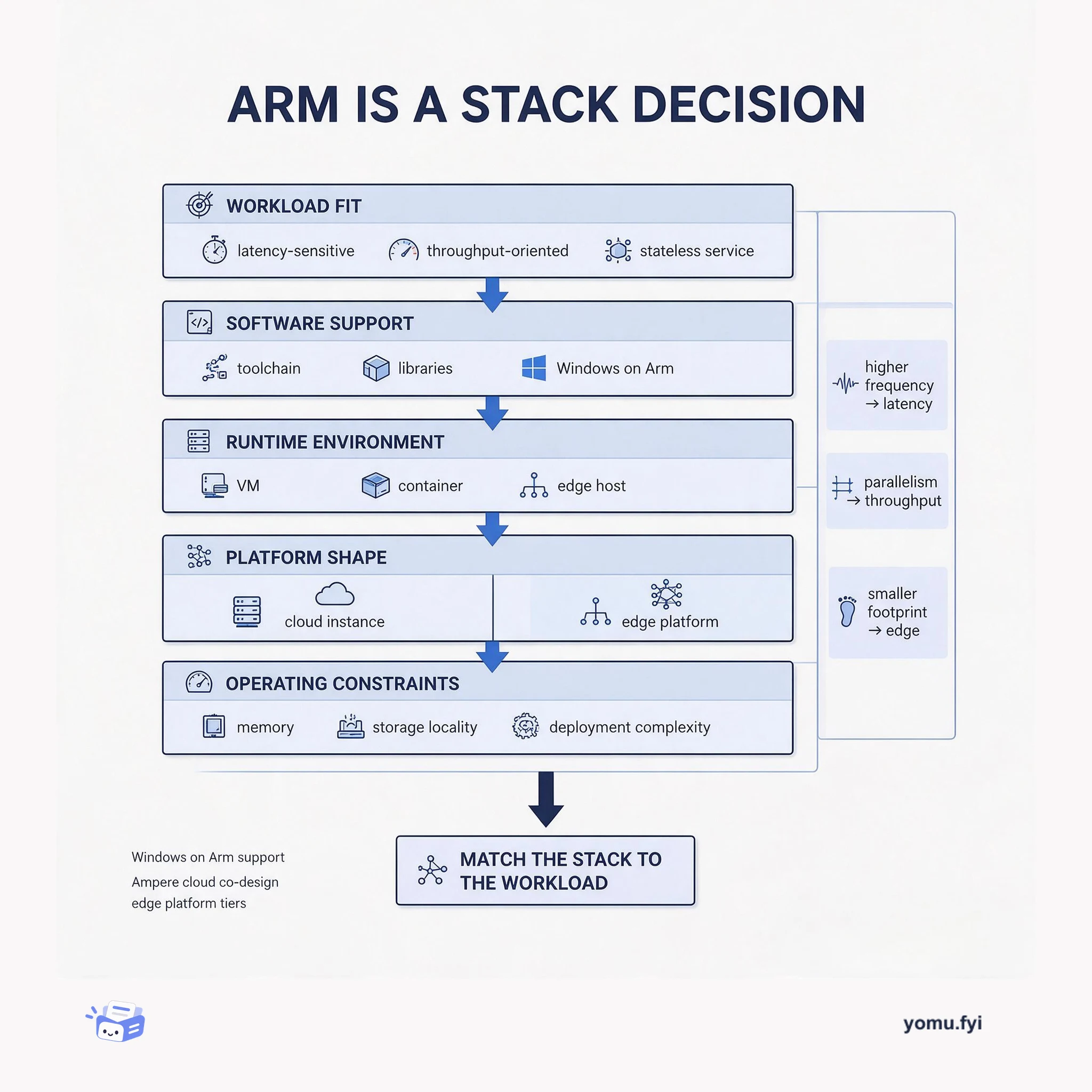
ARM Is a Stack Decision, Not a CPU Checkbox
An architecture view of ARM deployments, from workload fit and software support to platform choice, showing where performance, memory, storage, and operations shape the decision.
Loading…
Topic
9 posts about Edge Computing. Every summary links to the original.
See the idea
An architecture view of ARM deployments, from workload fit and software support to platform choice, showing where performance, memory, storage, and operations shape the decision.
The Good Stuff
Paid picks we use ourselves. Links carry a referral code — a subscription through one earns us a commission at no extra cost to you.
Newest first
D1, Cloudflare’s serverless SQLite database, has seen 15x growth in live databases over the past year and scales by keeping query execution on the edge in Durable Objects, separate from the control plane’s metadata operations. The control plane uses an Edge API Worker with Hyperdrive to access Postgres clusters for transactional metadata, while Workers KV caches database-to-Durable-Object mappings for fast edge lookups. Database creation completes in about 1.6 seconds by generating a Durable Object ID, persisting metadata to Postgres, and storing the mapping in Workers KV, with the Durable Object lazily initialized on first query. Storage usage enforcement uses atomic counters in Workers KV that are checked locally on each query and updated asynchronously after execution, avoiding any central database round trip during the query. Precomputed aggregations for billing are stored in ClickHouse, and guiding principles such as eventual consistency and idempotency further reduce reliance on centralized components.
Managing edge infrastructure at scale across hundreds of locations demands consistent management rather than disparate tools. Red Hat’s layered approach organizes tools into three compartments: a universal foundation, OS-level fleet management for RHEL, and Kubernetes lifecycle management for OpenShift. The universal layer includes Ansible for agentless automation, Quay for container image registry with geo-replication, Lightspeed for proactive drift detection and compliance, and Trusted Software Supply Chain for end-to-end security. For RHEL-based edges, Edge Manager provides SaaS fleet management with OTA updates while Satellite offers on-premise content management for air-gapped environments. For OpenShift-based edges, Advanced Cluster Management handles cluster lifecycle and zero-touch provisioning while Advanced Cluster Security enforces container security across the fleet.
Connected vehicles face intermittent connectivity in tunnels, rural roads, and underground garages, yet drivers expect reliable AI assistance during those moments. The post argues that offline capability is a requirement, not a fallback, for trustworthy in-vehicle AI. It proposes three principles: design for the moment of need, treat vehicle knowledge as an evolving product asset, and separate availability from connectivity. A reference architecture uses ObjectBox for local persistence and synchronization with MongoDB Atlas, which provides the cloud foundation for shared knowledge and updates. The enduring pattern is to keep critical interactions available at the edge while using the cloud for scale, coordination, and continuity when connectivity returns.
Red Hat OpenShift topologies are mapped to edge-site constraints such as hardware footprint, availability, rack space, power, and workload needs. It is presented as a micro cloud that brings full Kubernetes functionality to server-class edge hardware, with optional virtualization and software-defined storage. Cluster capabilities can be minimized with baselineCapabilitySet: none and selectively enabled later, although added capabilities cannot be removed without reinstalling. Options span single-node OpenShift, which requires 4 vCPUs, 16 GB RAM, and 120 GB storage, two-node designs using fencing or an arbiter, and three-node compact clusters for resilient high availability. Each topology retains shared management and security practices, so selection depends on the physical footprint, failure tolerance, and scale required at the site.
Choosing an edge platform requires balancing hardware footprint, workload needs, high availability, and operational complexity; the options range from RHEL with Podman or KVM to OpenShift clusters. The guide organizes Red Hat's offerings into RHEL-based and OpenShift-based deployments, noting that both traditional virtual machines and modern containerized workloads can coexist and that platforms can overlap as requirements grow. It details image-mode RHEL (bootc), transactional updates with rollbacks, efficient over-the-air delivery, offline installation, and dependency pre-resolution for constrained or disconnected sites. RHEL is positioned for static workloads of one to five components, while Red Hat Device Edge adds MicroShift when lightweight Kubernetes is needed. Kubernetes becomes more appropriate for larger microservices or event-driven systems, automated recovery, dynamic workloads, cross-environment scaling, and rolling updates; the series next covers OpenShift topologies.
At Sonoma Raceway, Google Developer Experts built an AI-powered race coach to turn vehicle telemetry into split-second driving advice, extending an earlier pilot that handled basic telemetry. The system uses Antigravity for stateful orchestration and ingestion, Python and Jetpack Compose for mobile processing and display, Agent Development Kit for agent coordination, and hybrid Gemma 4 edge reasoning plus Gemini API cloud analysis. A custom USB interface connected a Pixel 10 directly to the vehicle telemetry network, providing a 10 Hz stream from hundreds of sensors, while an activated on-device TPU reached 40 tokens per second for local coaching alerts delivered through text-to-speech. The test identified a throttle application zone in Turn 2 associated with a 0.1-second gain, and the initiative is scheduled to continue at Interlagos, Brazil.
IoT in manufacturing is presented as an operational architecture for collecting machine data, improving production and supply-chain visibility, and preventing equipment failures under strict latency, reliability, and safety requirements. The guide covers device selection, sensor placement, tiered sampling, edge-to-cloud pipelines, platform criteria, security, compliance, workforce training, and a phased deployment roadmap. Its technical split sends high-frequency vibration and acoustic signals to edge gateways for local processing while cloud systems support stateful analytics, predictive maintenance scoring, and model training; protocols such as MQTT, OPC-UA, AMQP, and Modbus are evaluation criteria. Reported examples include multi-factory OEE monitoring across more than 200 production lines, reducing reporting lag from 24 hours to under five minutes, digital twins for maintenance simulation, and IoT logistics routing. The action plan recommends starting with predictive maintenance and OEE monitoring on one line before scaling.
Fly.io announces GPU support for its cloud, extending its near-user deployment model to AI and machine-learning workloads at the edge. The offering attaches Nvidia A100 GPUs with 40GB or 80GB of RAM, CUDA support, eight AMD EPYC CPU cores, and volumes up to 500GB; L40s are also listed as coming soon and then noted as available. A sample fly.toml deploys Ollama with a 100GB model volume, while auto-start and auto-stop settings can reduce min_machines_running to zero when idle. GPU apps can scale across supported regions, retaining the same public IP address and TLS certificates, with an Amsterdam example using fly scale count 2 --region ams. Listed prices are $2.50 per hour for A100 40GB and $3.50 for A100 80GB, with reserved-instance and dedicated-host discounts available.
Fly.io announces $25MM from A16Z and existing investors followed by $70MM led by EQT Ventures, and uses the occasion to explain its platform vision. Its central problem is the “two hour” barrier: ordinary tooling makes global deployment, VMs, real-time features, encryption, and clustered databases too difficult to pursue quickly, leaving many applications concentrated in us-east-1. The company’s approach is to build a hardware-backed platform and toolchain spanning many regions, with Fly Machines making on-demand VM creation as straightforward as a function call. Funding will support 33 regions, support and reliability, advanced storage, security capabilities, and new hardware while preserving a self-service experience for containerized applications. The stated user-facing promise is that an existing Docker container can run on Fly.io in single-digit minutes and reach every continent in another minute or two.
The best engineering reads, once a week.






