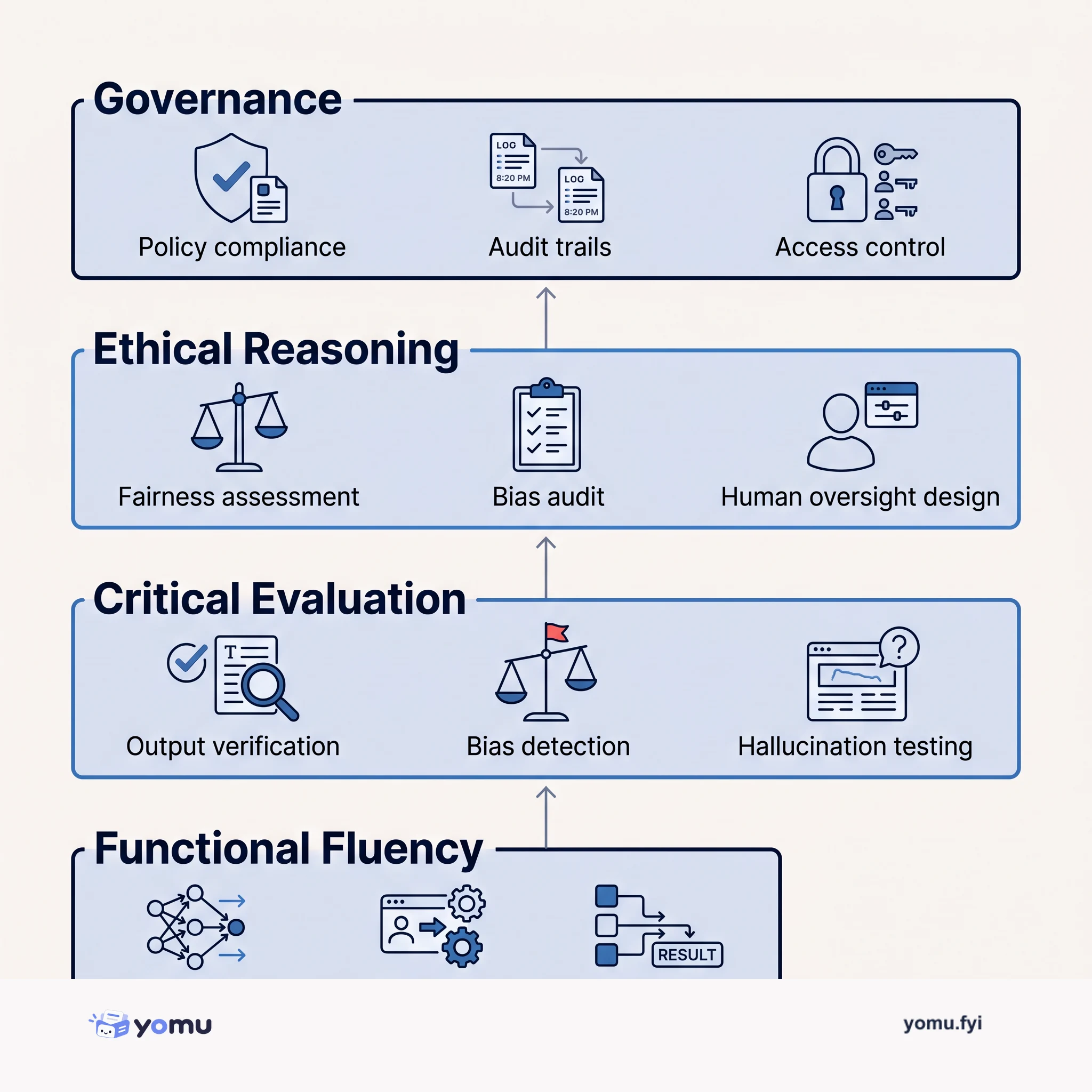
AI Literacy: The Four Domains Engineers Need
AI literacy spans functional fluency, critical evaluation, ethical reasoning, and governance. Engineers need all four to deploy AI responsibly and make sound technical decisions.
 DatabricksDatabricks StaffExplainer
AI literacy is presented as the ability to understand how AI works, use its tools effectively, evaluate outputs critically, and recognize ethical implications. The guide organizes this fluency into functional, critical, and ethical domains, with progression from defining terms and crafting prompts to comparing tools, auditing outputs for bias, and designing human oversight. It explains that large language models generate probable continuations from statistical patterns in training data, so hallucinations and bias require verification against trusted sources rather than assuming factual correctness. For education and organizations, it recommends distributed curriculum or role-specific modules, hands-on assignments, measurable assessment checkpoints, governance policies, internal champions, iterative pilots, and longer-term impact metrics.
Generative AI tools have moved from novelty to daily workplace utility, increasing the need for people to use them effectively, evaluate their outputs, and understand their limitations and ethical implications. Higher education and organizations need ways to build and measure these competencies across roles and departments.
The guide proposes a functional, critical, and ethical AI literacy framework organized around understanding, evaluating, and using AI. It combines progression levels, prompt-writing and verification exercises, role-specific curriculum, behavior-based assessments, governance policies, internal champions, iterative pilots, and a six-month rollout roadmap.
AI literacy frameworks commonly separate functional skills such as prompting, critical evaluation of accuracy and bias, and ethical concerns including privacy and academic integrity.
Large language models generate statistically probable continuations from training patterns rather than verifying facts; hallucinations may be indicated by unlocatable citations or answers that change when prompted again.
A six-month rollout can use month one for baseline assessment, months two through four for module delivery and champion training, and months five and six for impact measurement and refinement.
Summaries are generated from the original by a language model. Check the original before relying on it.
See the idea
AI literacy spans functional fluency, critical evaluation, ethical reasoning, and governance. Engineers need all four to deploy AI responsibly and make sound technical decisions.
Keep reading
The Good Stuff
Paid picks we use ourselves. Links carry a referral code — a subscription through one earns us a commission at no extra cost to you.
One useful email. Unsubscribe anytime.
