API Versioning as a Translation Layer
API versioning as an architecture: requests enter through a version header, pass through a chain of reversible version changes, and reach controllers that only ever see the latest model.
AI literacy spans functional fluency, critical evaluation, ethical reasoning, and governance. Engineers need all four to deploy AI responsibly and make sound technical decisions.
AI literacy is not a single skill but a layered competency: functional fluency lets you use AI tools and understand how models work; critical evaluation teaches you to verify outputs and spot hallucinations; ethical reasoning helps you recognize bias and design human oversight; governance ensures your systems comply with policy and audit requirements. Each domain builds on the others. Without functional fluency, critical evaluation is impossible. Without ethics, governance becomes checkbox compliance. Engineers who master all four can architect AI systems that are both capable and trustworthy, reducing costly failures and regulatory risk.
The posts behind it
 Databricks · · Explainer
The post argues that healthcare AI governance must extend beyond security controls to include knowledge, context, and ontology: security governs access, while semantics determine what data means and whether models can trust it. DEP frames classification tags, model cards, data contracts, and lineage as machine-readable governance artifacts, with Unity Catalog serving as the metadata runtime for agents. Build agents can generate ETL, testing, de-identification, and deployment, while analytic agents answer questions over individual data products; human stewards approve proposals and own accountability. A shared lifecycle certifies the data product and AI track through gates using scores for governance, quality, semantics, and ownership, with certification expiring after relevant changes or failures. The approach applies data-layer ABAC to SQL and vector retrieval, logs agent prompts with lineage, and connects readiness metrics to model economics by enabling smaller models when cataloged data supplies sufficient context.
 Jetbrains · · Explainer
An interview with Python educator Ardit Sulce examines how beginners should learn programming as AI changes development and teaching. Sulce says AI now handles many small questions, while teachers provide curated learning paths, judgment, and context; he also argues that students should preserve productive struggle while outsourcing setup friction. He recommends evaluating understanding through code explanation, review, and debugging rather than treating working code as proof, and identifies reading unfamiliar code, debugging, and system understanding as important junior skills. His proposed three-stage path moves from writing syntax by hand in a professional IDE, to using AI as a tutor, and finally to using it as a co-worker while reviewing increasingly complex projects.
 Stack Overflow · · Explainer
The conversation examines the economics and platform implications of operating dozens or hundreds of AI agents rather than a small number of human-driven workflows. Andi Gutmans argues that many current models are already sufficient for automation, shifting the optimization problem to the complete system: model, harness, context, personalization, and evaluation. The goal is the least sophisticated model and smallest viable context that produce a reliable outcome at the lowest cost, with better trajectories reducing reasoning loops and token processing; Google’s stated approach is to hill climb models and data together. The discussion also addresses cost governance, search and observability for agents as a distinct persona, human-in-the-loop handling, and the continuing importance of computer-science fundamentals, agentic fluency, and business judgment.
Databricks · · ExplainerAI literacy is presented as the ability to understand how AI works, use its tools effectively, evaluate outputs critically, and recognize ethical implications. The guide organizes this fluency into functional, critical, and ethical domains, with progression from defining terms and crafting prompts to comparing tools, auditing outputs for bias, and designing human oversight. It explains that large language models generate probable continuations from statistical patterns in training data, so hallucinations and bias require verification against trusted sources rather than assuming factual correctness. For education and organizations, it recommends distributed curriculum or role-specific modules, hands-on assignments, measurable assessment checkpoints, governance policies, internal champions, iterative pilots, and longer-term impact metrics.
Databricks · · ExplainerArtificial intelligence (AI) is a branch of computer science that enables machines to perform tasks associated with human intelligence, including learning, reasoning, pattern recognition and decision-making. Modern AI generally learns patterns from large datasets, tunes internal weights and parameters during training, evaluates outputs on held-out data, and applies the resulting model during inference to classify, predict, generate content or trigger actions. Most organizations fine-tune existing foundation models rather than train from scratch, while output quality remains dependent on the completeness, bias and quality of training data. The page separates reactive machines and limited memory from theoretical theory of mind and self-aware systems, and distinguishes today’s narrow AI from theoretical general AI and superintelligence. It also describes generative AI, common applications, risks including hallucinations, bias, privacy and security gaps, and governance, concluding that practical adoption depends on real problems, trusted data and responsible oversight.
Databricks · · ExplainerAer Lingus is redirecting a significant share of its IT and change spending from traditional maintenance toward a Databricks-powered data foundation, addressing legacy systems that trap information in departmental silos. Dave O’Donovan says the airline spent the past 18 months prioritizing platform development, governance, data quality and data literacy rather than chasing each new AI product. Databricks was selected for a unified lakehouse architecture, with data warehousing, Genie’s plain-English querying and real-time operational data intended to broaden access beyond specialist teams. At Aer Lingus’s Operations Control Center, combining sensor and operational inputs gives teams a fuller real-time view for disruption decisions, while commercial teams use live insights to adjust pricing. The transformation also includes a Data Literacy Academy, a 75/25 capacity split between foundational work and innovation, a 20-person Continuous Improvement team, and experiments with agents for business-case development and CFO review.
More like this
API versioning as an architecture: requests enter through a version header, pass through a chain of reversible version changes, and reach controllers that only ever see the latest model.
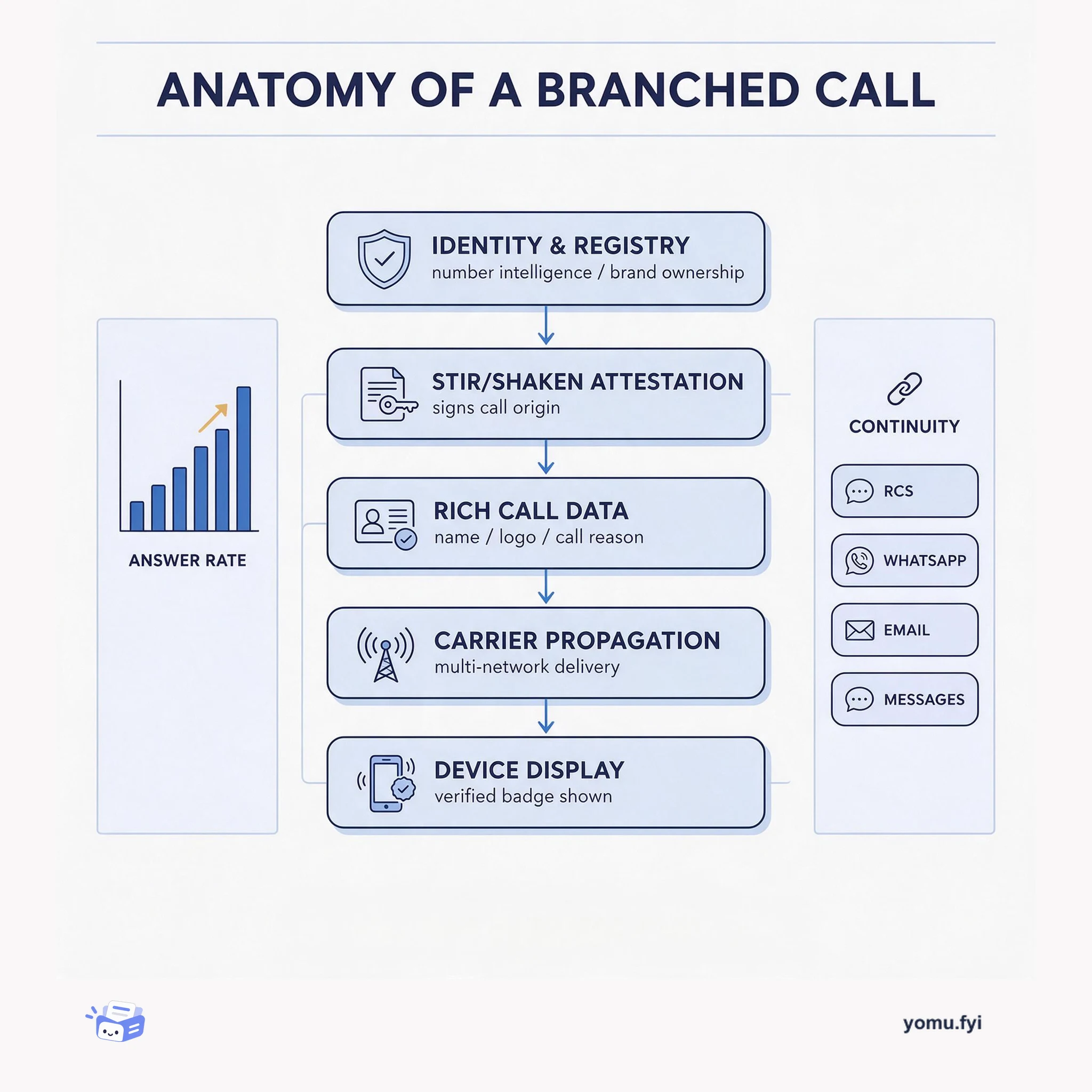
The Branded Calling trust chain, layer by layer: how identity, STIR/SHAKEN attestation, Rich Call Data, and carrier delivery combine so a verified brand name reaches the recipient's screen.
BIAN gives banks a shared vocabulary and service-domain contracts that sit between business concepts and the systems implementing them. See how domains, contracts, and governed access stack into one architecture.
The Good Stuff
Paid picks we use ourselves. Links carry a referral code — a subscription through one earns us a commission at no extra cost to you.
One useful email. Unsubscribe anytime.