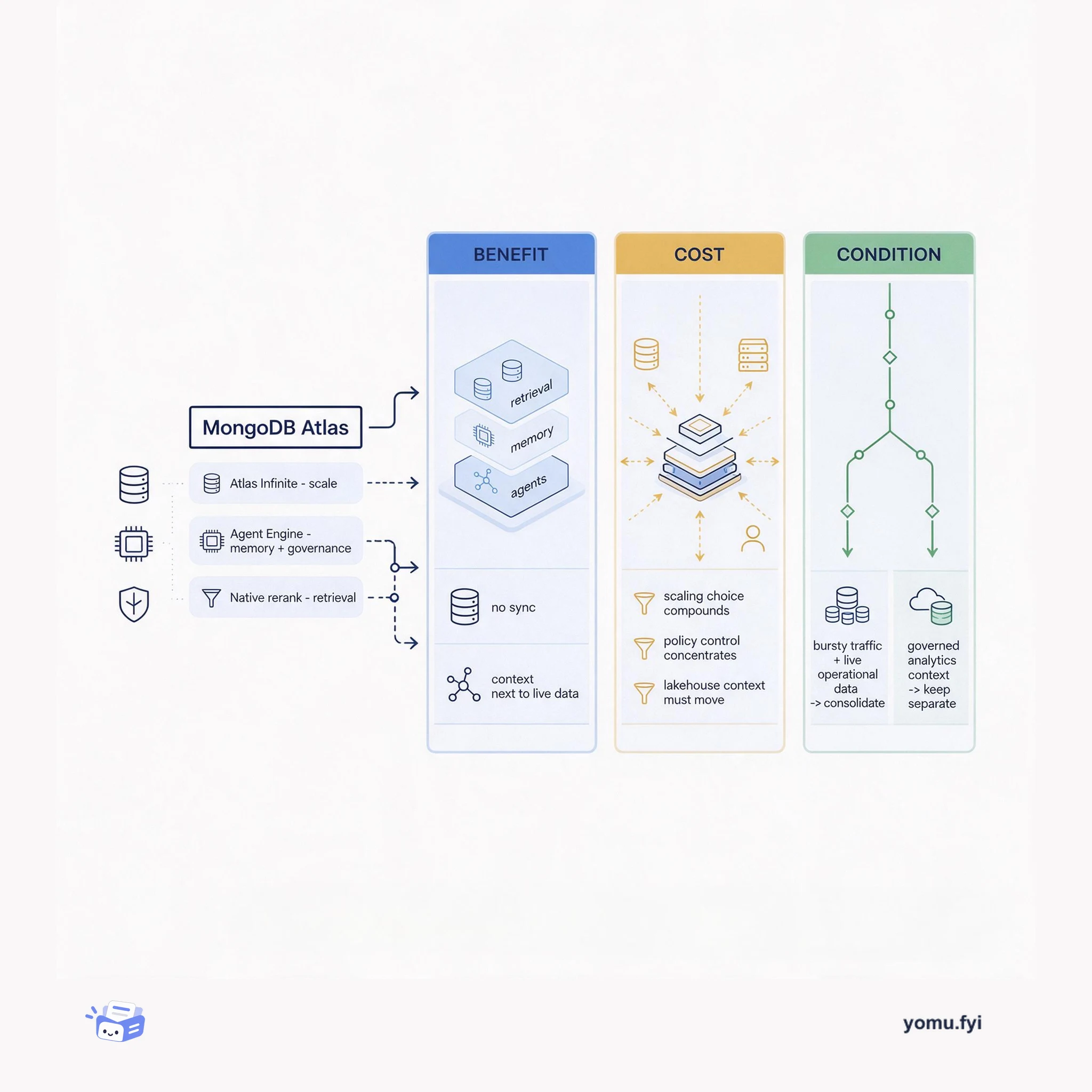
AI agents require precise context retrieval, not larger windows, and MongoDB’s new Rerank-3 and Rerank-3-lite models outperform Cohere Rerank v4.0 Pro by 2.14% and Qwen3-Reranker-8B by 3.31% overall, with greatest improvements on long documents and code. The $rerank native aggregation stage rescores candidate sets index-free within MongoDB, while Automated Embedding generates and refreshes vectors near-real-time to prevent model version drift. This unified platform eliminates separate vendors and external API calls, supporting lexical, vector, and hybrid search directly against operational data without moving or syncing. The result is simpler retrieval architecture that improved Gravity’s accuracy and cut latency by roughly 50% by better discriminating between strong and weak matches. Retrieval quality forms one layer of MongoDB’s broader agent platform, which also includes performance scaling with Atlas Infinite and agent memory with Atlas Agent Engine.
Context
The post argues that AI agent success depends on context engineering through high-quality retrieval, not just large context windows. Teams use separate providers for embeddings, reranking, and databases, causing sync issues and complexity. MongoDB’s intelligent data platform integrates Voyage AI’s models, Automated Embedding, and native $rerank to provide a unified retrieval system.
Approach / What changed
MongoDB introduces Rerank-3 and Rerank-3-lite models and a native $rerank aggregation pipeline stage, combined with Automated Embedding for vector synchronization. Developers can perform lexical, vector, and hybrid search with native reranking in a single system without external API calls or data movement.
Takeaways
1
Rerank-3 outperforms Cohere Rerank v4.0 Pro by 2.14% and Qwen3-Reranker-8B by 3.31% overall, with largest gains on long documents and code.
2
The $rerank aggregation stage rescores candidate sets index-free within MongoDB, eliminating the need for external reranking APIs and reassembly code.
3
Automated Embedding prevents model version drift by generating and refreshing vectors near-real-time at the field level, with health visible in Atlas UI.
FAQ
How does $rerank improve retrieval accuracy?
$rerank rescores candidate sets from first-stage retrieval (e.g., BM25, vector search) using Rerank-3 or Rerank-3-lite to better separate strong matches from weak ones. It improved NDCG@10 by 20.56% over lexical-only retrieval and by 12.77% over OpenAI v3 large embeddings.
What are the available reranking models and how to upgrade?
MongoDB offers Rerank-3 and Rerank-3-lite via Voyage AI. Existing users of rerank-2.5 can upgrade with a one-line model-name change using the same API and price. Rerank-3 shows best gains on long documents and code.
How does MongoDB prevent model version drift in vector search?
Automated Embedding generates vectors near-real-time at the field level, ensuring the embedding model version used for index building matches query models. Token consumption and index health are visible in the Atlas UI, eliminating silent version splits.
Consolidating agent memory, retrieval, and governance onto MongoDB Atlas removes sync and vendor layers, but ties scaling and control to one platform. This trade-off view shows the payoff, the cost, and the condition that decides it.
Keep reading
Related reading
The Good Stuff
Paid picks we use ourselves. Links carry a referral code — a subscription through one earns us a commission at no extra cost to you.