Prevent, Verify, Contain: The Three Bills of AI Safety
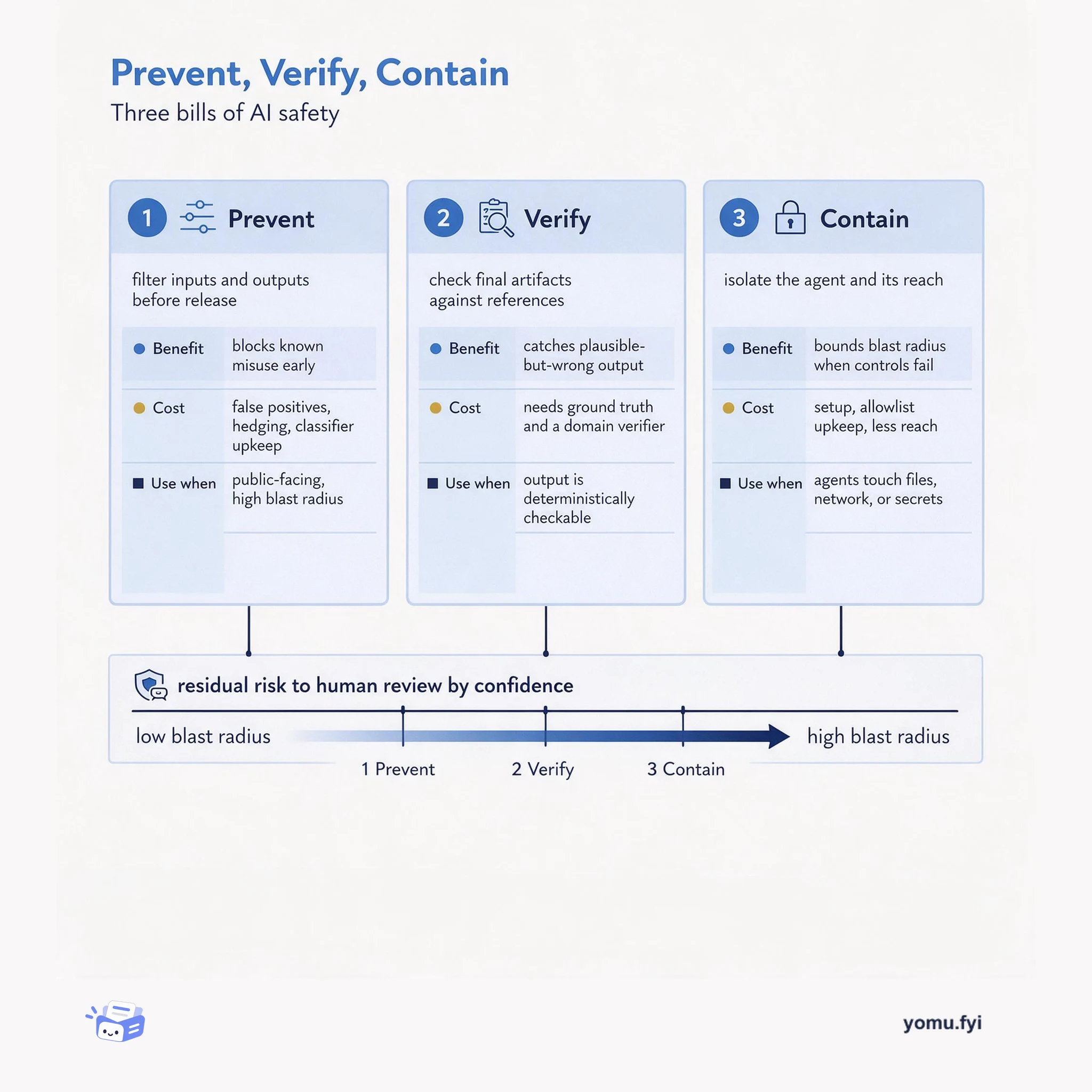
AI safety is a budget: prevention, verification, and containment each buy different protection at a different cost. This map shows what each control costs and when it pays off.
Consolidating agent memory, retrieval, and governance onto MongoDB Atlas removes sync and vendor layers, but ties scaling and control to one platform. This trade-off view shows the payoff, the cost, and the condition that decides it.
MongoDB Atlas now spans three jobs: Atlas Infinite scales compute and storage independently for spiky AI demand, Atlas Agent Engine supplies agent memory, orchestration, and governance, and native reranking rescores retrieved context inside the database. The benefit is a shorter path from operational data to grounded agent answers, without syncing to a separate retrieval vendor. The cost is coupling, because scaling choices and policy controls concentrate on one platform. The condition that decides it is whether your agents run on live operational data under bursty traffic, or whether governed analytics context is the real source.
Native reranking runs a $rerank aggregation stage that rescores candidate sets index-free inside the database, so lexical, vector, and hybrid search run against operational data without an external API call; one reported deployment cut latency by roughly half. The trade-off is that retrieval quality and vector freshness now share the platform serving your operational traffic.
Atlas Infinite is a deployment option inside MongoDB Atlas that scales compute and storage independently within minutes, supporting replica sets with about 10x the data capacity of Atlas Core and, in internal tests, 189% more throughput per dollar. The cost is a new decision: you must pick the deployment option and accept that capacity planning shifts from one lever to two.
Atlas Agent Engine builds, deploys, and governs agents with built-in memory and retrieval, validated internally by Holly, an agentic workspace that replaced seven tools and cut prospecting prep by about 95%. The trade-off is governance: controls and policy sit with the platform, so agents gain autonomy without sprawling integrations.
The posts behind it
 Databricks · · Problem & solution
As agentic applications move from answering questions to taking actions, enterprises risk AI sprawl from duplicated integrations, inconsistent policies, and fragmented context. Databricks asserts scaling requires three pillars: choice across models and tools, context grounded in governed enterprise data and business semantics, and control through consistent permissions, policies, observability, and cost management. Its platform provides Agent Bricks for unified agent fleet building and governance, Omnigent as a common layer above agent harnesses, and Unity Gateway as a centralized control plane for models, agents, and tools. Context is shared via Unity Catalog for data and AI asset governance and Genie Ontology for common business concepts, letting teams reuse governed context across applications. Control uses Unity Gateway for access policies, budgets, and traces and Databricks Sandbox for isolated execution, with MLflow enabling evaluation and workflow inspection to maintain reliability as agents scale.
 MongoDB · · Announcement
MongoDB announced the public preview of Atlas Agent Engine, a secure platform for building, deploying, and governing AI agents with built-in memory, retrieval, and open flexibility to choose any LLM or framework. The company validated the platform internally with Holly, a unified agentic workspace that replaces seven disconnected tools for sales reps and is powered by Atlas Agent Engine’s runtime, orchestration, and governance. Compared to manually hopping between tools, Holly cuts the time to research and build an outbound prospecting list by roughly 95%, reducing account prep from hours to minutes. Atlas Agent Engine enforces centralized controls and governance while granting developer autonomy, addressing CIO fears about agents running amok in enterprise systems. It is part of a trio of launches alongside MongoDB 9.0 and Atlas Infinite, giving builders a governed platform to run agents grounded in real-time operational data.
MongoDB · · AnnouncementAI-driven demand is constant, unpredictable, and extreme, unlike earlier internet and cloud eras where spikes were more predictable. Enterprises need a data layer that can absorb sudden bursts of traffic without re-architecture. MongoDB announced Atlas Infinite, a new deployment option within MongoDB Atlas that independently scales compute and storage within minutes. Atlas Infinite supports replica sets with 10x the data capacity of Atlas Core and delivers 189% more throughput per dollar in internal tests. MongoDB 9.0 was also released, offering up to 35% faster find-one queries and new security features like queryable encryption with prefix, suffix, and substring searches.
MongoDB · · AnnouncementAt MongoDB.local NYC, MongoDB launched Atlas Agent Engine in Public Preview, providing a single foundation for building, deploying, and governing AI agents. Six global systems integrators—Accenture, Capgemini, Cognizant, Infosys, TCS, and Tech Mahindra—are launch partners, integrating the engine into their AI offerings. The platform is model- and framework-neutral, with partners like Arize AI offering trace monitoring for production reliability. MongoDB also announced Devin for MongoDB Modernizations, leveraging Cognition’s AI software engineer to automate legacy code migration while AMP handles data movement. New partnerships with Emergent, Monk.io, and Retool extend MongoDB’s reach into AI application development and internal tools, reinforcing that the agentic era requires an ecosystem of partners with industry expertise.
MongoDB · · AnnouncementAI agents require precise context retrieval, not larger windows, and MongoDB’s new Rerank-3 and Rerank-3-lite models outperform Cohere Rerank v4.0 Pro by 2.14% and Qwen3-Reranker-8B by 3.31% overall, with greatest improvements on long documents and code. The $rerank native aggregation stage rescores candidate sets index-free within MongoDB, while Automated Embedding generates and refreshes vectors near-real-time to prevent model version drift. This unified platform eliminates separate vendors and external API calls, supporting lexical, vector, and hybrid search directly against operational data without moving or syncing. The result is simpler retrieval architecture that improved Gravity’s accuracy and cut latency by roughly 50% by better discriminating between strong and weak matches. Retrieval quality forms one layer of MongoDB’s broader agent platform, which also includes performance scaling with Atlas Infinite and agent memory with Atlas Agent Engine.
More like this
AI safety is a budget: prevention, verification, and containment each buy different protection at a different cost. This map shows what each control costs and when it pays off.
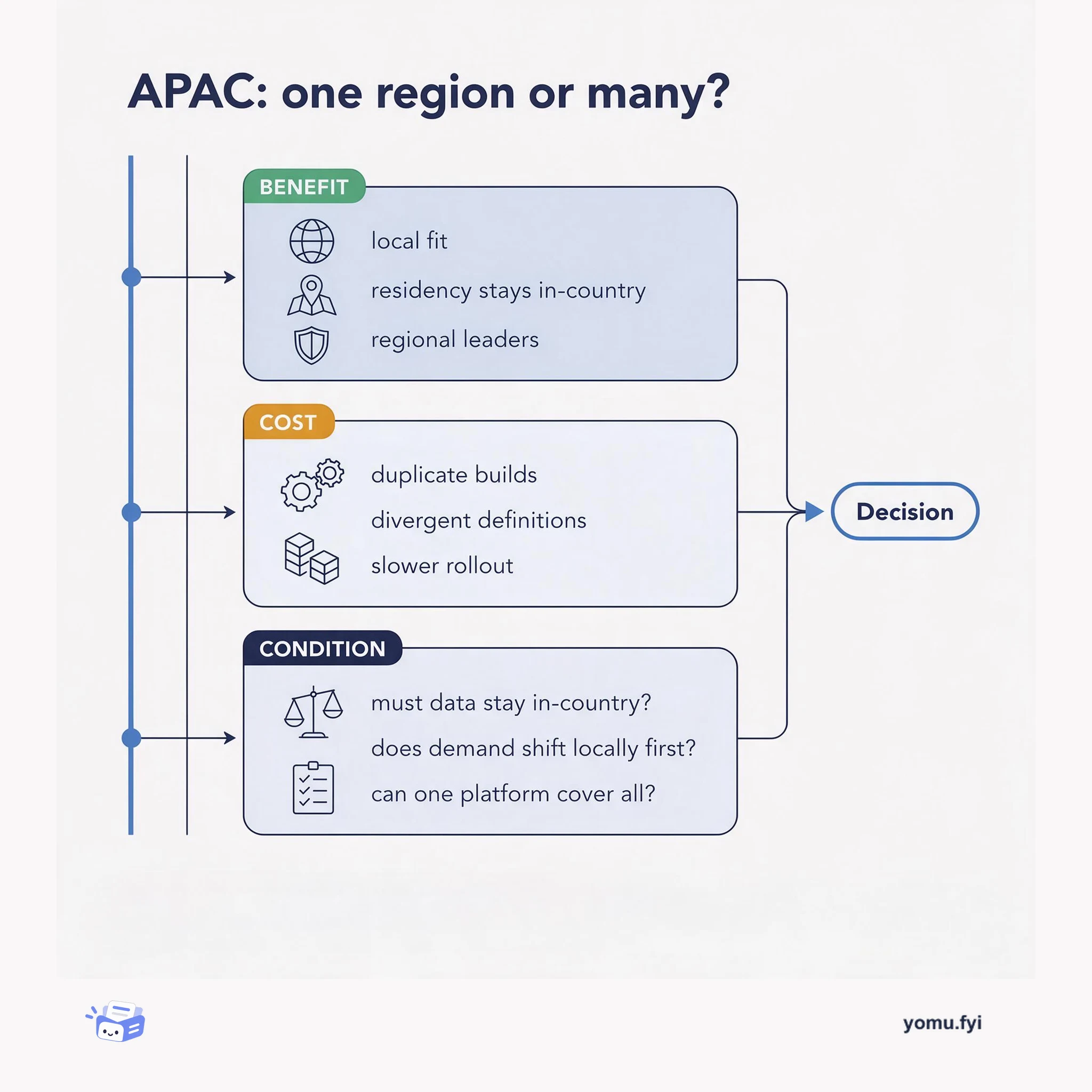
APAC is a federation of markets, not a single deployment region. This diagram maps the tradeoff between local autonomy and one shared platform, and the conditions that decide it.
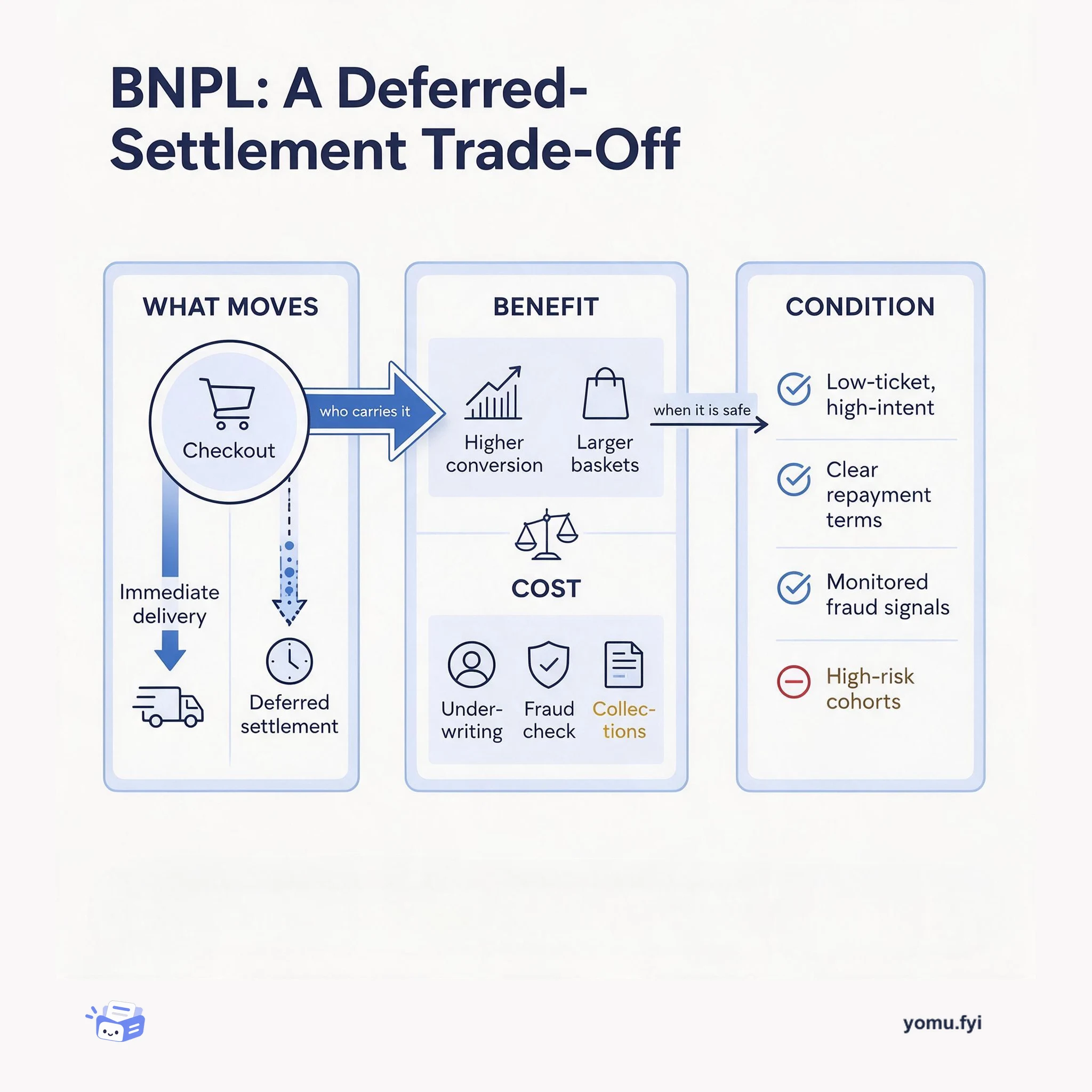
Buy Now, Pay Later is a deferred-settlement trade-off: merchants gain conversion while underwriting, fraud, and collections risk move elsewhere. This diagram maps the benefit, the cost, and the condition that decides.
The Good Stuff
Paid picks we use ourselves. Links carry a referral code — a subscription through one earns us a commission at no extra cost to you.
One useful email. Unsubscribe anytime.