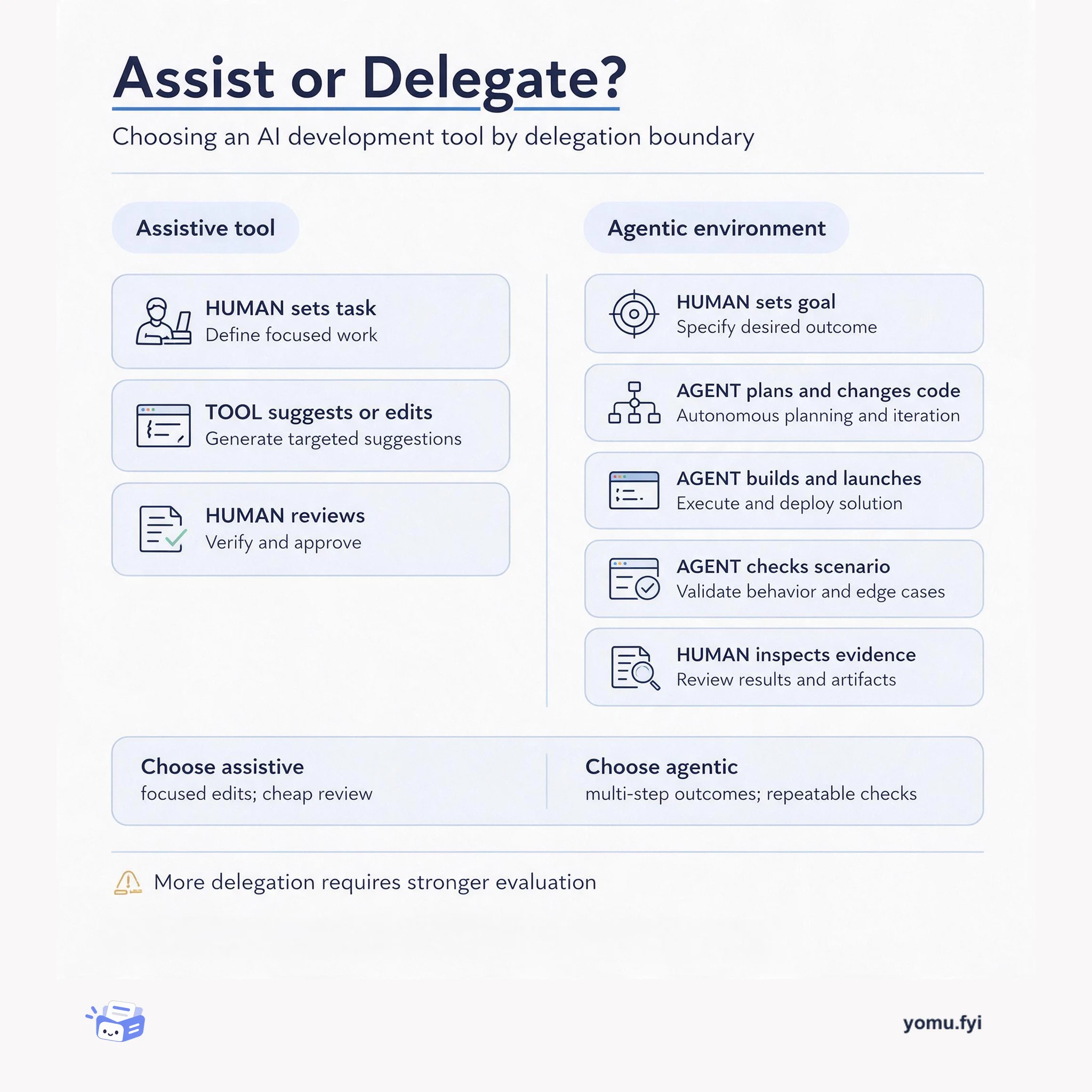
Assist or Delegate? Choosing an AI Development Tool
Compare assistive coding tools with agentic development environments to see where human control, automation, verification, and evaluation belong in the workflow.
 DatabricksAlkis PolyzotisExplainer
Databricks describes coSTAR, a methodology for testing and iteratively improving long-running, stochastic AI agents without relying on manual review for every change. It addresses nondeterministic outputs, slow executions, cascading failures, and subjective quality by treating scenarios as fixtures, MLflow traces as a reusable harness, and judges as an automated test suite. Its two coupled STAR loops align judges with human experts using a Golden Set, then use those judges to refine the agent until it passes the scenarios. Agentic judges selectively explore traces with tools instead of receiving entire, potentially thousands-line executions, while persisted traces allow rescoring without rerunning agents. The approach can also reuse judges for production monitoring, but remains limited by manually authored scenarios, judge-calibration costs, coverage gaps, overfitting, and difficult root-cause attribution.
Databricks had agents performing long-running tasks and generating code and data or AI assets, but its earlier workflow depended on manually reviewing outputs and lacked a comprehensive automated test suite. Agent testing is complicated by nondeterminism, expensive executions, cascading failures, and subjective quality criteria.
coSTAR uses two coupled Scenario, Trace, Assess, Refine loops. Scenario definitions specify initial state, prompts, and expected outcomes; a harness runs the agent under test and persists MLflow traces; agentic judges inspect traces with targeted tools; and a coding assistant refines the implementation. A Golden Set of human-graded examples calibrates the judges before they drive automated refinement.
Persisting MLflow traces separates agent execution from scoring, allowing thresholds or judges to change and be evaluated without rerunning expensive scenarios.
Agentic judges use targeted trace-exploration tools to assess properties such as skill invocation, documented best practices, and output assets instead of consuming an entire trace at once.
coSTAR can improve only within its scenario and judge coverage; manually authored scenarios, judge recalibration, overfitting, and unclear multi-step root causes remain limitations.
A single trace can contain thousands of lines, and placing it all in a judge’s context is described as expensive, fragile, and harmful to judgment quality. Agentic judges selectively explore traces with tools and check targeted properties.
Domain experts manually grade examples in a Golden Set. The judge loop refines judges until their assessments align with those human evaluations.
Yes. The post says the same judges used during evaluation can monitor live traffic, so the evaluation investment can also support production monitoring.
Summaries are generated from the original by a language model. Check the original before relying on it.
See the idea
Compare assistive coding tools with agentic development environments to see where human control, automation, verification, and evaluation belong in the workflow.
Keep reading
The Good Stuff
Paid picks we use ourselves. Links carry a referral code — a subscription through one earns us a commission at no extra cost to you.
One useful email. Unsubscribe anytime.
