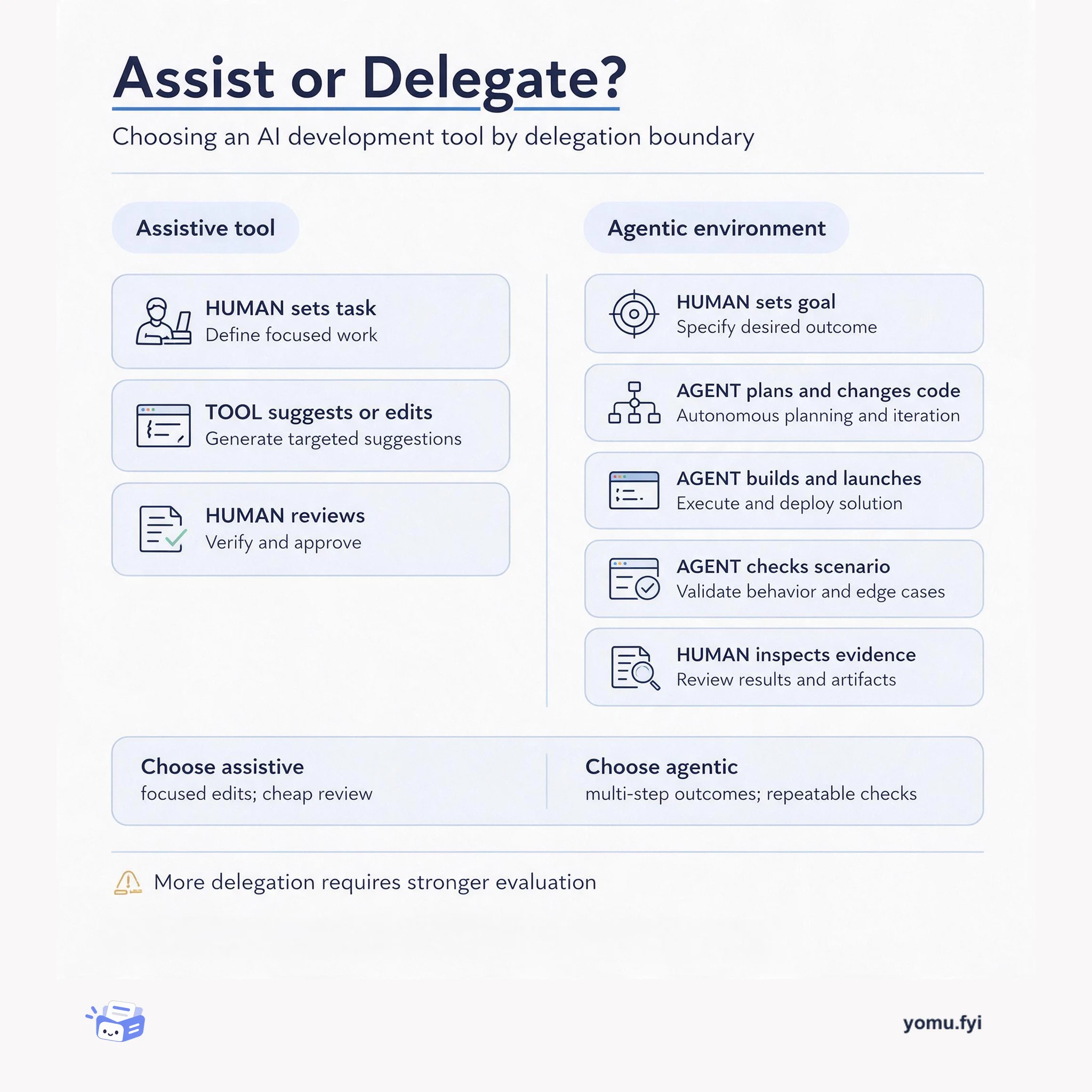
Assist or Delegate? Choosing an AI Development Tool
Compare assistive coding tools with agentic development environments to see where human control, automation, verification, and evaluation belong in the workflow.
Loading…
Topic
2 posts about AI Development Tools. Every summary links to the original.
See the idea
Compare assistive coding tools with agentic development environments to see where human control, automation, verification, and evaluation belong in the workflow.
The Good Stuff
Paid picks we use ourselves. Links carry a referral code — a subscription through one earns us a commission at no extra cost to you.
Newest first
JetBrains Air is a system of products for agentic software development, built on the premise that no single model, agent, or service fits every developer, team, or task. It connects products for individual work, team coordination, organizational control, context, and process automation, while remaining open to tools and agents developers choose, including those JetBrains does not build. This openness lets developers select the agent, model, or service suited to a task without forcing the organization to give up context, visibility, or control. The Post notes that every new model, agent, or service an organization adds reduces visibility into its own development work. Because intelligence does not belong to one model, the benefit can extend across supported agents and services.
JetBrains presents the AIDEs Framework as a model for understanding how AI development tools evolve, rather than trying to track every market change. The post describes a progression from single-line completion through multiline completion, IDE chat, AI code editors, agentic development environments, and cloud-based agents. It defines an Artificial Intelligent System as a system that demonstrates intelligence in helping users achieve goals, and an Artificial Intelligent Development Environment (AIDE) as an AIS for creating software; intelligence may come from deterministic heuristics as well as LLMs. The framework treats principals and agents as potentially human or AI actors and views software creation as a broader delegation process than coding alone. It proposes examining assumptions, building a model, and validating it against ongoing change, while suggesting a possible future of vertically integrated Agentic Software Production Platforms that use AI as an “intelligence” resource.
The best engineering reads, once a week.

