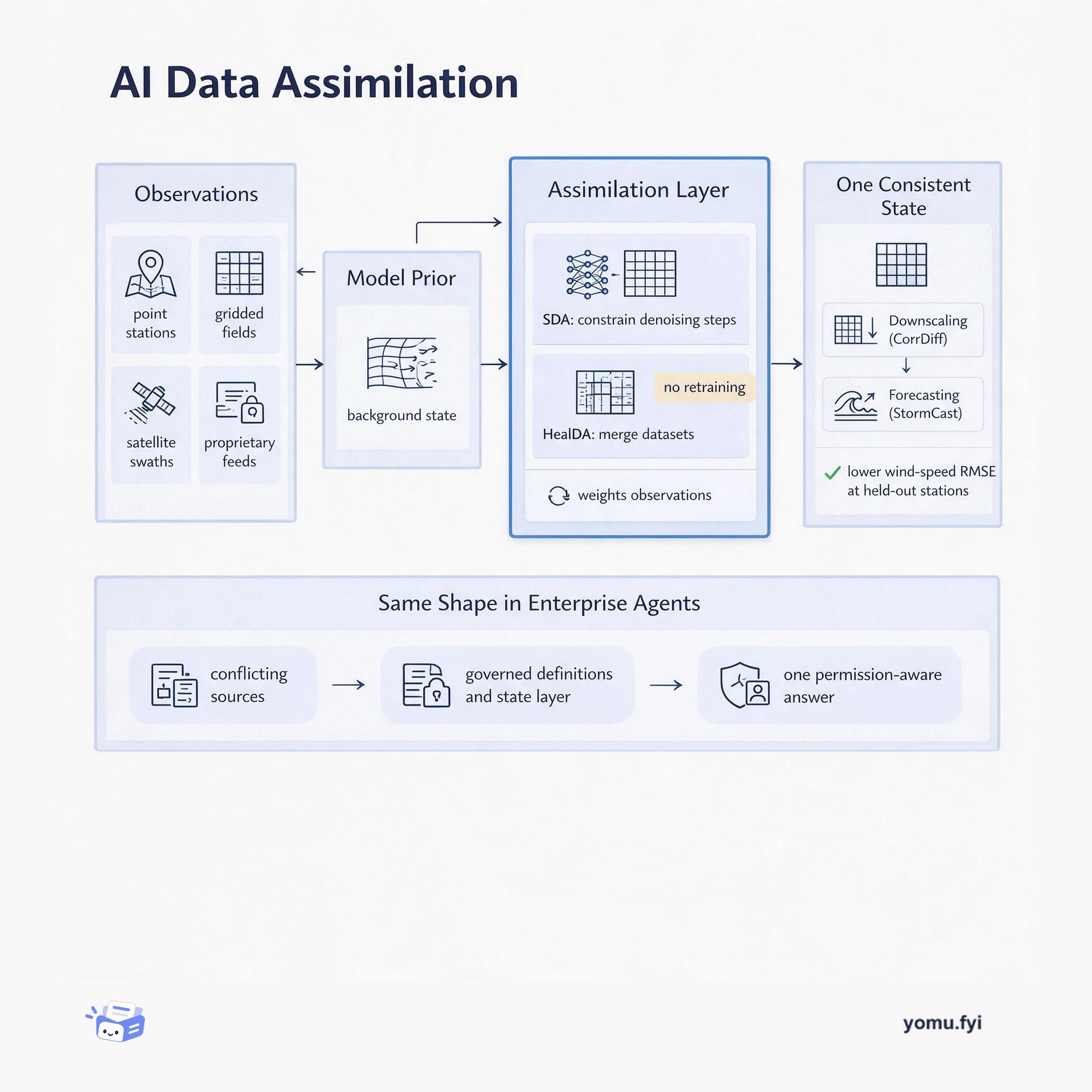
AI Data Assimilation: Turning Scattered Signals Into One State
AI data assimilation fuses a model's prior state with fresh, uneven observations into one consistent state. See the four-layer architecture and where each layer can break.
 DatabricksRichard TomlinsonExplainer
The Post argues that AI agents are breaking a long-standing assumption in enterprise data: that a human analyst can always resolve ambiguity. Richard Tomlinson explains that while analysts rely on tribal knowledge—like which revenue table is trusted or what ‘active customer’ means—agents lack this context. This gap causes inconsistent answers and erodes trust in self-service tools. The conversation examines why previous ontology efforts stalled and what must be true for an ontology to support agents. The ontology is positioned as the missing context layer that companies have not yet built.
The Post is an interview with Richard Tomlinson about the role of data ontology in enterprise AI. It argues that AI agents lack the implicit business context that human analysts rely on, such as which revenue table is trusted or what ‘active customer’ means. The conversation highlights why previous ontology attempts stalled and what is needed for ontologies to support AI agents.
AI agents lack the tribal knowledge human analysts use to interpret ambiguous data, such as which revenue table is trusted or what ‘active customer’ means.
Without ontology, different tools return different answers, causing business users to distrust self-service analytics.
Previous attempts to build ontologies stalled, and a successful ontology must hold up when agents rely on it.
AI agents need business context because they lack the tribal knowledge human analysts have, such as which revenue table is trusted or what 'active customer' means. Without this, agents may give inconsistent answers, eroding user trust.
The assumption is that a knowledgeable human can always interpret ambiguous data. AI agents break this by operating without such a human, leading to inconsistent answers and distrust in self-service tools.
Summaries are generated from the original by a language model. Check the original before relying on it.
See the idea
AI data assimilation fuses a model's prior state with fresh, uneven observations into one consistent state. See the four-layer architecture and where each layer can break.
Antibody discovery is a three-stage prediction pipeline, and AI models that excel on familiar targets degrade sharply on unfamiliar ones. This explainer maps where that gap appears and what it costs.
Keep reading
The Good Stuff
Paid picks we use ourselves. Links carry a referral code — a subscription through one earns us a commission at no extra cost to you.
One useful email. Unsubscribe anytime.

