APAC Is Not One Region: The Regionalize vs. Standardize Tradeoff
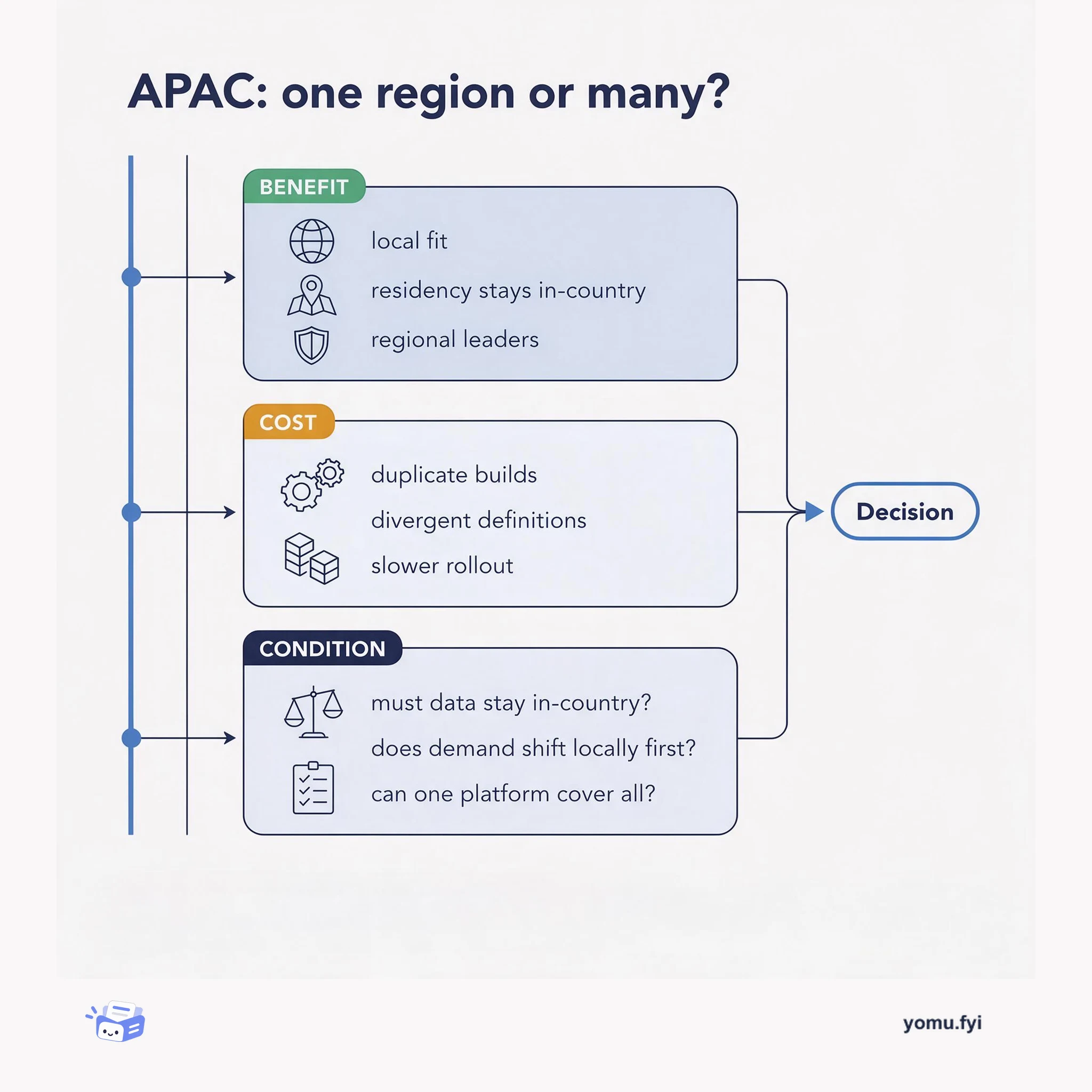
APAC is a federation of markets, not a single deployment region. This diagram maps the tradeoff between local autonomy and one shared platform, and the conditions that decide it.
Antibody discovery is a three-stage prediction pipeline, and AI models that excel on familiar targets degrade sharply on unfamiliar ones. This explainer maps where that gap appears and what it costs.
Therapeutic antibody discovery asks three questions in sequence: which binding site on the target matters, which candidate binds most tightly, and whether that candidate survives manufacturing and the clinic. Each question maps to a class of predictive model, and each model performs well on targets and assays it has seen before but considerably worse on unfamiliar ones. In-distribution benchmarks hide this failure because they sample from the same familiar distribution the models were trained on. The practical cost is that a pipeline validated on familiar targets can look production-ready while quietly degrading on the novel targets where discovery value actually lives.
Not by itself. The AI analytics and data ontology posts argue that trust is a system property requiring governed data, shared definitions, and permission-aware execution, but that addresses consistency of inputs rather than model generalization. For antibodies, context helps you know which target is unfamiliar; it does not make the model accurate on it.
The posts behind it
 Databricks · · Explainer
AI analytics applies AI and machine learning to data analysis, enabling natural-language queries and automated insights without manual query-building, shifting from retrospective dashboards toward agentic investigations. Unlike traditional BI, which requires users to navigate predefined dashboards and filters, AI analytics systems understand intent, determine relevant data and business context, and can conduct multi-step investigations on behalf of the user. A key challenge is that AI analytics only works when grounded in governed data: without shared metric definitions, authoritative sources, and permission-aware execution, the system produces untrustworthy results. Trust in AI analytics is a system property, not a model property; it requires governed data, shared business context, permission enforcement, and verifiability of queries and calculations. Better AI models do not eliminate the need for business context; as AI becomes more autonomous, semantic definitions and governance become more critical.
Databricks · · ExplainerThe Post argues that AI agents are breaking a long-standing assumption in enterprise data: that a human analyst can always resolve ambiguity. Richard Tomlinson explains that while analysts rely on tribal knowledge—like which revenue table is trusted or what ‘active customer’ means—agents lack this context. This gap causes inconsistent answers and erodes trust in self-service tools. The conversation examines why previous ontology efforts stalled and what must be true for an ontology to support agents. The ontology is positioned as the missing context layer that companies have not yet built.
 NVIDIA · · Explainer
Standard LLM benchmarks are insufficient for evaluating AI agents because they score static outputs rather than multi-step tool-call sequences against a live environment. The post explains that agent evaluation requires two scoring layers: step-level (process scoring) checks each call’s validity and usefulness, while end-to-end (E2E) scoring checks only the final environment state. A trace logs every step and environment state, and metrics roll up through a hierarchy of benchmark, trial, task, turn, and step. Key metrics include task success rate, consistency, tool-call precision, argument accuracy, steps per success, and cost per success. The post argues that benchmarks are converging on tool use because deployed agents always use tools, and enterprise benchmarks should measure task completion against real APIs and policies.
 AWS · · Announcement
Monoclonal antibodies are a mainstay of biopharmaceutical development, with over 100 FDA-approved drugs and established manufacturing and regulatory pathways, yet conventional discovery is costly and slow, typically taking six to twelve months from target to lead candidate. AI promises to make antibody development cheaper, faster, and more flexible by designing and characterizing therapeutic antibodies computationally, but scientific questions remain. Development hinges on three factors: the best binding site on the target, which candidates bind most tightly, and whether candidates can survive manufacturing and the clinic. Predictive models for each factor do well on familiar targets and assays but considerably worse on unfamiliar ones, a gap that in-distribution benchmarks have made difficult to measure. Three papers from Amazon Bio Discovery’s science team address research questions about each factor, with methods integrated into the AI-powered application that connects biological AI models with lab services.
Databricks · · ExplainerThe post defines a database for AI agents as infrastructure for short-term, episodic, procedural, and operational memory, rather than merely a place to retrieve documents. It proposes five evaluation criteria for moving agent workloads from prototypes to production: per-agent branch isolation, serverless scale-to-zero, hybrid search, ACID guarantees, and unified platform access. The technical rationale is that agents perform repeated reads and writes, resume tasks, share state concurrently, and need current data across vector, keyword, and metadata retrieval; zero-copy branches, sub-second wakeups, and single-query hybrid search address specific operational constraints. It concludes that a database missing more than one minimum bar becomes a production risk, while standard Postgres alone supplies ACID but not branching, scale-to-zero, or unified operational and analytical access.
More like this
APAC is a federation of markets, not a single deployment region. This diagram maps the tradeoff between local autonomy and one shared platform, and the conditions that decide it.
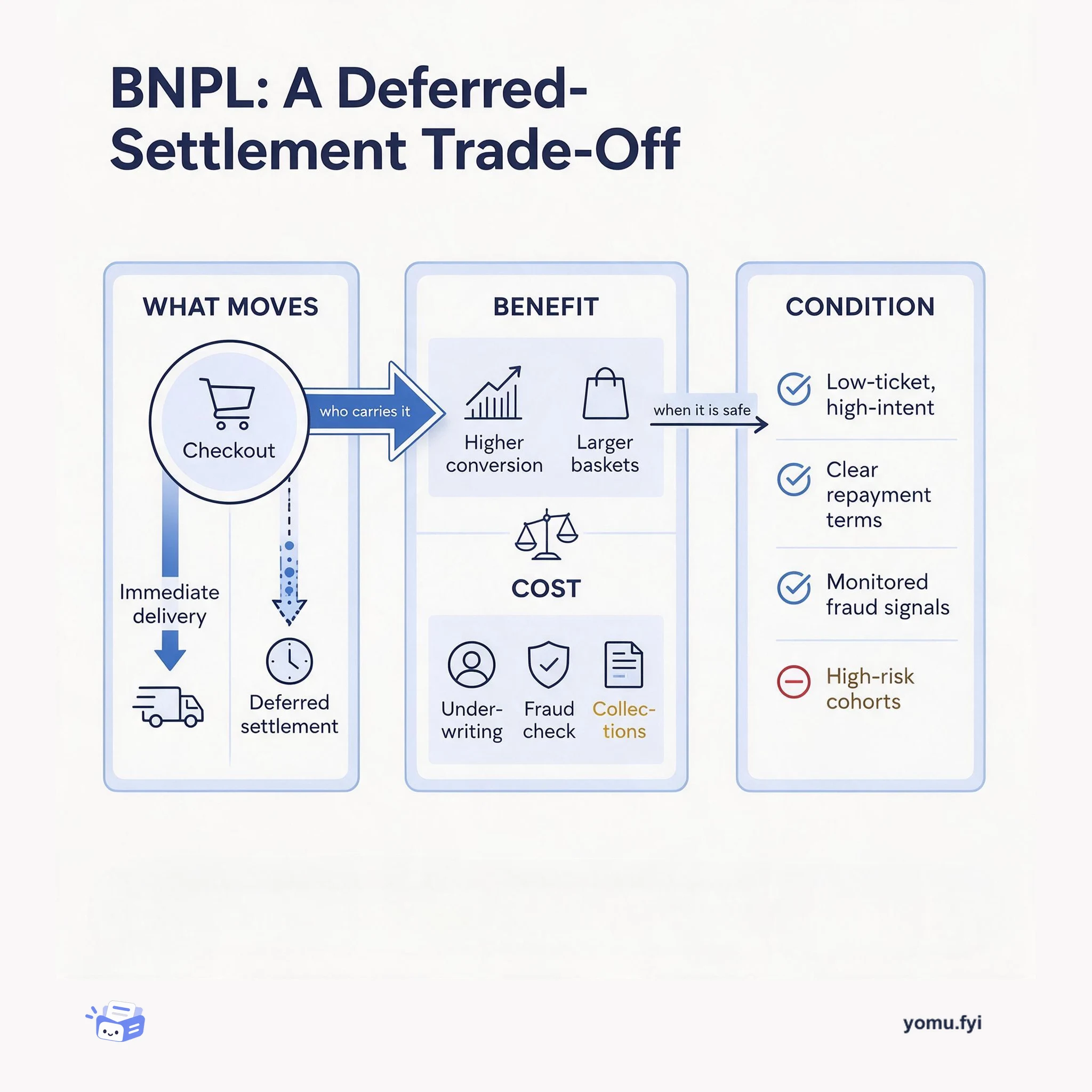
Buy Now, Pay Later is a deferred-settlement trade-off: merchants gain conversion while underwriting, fraud, and collections risk move elsewhere. This diagram maps the benefit, the cost, and the condition that decides.
Bare metal gives engineers direct control over GPU, network, and virtualization layers, but it shifts elasticity and lifecycle work onto the team. This trade-off map shows when that bargain pays off.
The Good Stuff
Paid picks we use ourselves. Links carry a referral code — a subscription through one earns us a commission at no extra cost to you.
One useful email. Unsubscribe anytime.