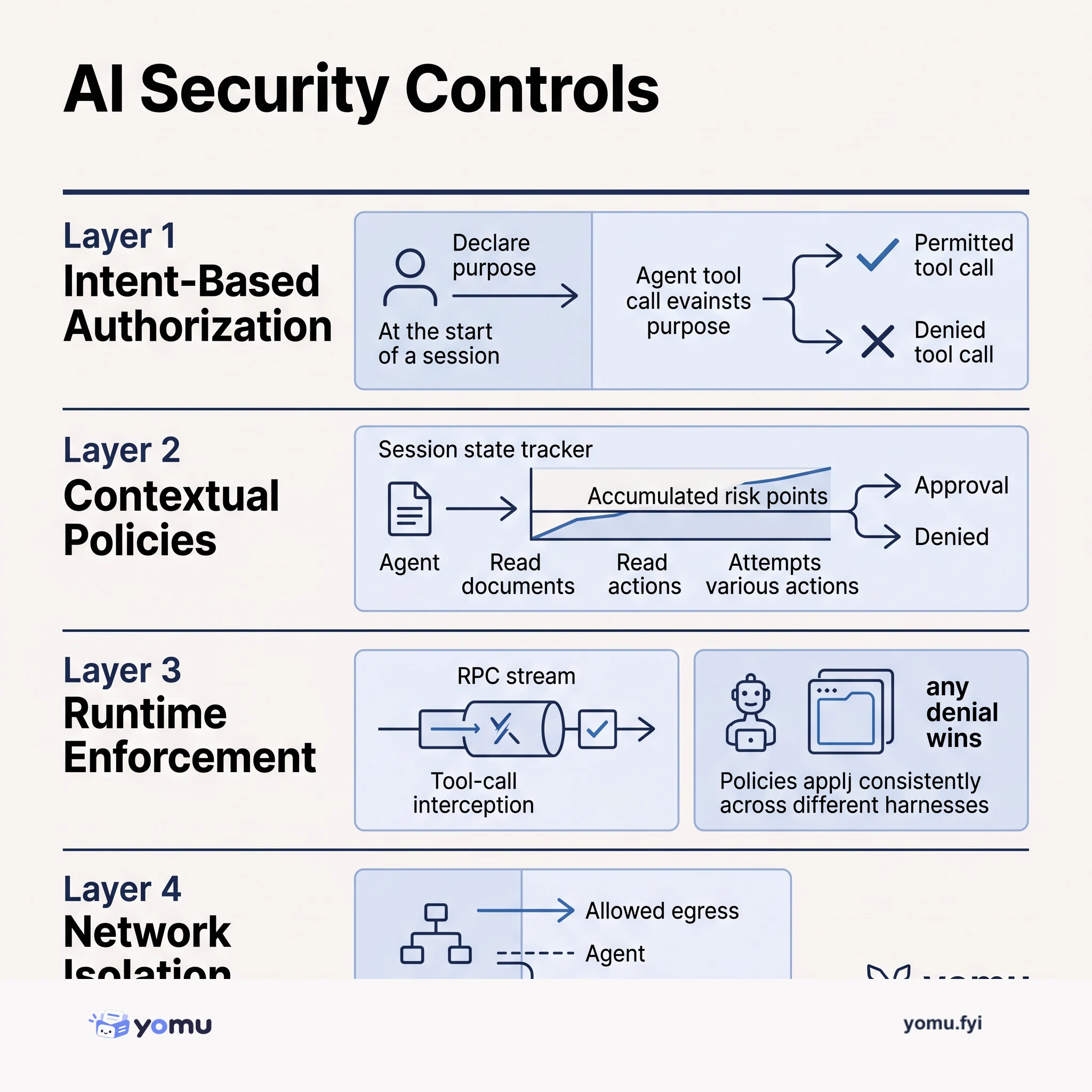
How to Layer AI Security Controls
Defense-in-depth for AI agents combines intent verification, contextual policies, runtime enforcement, and network boundaries to block both direct attacks and slow-burn data exfiltration.
 DatabricksKatie Cummiskey, Maria Pere-Perez, Arun Pamulapati, Nishith SinhaAnnouncement
Databricks announces that it is a founding member of the Open Secure AI Alliance, formed with NVIDIA and more than 75 organizations to advance openly shared AI safety, AI security, and AI-enabled cyber defense research. The alliance’s scope extends beyond model weights to an open execution stack covering runtimes, guardrails, agent harnesses, risk frameworks, and governance. Databricks contributes Omnigent, an Apache 2.0 meta-harness supporting 13+ harnesses with contextual policies, spend caps, and sandbox isolation; DASF 3.0, which maps 97 risks across 13 components to 73 controls; DAGF; and BlackIce, a containerized toolkit bundling 14 red-teaming tools. Its Lakewatch Security Lakehouse applies the same openness to governed, agentic detection and response over portable data formats.
As AI systems become more capable and autonomous, the source identifies converging needs to secure AI systems against new attacks and use AI to improve cyber defense. It argues that open security intelligence and inspectable systems are necessary to strengthen the broader ecosystem.
Databricks joins the alliance as a founding member and contributes open tools and frameworks, including Omnigent, DASF 3.0, DAGF, and BlackIce. It also extends the open approach to Lakewatch, the Security Lakehouse, and Unity Catalog for governed, portable access to data, models, and tools.
Omnigent is an Apache 2.0 open-source meta-harness that supports 13+ open and closed harnesses while enforcing contextual policies, spend caps, and sandbox isolation.
DASF 3.0 catalogs 97 technical security risks across 13 components and maps them to 73 mitigation controls, including coverage for agentic threats such as memory poisoning and insecure MCP connections.
BlackIce packages 14 AI security tools in a reproducible container mapped to MITRE ATLAS and DASF, enabling testing for prompt injection, data leakage, and supply-chain attacks.
Summaries are generated from the original by a language model. Check the original before relying on it.
See the idea
Defense-in-depth for AI agents combines intent verification, contextual policies, runtime enforcement, and network boundaries to block both direct attacks and slow-burn data exfiltration.
Keep reading
The Good Stuff
Paid picks we use ourselves. Links carry a referral code — a subscription through one earns us a commission at no extra cost to you.
One useful email. Unsubscribe anytime.
