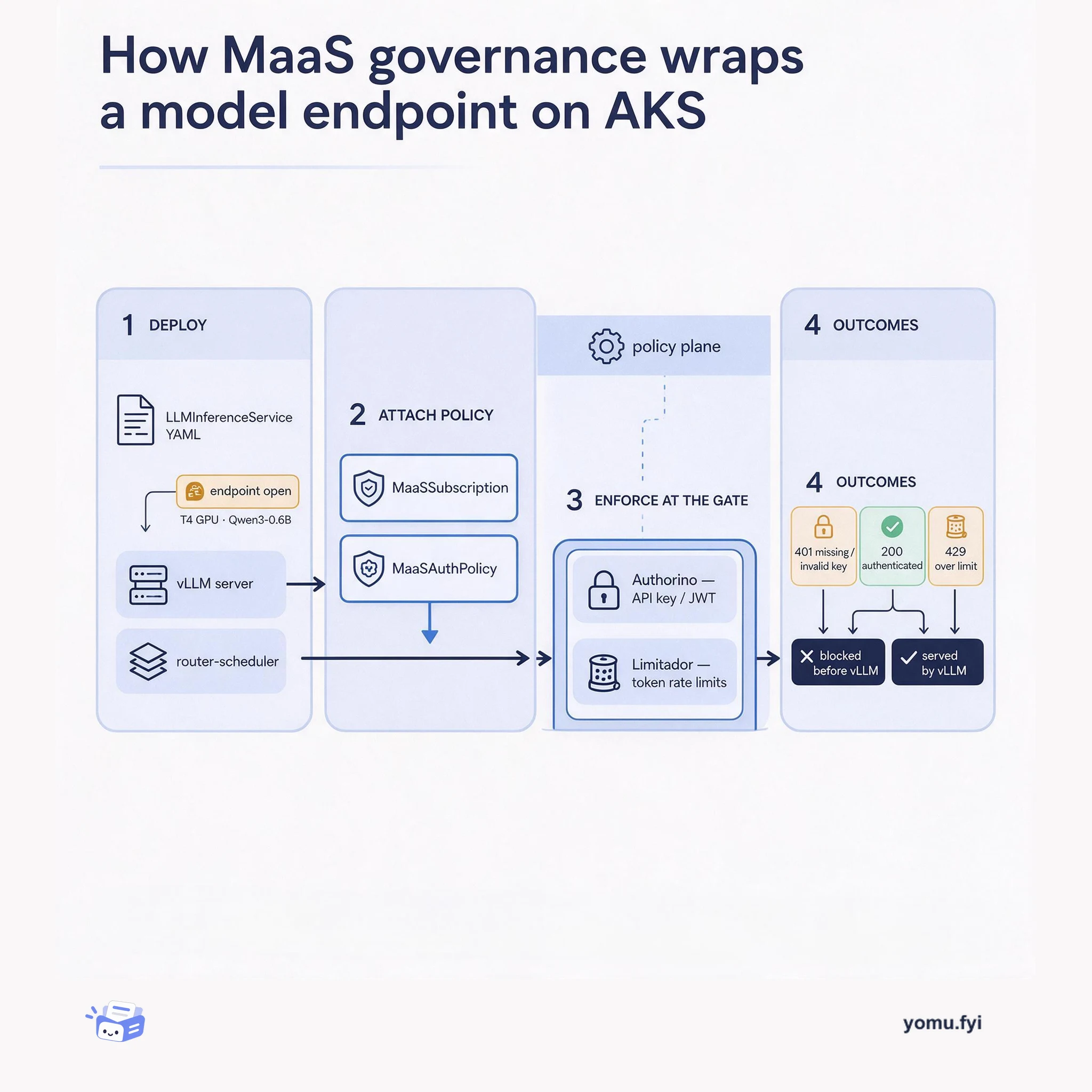
How MaaS Governance Wraps a Model Endpoint on AKS
A model deployed on AKS is open by default. See how MaaS policies insert Authorino authentication and Limitador rate limits in front of vLLM, so bad keys and over-quota requests stop at the gate.
Loading…
Topic
21 posts about AI Gateway. Every summary links to the original.
See the idea
A model deployed on AKS is open by default. See how MaaS policies insert Authorino authentication and Limitador rate limits in front of vLLM, so bad keys and over-quota requests stop at the gate.
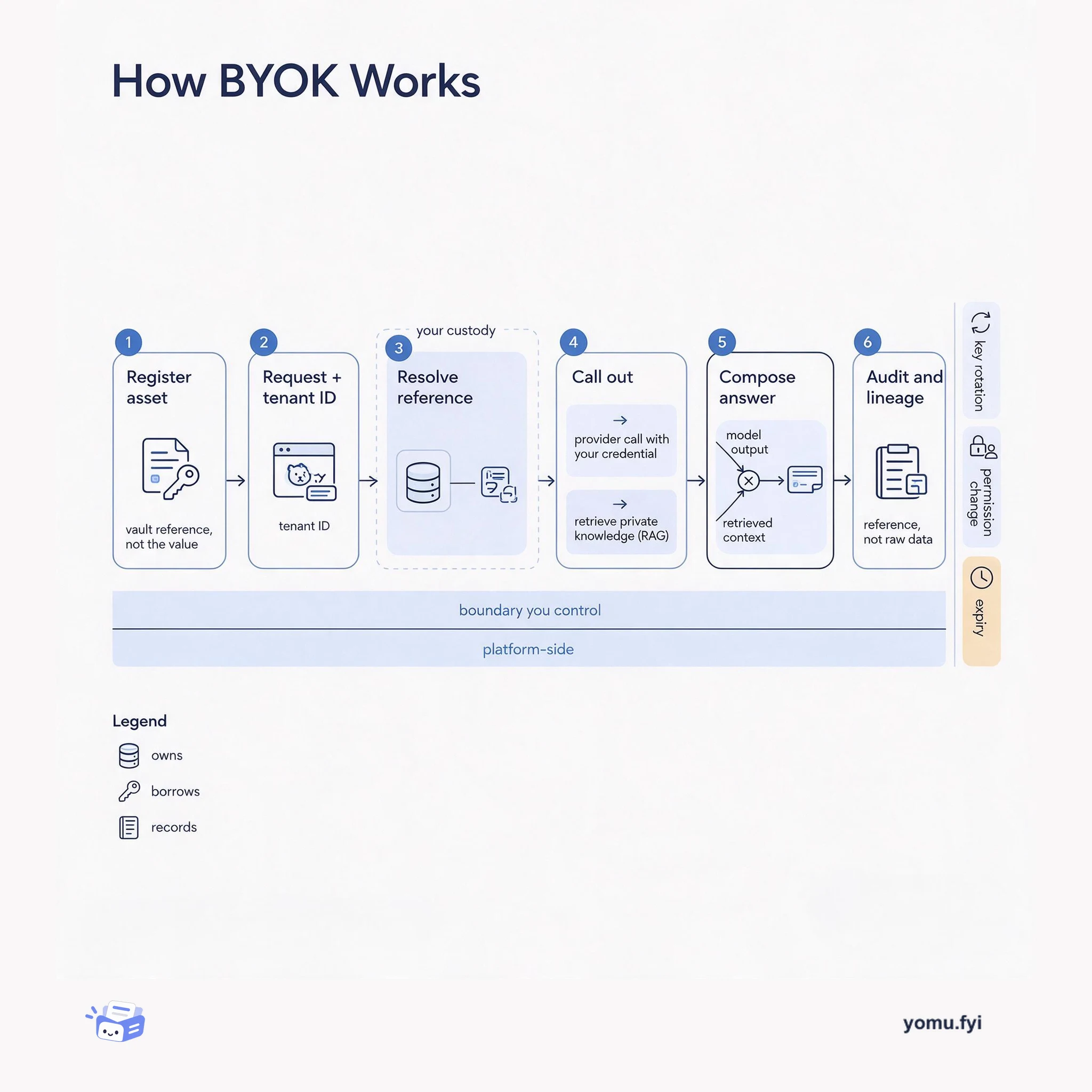
BYOK lets a system run on assets you supply — your model credential or your private knowledge — instead of the vendor's defaults. This walkthrough traces six steps from registration to an audited response.
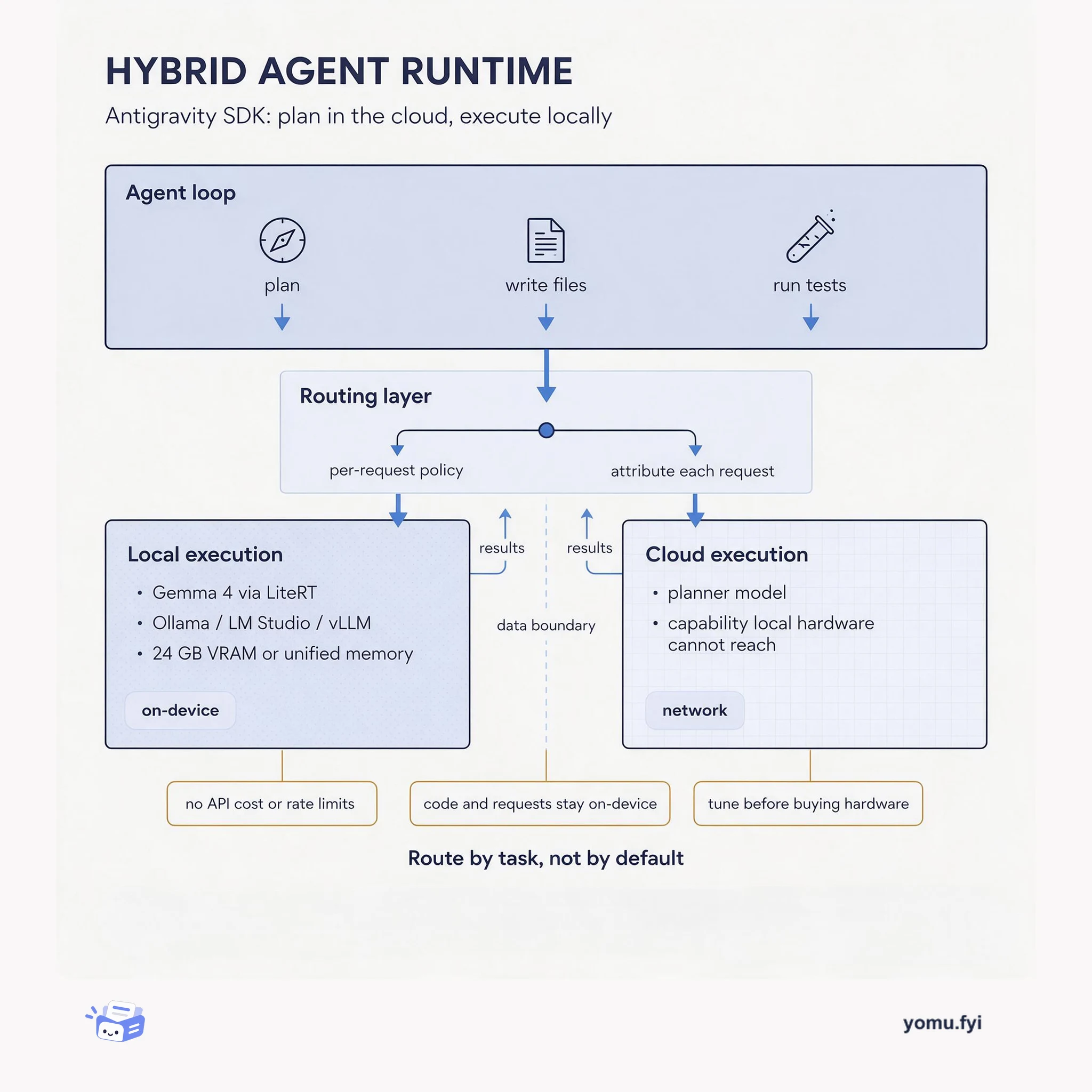
Antigravity SDK's hybrid architecture separates planning from execution: a cloud model plans, local models run most tokens on-device. See how routing, execution, and the data boundary fit together.
The Good Stuff
Paid picks we use ourselves. Links carry a referral code — a subscription through one earns us a commission at no extra cost to you.
Newest first
Cloudflare launched a Web Search API via AI Gateway, partnering with Ceramic.ai, Exa, and Linkup, to provide grounded intelligence by letting AI agents search the web instead of guessing URLs that return 404 errors. The API injects live, structured snippets into inference pipelines, giving models access to information beyond their training cutoff, such as new Birthday Week releases, and grounding agent responses with real-time data. Developers can integrate via AI Gateway credits, a direct REST endpoint with curl, or Workers bindings with one line of code. Partners commit to Cloudflare’s verified bot standards, including identifying crawlers, respecting robots.txt, and providing source links for transparency. Web search calls are logged in AI Gateway observability, billed at list pricing without markup, support Bring-Your-Own-Key and Zero Data Retention, with native server tools coming soon.
Cloudflare released Auto Router in public beta through AI Gateway. Set the model to “cloudflare/auto” and the gateway automatically routes each request to a model capable enough for the task, filtering by credentials, access controls, and provider health. A multi-head classifier on Workers AI assigns probabilities across 14 task categories and rates complexity, ambiguity, stakes, and context dependence on a 1-5 scale. A separate scoring matrix combines those signals with model benchmark results and token prices, applying an adaptive cost penalty and switching costs for cached contexts in long sessions. On an internal general knowledge-work benchmark of 97 tasks with three samples each, Auto Router achieved 86.6% success at $0.0084 per success, costing 35% of Claude Opus 5.5 and 80% of GPT-6 Sol while remaining free during beta.
Cloudflare AI Gateway’s User Insights now provides context beyond model names and request counts, using a dedicated Worker to classify conversations by task type such as coding, research, summarization, or formatting. The “model overkill” view identifies conversations where a high-capability reasoning model is used for simple tasks, showing which users or agents are driving that usage and the associated cost. Teams can analyze conversation turns to see how many back-and-forth exchanges a task requires, helping uncover inefficiencies in prompts or workflows. The Potential Savings view and Auto Router (closed beta) use task and model-fit signals to automatically route requests to appropriate models without a separate rule for each workload. These features are free for AI Gateway users and require stable user_id and session_id for analysis, with optional Access integration.
Google Cloud API Gateway adds model routing in Public Preview for AI applications that need to direct traffic among models without hardcoded endpoints or open-source proxies. The serverless ingress layer accepts OpenAI-compatible requests and uses routing rules in an OpenAPI 3.x specification, where x-google-api-management defines backends and routers map virtual model names to targets such as Gemini, Claude, or OpenAI OSS-GPT. After deployment, clients call a stable endpoint; the Gateway transcodes the request to the backend’s native schema, adds an Agent Platform authentication token, and forwards it, separating client authentication from provider credentials. The guide also notes that every backend in one router must share a host, and shows standalone routing alongside possible Agent Gateway integration for security governance.
Databricks describes how it manages coding-agent costs as thousands of engineers use Claude Code, Codex, Cursor, and other tools, creating exposure to runaway automation and growing R&D spend. The company routes all agent traffic through Unity AI Gateway Budgets and separates short-term runaway-spend protection from long-term monthly spend governance. A daily budget triggers self-service acknowledgement through Slack, an internal portal, or the CLI, while a high monthly limit uses manager-approved, project-scoped tiers that expire. Both budgets apply simultaneously, so effective usage is capped by the lower of the month-to-date total plus one runaway increment and the monthly maximum. Centralizing metering also gives managers and finance shared usage data, and the company reports that approval queues disappeared, monthly requests became rare, and engineers stopped rationing usage.
Unity AI Gateway now offers AI Spend Controls, extending existing cost visibility with proactive budget alerts across models and workloads. The feature supports budgets at user, use-case, workspace, and account levels, plus shared and per-user thresholds that can trigger email alerts or enforce hard caps by stopping requests after a limit is exceeded. Configuration starts in account settings under Usage and Budgets, where administrators select Unity AI Gateway, optionally scope workspaces and resource tags, and define monthly limits and recipients. Budget status and trends are available in the Cost section, while customizable Cost Analytics dashboards use Unity Catalog system tables to attribute DBU and model-provider costs by identity, workspace, endpoint, tags, model, provider, and request tags. The release positions Databricks budgets, Unity AI Gateway, and Unity Catalog as a combined governance layer for controlling AI access, usage, and spend.
Databricks announces support for Meta’s Muse Spark 1.1 through Model Provider Services (MPS) in Unity AI Gateway, addressing fragmented API keys, access controls, and usage visibility when organizations adopt new models. An MPS is a Unity Catalog securable that stores provider configuration and an encrypted API key, while callers use their Databricks credentials and the gateway attaches the key at request time. The post demonstrates registering Muse Spark through the OpenAI provider type with Meta’s API base URL and Responses API, then governing use with Unity Catalog privileges, model allowlists, policies, rate limits, usage metering, and inference tables. Requests are routed through the gateway, where access and guardrails are applied before reaching Meta; usage, spend, tokens, latency, status codes, and optionally full payloads are recorded for attribution and audit.
Databricks announces that Inkling, Thinking Machines Lab’s first open-weights model, is available to enterprise customers through the Unity AI Gateway. The model is positioned for coding and agentic reasoning workflows, supports multi-modal inputs, and can be applied to enterprise data, including proprietary codebases, internal documentation, and domain-specific data. Unity AI Gateway provides centralized security, permissions, audit logging, policy enforcement, cost controls, budgets, and observability, while data remains within the governed environment; Inkling is invoked through a REST API, with SQL query support planned. Teams can try it in AI Playground, deploy a governed endpoint, connect coding agents such as Cursor, OpenCode, or Pi, and build agents with Agent Bricks, with open weights enabling customization and inference-cost optimization without per-token API pricing.
Enterprise AI pilots often move data into separate vector databases, SaaS LLMs, or serving layers, creating governance gaps, compounded latency, fragmented costs and observability, and duplicated lifecycle work. The post advocates data-native agents: models, agents, tools, retrieval, and memory run inside the governed data platform, with policy enforced during query planning and computation rather than after responses are produced. It argues that post-hoc controls cannot undo sensitive information encoded in aggregations and can trigger token-burning retry loops. For state and memory, it presents Lakebase, managed PostgreSQL within Databricks, as transactional storage and a shared source of truth for multi-agent swarms. The described platform pattern combines Unity Catalog, Unity AI Gateway, Model Serving, MLflow 3, AI Search, Lakebase, and business-context services, and recommends inventorying workloads already outside the perimeter before closing seams incrementally.
At Data + AI Summit 2026, Databricks and OpenAI presented a partnership centered on combining OpenAI’s frontier models and agents with Databricks’ enterprise context and control. The post describes GPT models and Codex running natively on Databricks, with Unity AI Gateway governing interactions, budgets, routing, auditing, and visibility, while Agent Tools provide governed enterprise data access through MCPs. Examples include OpenAI’s marketing data foundation on Databricks, which cut storage costs by $400,000 per month, and a Hertz application built in 11 business days with GPT-5.5 and Databricks that lifted lead conversion from 60–65% to 75–80%. The sessions argue that deployment, security, evaluation, monitoring, context, and sharing comprise most of the work around enterprise agents. A joint virtual event scheduled for August will address shipping agentic applications at scale, including a Stellantis case study.
Databricks announced the Unity AI Gateway partner ecosystem, extending enterprise AI governance beyond models to runtime interactions among models, agents, MCP servers, skills, and AI tools. Built on Unity Catalog, the gateway lets organizations apply policies, monitor activity, manage spend, and govern AI across providers and frameworks, while integrating security, identity, and governance products they already use. The announcement groups the integrations into runtime AI security, observability and guardrails; agent identity and access governance; and AI observability and risk monitoring. Named integrations include Alice, CrowdStrike Falcon AI Detection and Response, Cyera, HiddenLayer, Netskope, Noma Security, Obsidian Security, Openlayer, Okta, Ping Identity, SailPoint, and Saviynt, with described capabilities including prompt-injection detection, data-loss prevention, agent discovery, authorization, and lifecycle governance.
At Data + AI Summit 2026, Unity Catalog announcements position the catalog as a runtime governance layer for enterprise data and AI, organized around control, context, and choice. Control additions include Unity AI Gateway for governing models, agents, MCP services, skills, and tools; contextual service policies can allow, deny, or require approval for runtime actions, while budgets, hard caps, tracing, and guardrails address spend, investigation, and safety. Context additions include Glossary and Domains for business meaning and scoped asset organization, plus Metrics that standardize KPIs for SQL, BI tools, APIs, and agents; Genie Ontology is described as a continuously learned enterprise context layer. Choice additions span cross-cloud and cross-region addressability, managed disaster recovery, Delta and Iceberg interoperability, multimodal and geospatial types, and open sharing of data, AI assets, and applications across organizations.
Databricks announces new Unity AI Gateway capabilities for governing enterprise AI as organizations operate multi-model, multi-agent, and multi-vendor estates connected to models, MCP services, APIs, and tools. The update adds unified spend visibility, granular attribution, hard spend caps, and smart routing, alongside Unity Catalog support for registering and governing models, MCP services, agents, and skills. Contextual Service Policies, in Beta, can allow, deny, or require approval for actions based on users, agents, models, tools, services, or request and response contents, with guardrails for risks such as PII exposure and prompt injection. The announcement also covers end-to-end tracing, coding-agent analysis with Genie, incident investigation with Lakewatch, ecosystem integrations, and Managed Omnigent on Databricks in Beta.
Claude Fable 5 is now generally available on Databricks, with rollout across AWS, Azure, and Google Cloud through Unity AI Gateway. The Mythos-class model targets long-running, complex, and ambiguous work, including autonomous enterprise workflows, document question answering, code investigation, and multimodal tasks. In Databricks' OfficeQA Pro benchmark, Fable 5 achieved 57.9% correctness, setting a state of the art; compared with Claude Opus 4.8, it was 20% more accurate and used 12% fewer tool calls, but ran approximately 30% slower and generated 2.5x more output tokens. Unity AI Gateway provides unified API access, fine-grained permissions, Unity Catalog logging, request and tool-call guardrails, and spend controls. Agent Bricks supports domain-specific agents, while Anthropic's policy includes 30-day retention for trust and safety purposes only.
The World Bank Group is building a unified data and AI platform on Databricks to make tens of millions of repository documents and structured operational data findable for teams pursuing shared prosperity. Legacy databases and disconnected document repositories forced researchers to search manually, slowing decisions and limiting the ability to surface lessons learned across its global portfolio. The implementation migrates operational data, applies Unity Catalog governance, uses Databricks Volumes for unstructured content, Genie for natural-language structured queries, a metrics layer for deterministic reporting, and vector search for retrieval-augmented generation over project documents. Because each Genie serves a specific metrics domain, an agentic layer combines intent and domain classification with query decomposition, routing requests among domain agents, RAG, and visualization components before assembling one response; a multi-region feedback prototype was deployed in approximately two and a half days.
Unity AI Gateway is expanding runtime governance for production AI agents, model calls, and MCP tool interactions as teams face rising costs, unclear behavior, and limited control. The Beta adds LLM-based guardrails, token-level cost attribution with per-user alerts and hard budget limits, payload logging, and MCP service policies. Guardrails use a model and prompt to evaluate inputs, outputs, or both in real time, while inference tables and Unity Catalog system tables centralize governed records of usage and interactions. For MCPs, administrators can define SQL policies as Unity Catalog functions using agent identity, user context, and request parameters to constrain tool access and sensitive actions. The capabilities are available in Beta, with payload logging and service policies offered through gated enrollment, and are intended to improve observability, compliance, and cost control.
The next generation of Databricks Genie expands the assistant beyond individual Genie Spaces, combining structured and unstructured enterprise data in a unified chat experience. It reuses logic from certified Genie Spaces, governed dashboards, and Databricks Apps, with metadata-based routing that prioritizes higher-trust sources, while new reasoning models and agent architecture handle questions spanning multiple domains. Built-in connectors for Google Drive and SharePoint, plus MCP support, let Genie access knowledge stores and take actions; Unity Catalog AI Gateway manages these connections. The experience replaces Databricks One as an account-level global home, adding domains, custom URLs, unified login, automated identity management, and governance through Unity Catalog. Native iOS and Android apps extend access to dashboards, apps, and chat beyond desktop environments.
Databricks introduces coding agent support in Unity AI Gateway to address security, cost, and visibility challenges created by organizations using multiple coding tools. The gateway provides a unified governance hub for Codex, Cursor, and Gemini CLI, combining access controls, usage statistics, operational observability, cost management, guardrails, and inference capacity. Agent access can be governed centrally, with audit logs in Unity Catalog, MCP servers managed in Databricks, MLflow tracing, shared cost limits, and coding metrics and traces ingested into Unity Catalog-managed Delta tables through OpenTelemetry. The announcement says developers can authenticate with Databricks credentials across connected services, use centralized budgets and model capacity, and let organizations analyze adoption, developer velocity, and rate-limit pressure in the lakehouse; support for Cursor, Gemini CLI, and Codex CLI is available to all Databricks customers.
Unity AI Gateway extends Unity Catalog’s permissions, auditing, and policy controls to agentic workflows involving LLMs, MCP servers, and APIs. The release addresses limited visibility across multi-step actions with on-behalf-of user execution for MCP calls, configurable guardrails, and consistent governance across model providers without separate configurations for each provider and model choice can vary by task. Guardrails can detect PII, prompt injection, unsafe content, and data exfiltration, while logs capture identities, timestamps, MCP details, dollar costs, payloads, latency, status codes, and errors. OpenAI-compatible APIs, fallback models, and endpoint-, user-, or group-level rate limits support production operation, although some capabilities are in Beta or rolling out and availability is limited to supported Databricks regions.
Agent Bricks is presented as Databricks’ enterprise platform for building, deploying, and governing agents that operate on business data under real identities, permissions, and operational constraints. The platform combines multi-model and framework support, execution, routing, fallback, cost optimization, and unified governance through Unity Catalog and AI Gateway, including on-behalf-of token passing and observability across data, models, MCPs, and APIs. Its context layer uses metadata such as schemas, business definitions, lineage, permissions, and data-quality signals, while Genie Spaces, Document Intelligence, Knowledge Assistant, and Agent Mode address structured and unstructured business information. The announcement includes general availability for Document Intelligence, Custom Agents on Apps, and Supervisor Agent, plus AI Gateway guardrails, managed OAuth MCP Connectors, web search, and MLflow’s CLEARS evaluation framework; the post reports 70% higher accuracy than standard RAG and a 30% improvement in multi-step workflows.
The best engineering reads, once a week.