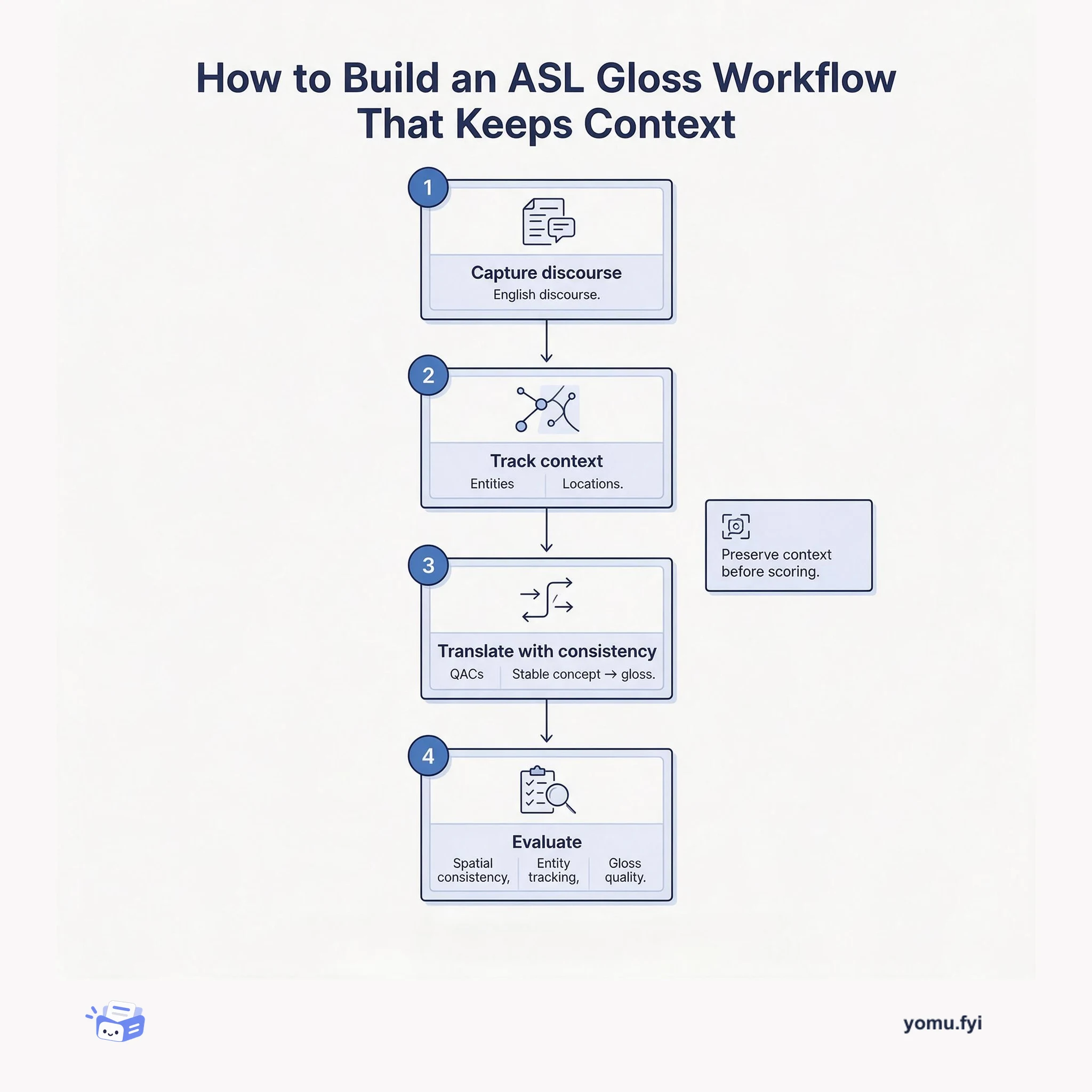
How to Build an ASL Gloss Workflow That Keeps Context
Learn a practical workflow for translating English discourse into ASL gloss while preserving spatial references, question-answer structure, and consistent concept-to-gloss mappings.
 AppleProblem & solution
DiscoSign addresses a limitation in sign language processing: systems have traditionally translated at the sentence level, overlooking discourse phenomena important to sign language comprehension. It presents a modular Large Language Model (LLM)-based framework for text-to-sign language gloss translation that handles spatial coreference resolution, Question-Answer Clauses (QACs), and concept-gloss consistency, preserving entity locations and stable English-to-ASL sign mappings across discourse. Because traditional translation metrics do not measure discourse-level quality, the authors introduce metrics for each coherence dimension targeted by the framework. Experiments on sentence-level and discourse-level datasets report improved spatial consistency and entity tracking over sentence-only translation, while maintaining competitive single-sentence gloss quality; the work describes this as the first systematic framework with a corresponding evaluation methodology.
Sign language processing systems have traditionally operated at the sentence level, ignoring discourse phenomena that are fundamental to sign language comprehension. Traditional translation metrics also fail to capture discourse-level quality.
DiscoSign uses a modular Large Language Model (LLM)-based translation framework to address spatial coreference resolution, Question-Answer Clauses (QACs), and concept-gloss consistency. It also introduces evaluation metrics for the discourse-coherence dimensions addressed by the framework.
The framework addresses spatial coreference, QACs, and concept-gloss consistency in text-to-ASL gloss translation.
The evaluation suite is designed to measure discourse coherence dimensions that traditional translation metrics do not capture.
Experiments report improved spatial consistency and entity tracking over sentence-only translation while retaining competitive single-sentence gloss translation quality.
Summaries are generated from the original by a language model. Check the original before relying on it.
See the idea
Learn a practical workflow for translating English discourse into ASL gloss while preserving spatial references, question-answer structure, and consistent concept-to-gloss mappings.
Keep reading
The Good Stuff
Paid picks we use ourselves. Links carry a referral code — a subscription through one earns us a commission at no extra cost to you.
One useful email. Unsubscribe anytime.
